EasyManua.ls Logo

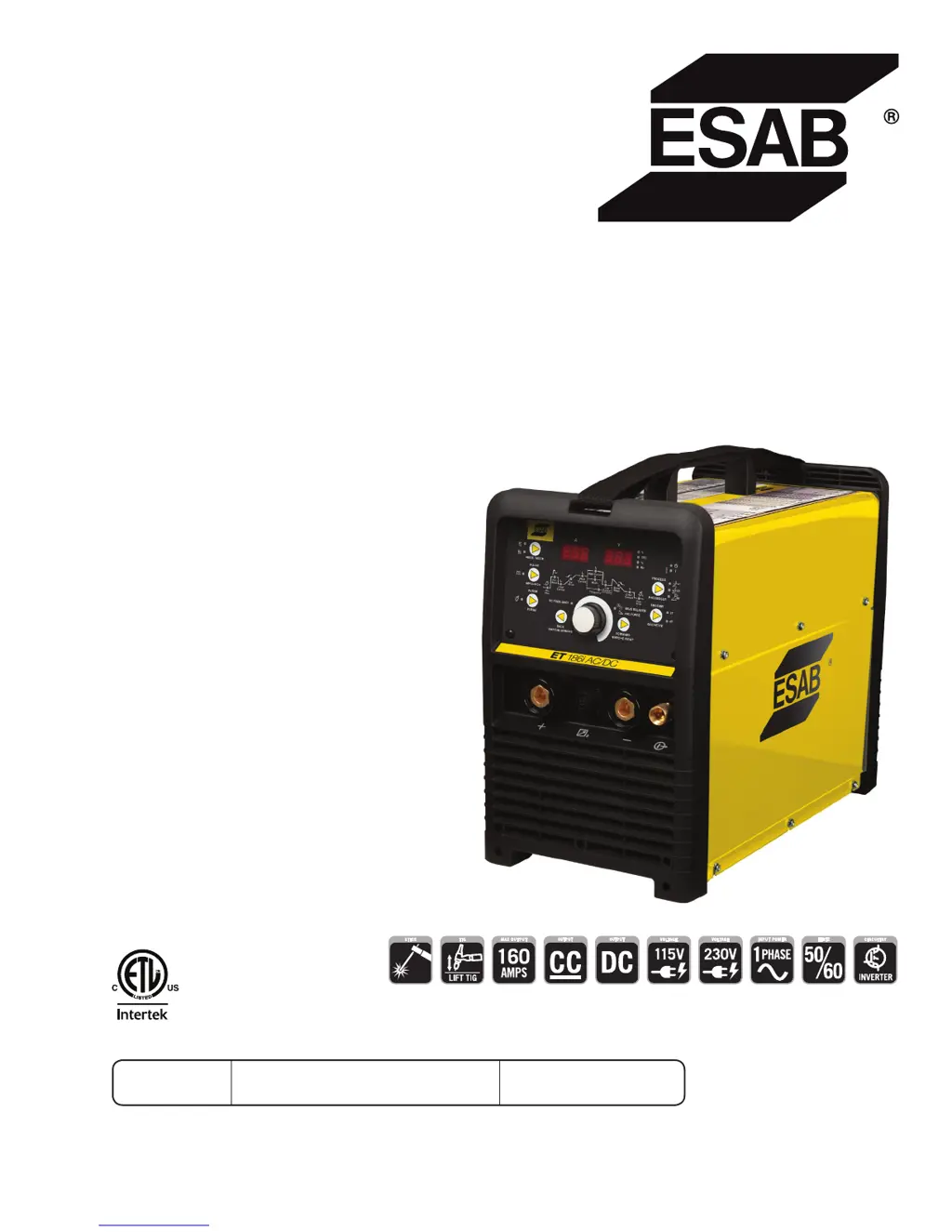
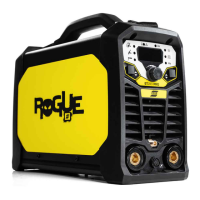
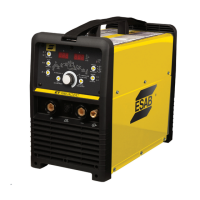
ESAB ET 186i AC/DC - User Manual

ESAB ET 186i AC/DC
60 pages
Print Icon
To Next Page IconTo Next Page
Loading...
3163339
Révision : AA Issue Date: June 1, 2016 Manual No.: 0-5425
Operating
Manual
ESAB ET 186i AC/DC
Inverter Arc Welder
esab.com
Art# A-13113

Questions and Answers

  • A
    alexanderescobarJul 31, 2025
    Why does my ESAB Welding System have gas pockets in the weld metal?
    • J
      James RiveraJul 31, 2025
      Porosity, or gas pockets and voids in the weld metal, can occur due to several factors. High levels of sulphur in the steel being welded, damp electrodes, excessive welding current, surface impurities like oil or grease, welding in windy conditions, or using damaged electrodes with incomplete flux coating can all contribute to this issue. To address this, use electrodes designed for high sulphur steels, ensure electrodes are dry before use, reduce welding current, thoroughly clean the joint before welding, shield the weld area from wind, and discard any damaged electrodes, using only those with a complete flux coating.
  • J
    Janet AllenAug 4, 2025
    How to fix undercut in ESAB Welding System?
    • W
      William HicksAug 4, 2025
      Undercut, where a groove forms in the base metal next to the weld toe, can be caused by several factors. These include using too high a welding current, maintaining too long a welding arc, incorrect electrode angle, joint preparation that restricts electrode angle, using an electrode that's too large for the joint, or insufficient deposit time at the weave's edge. To fix this, reduce the welding current and the length of the welding arc. Ensure the electrode isn't inclined less than 45° to the vertical face. Allow more room in the joint for electrode manipulation. Use a smaller gauge electrode, and pause momentarily at the weave's edge to allow weld metal buildup.
  • S
    Samantha JacksonAug 8, 2025
    Why is the welding current varying on my ESAB Welding System?
    • C
      Christopher WallaceAug 8, 2025
      The welding current may vary due to the ARC FORCE control knob being set too high, causing excessive variation with the arc length. To resolve this, reduce the ARC FORCE control knob setting until the welding current remains reasonably constant. This adjustment should prevent the electrode from sticking to the workpiece when you "dig" the electrode into the workpiece.
  • N
    Nicole JohnsonAug 13, 2025
    What to do if ESAB Welding System leaves a gap in the weld root?
    • T
      tharrisonAug 13, 2025
      Failure of the weld metal to fill the root of the weld, leaving a gap, can be attributed to several factors: welding current being too low, using an electrode too large for the joint, or insufficient gap. To solve this, increase the welding current, use a smaller diameter electrode, or allow a wider gap.
  • R
    Randy OrozcoAug 17, 2025
    Why is my ESAB Welding System weld not fusing to the metal surface?
    • T
      Tristan ReynoldsAug 17, 2025
      If portions of the weld run do not fuse to the surface of the metal or the joint's edge, several factors could be responsible. These include using small electrodes on heavy, cold plates, welding current being too low, incorrect electrode angle, travel speed of the electrode being too high, or scale or dirt on the joint surface. To resolve this, use larger electrodes and preheat the plate. Increase the welding current. Adjust the electrode angle to direct the welding arc more into the base metal. Reduce the travel speed of the electrode, and clean the surface before welding.
  • C
    Caitlin ParksAug 26, 2025
    Why is my ESAB Welding System weld cracking after solidification?
    • J
      Julie CarrAug 26, 2025
      Cracks occurring in the weld metal soon after solidification can be due to joint rigidity, insufficient throat thickness, or excessive weld current. To resolve this, redesign the joint to relieve severe stresses or use crack-resistant electrodes. Travel slightly slower to allow greater build-up in the throat, and decrease the welding current.
  • D
    Daniel WrightNov 20, 2025
    How to prevent non-metallic particles in ESAB Welding System weld metal?
    • J
      Jeffrey ClarkNov 20, 2025
      Non-metallic particles trapped in the weld metal can occur due to several reasons: non-metallic particles trapped in undercut from a previous run, joint preparation being too restricted, irregular deposits allowing slag to be trapped, lack of penetration with slag trapped beneath the weld bead, rust or mill scale preventing full fusion, or using the wrong electrode for the welding position. To address this: 1. Clean any bad undercut and cover it with a run from a smaller gauge electrode. 2. Ensure adequate penetration and room for cleaning out slag. 3. Chip or grind out any significant irregularities. 4. Use a smaller electrode with sufficient current for adequate penetration and remove slag from corners with suitable tools. 5. Clean the joint before welding. 6. Use electrodes desi...

Summary

Safety

Safety Precautions

Detailed safety instructions for operating ESAB welding equipment.

General Safety Warnings

Critical warnings for electric shock, fumes, arc rays, fire, and noise hazards.

System Introduction

Manual Usage and Equipment Identification

Guide on manual usage, symbols, and equipment identification.

Equipment Receipt and Description

Procedures for receiving and a general description of the welder.

User Responsibility and Handling

User obligations, safe transporting, package contents, and duty cycle explanation.

Specifications and Accessories

Detailed specifications, volt-ampere curves, and optional accessories.

Installation, Operation, and Setup

Environment, Location, and Power

Guidelines for operating environment, placement, ventilation, and mains voltage.

Interference Management

Managing High Frequency interference and Electromagnetic Compatibility.

Front Panel Controls and Indicators

Identification and explanation of front panel controls, indicators, and features.

Programming Modes

Setup and usage guides for STICK, LIFT TIG, and HF TIG programming modes.

Welding Setup Procedures

Short circuit protection, regulator use, torch specification, and TIG/STICK setup.

TIG and STICK Welding Setup

Step-by-step guides for setting up TIG and STICK welding processes.

Basic Welding Guide

STICK (SMAW) Welding Guide

Basic techniques, joint preparation, weld types, and troubleshooting for STICK welding.

TIG (GTAW) Welding Guide

Basic techniques, electrode/wire selection, parameters, and troubleshooting for TIG welding.

Service and Maintenance

Power Source Troubleshooting and Service

Basic troubleshooting, common faults, routine service, and calibration.

Cleaning and Spare Parts

Procedures for cleaning the unit and identifying spare parts.

Appendices

Circuit Diagram

Schematic diagram of the ESAB ET 186i AC/DC welding system.

Setup Guides

Guides for setting up LIFT TIG, HF TIG, Pulse, and STICK welding modes.

ESAB ET 186i AC/DC Specifications

General IconGeneral
Input Current16 A
AC Frequency50/60 Hz
Output Current Range5 - 180 A
Protection ClassIP23
Welding ProcessesTIG, MMA
TIG WeldingYes
MMA WeldingYes
AC/DCYes
Pulse FunctionYes
Hot StartYes
Arc ForceYes
Input Voltage230 V
Duty Cycle60% at 180 A

Related product manuals