18 19
Interpreting Alerts
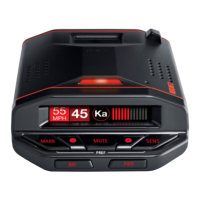
Although RedLine has a comprehensive
warning system and this handbook
is as complete as we can make it, only
experience will teach you what to
expect from your RedLine and how to
interpret what it tells you. The specific
type of radar being used, the type of
transmission (continuous or instant-on)
and the location of the radar source affects
the radar alerts you receive.
The following examples will give you
an introduction to understanding
RedLine’s warning system for radar, laser
and safety alerts.
Explanation
You are approaching a continuous radar
source aimed in your direction.
An instant-on radar source is being used
ahead of you and out of your view.
An instant-on radar source or laser source is
being used nearby. This kind of alert
requires immediate attention!
Laser is being used in the area. Because laser
is inherently difficult to detect, any laser
alert may indicate a source very close by.
A moving patrol car with continuous radar is
overtaking you from behind. Because these
signals are reflected (reflections are
increased by large objects), they may or may
not eventually melt into a solid point even
when the patrol car is directly behind you.
You are approaching a radar unit concealed
by a hill or an obstructed curve.
Explanation
A patrol car is traveling in front of you with a
radar source aimed forward. Because signals
are sometimes reflected off of large objects
and sometimes not, the alerts may seem
inconsistent.
A patrol car is approaching from the other
direction, sampling traffic with instant-on
radar. Such alerts should be taken seriously.
You are driving through an area populated
with radar motion sensors (door openers,
burglar alarms, etc.). Since these
transmitters are usually contained inside
buildings or aimed toward OR away from
you, they are typically not as strong or as
long as a real radar encounter.
CAUTION: Since the
characteristics of these alerts may
be similar to some of the preceding
examples, overconfidence in an
unfamiliar area can be dangerous.
Likewise, if an alert in a commonly
traveled area is suddenly stronger
or on a different band than usual,
speed radar may be set up nearby.
Alert
RedLine begins to sound slowly, then the
rate of alert increases. The Signal Meter
ramps accordingly.
RedLine emits short alerts for a few seconds
and then falls silent only to briefly alert and
fall silent again.
RedLine suddenly sounds a continuous tone
for the appropriate band received. All
segments in the Signal Strength Meter are
displayed.
A brief laser alert.
RedLine receives weak signals. These signals
may be a little stronger as you pass large,
roadside objects. The signals increase in
frequency.
RedLine alerts slowly for awhile and then
abruptly jumps to a strong alert.
Alert
RedLine alerts intermittently. Rate and
strength of alerts may be consistent or vary
wildly.
RedLine alerts intermittently. Rate and
strength of signal increases with each alert.
RedLine gives an X-band alert intermittently.


 To Next Page