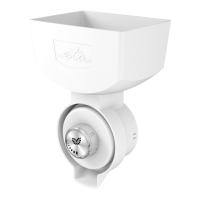
J2 – Sieve J9 – Pressure disc
J3 – Nut J10 – Juice container
J4 – Cover / outlet J11 – Container lid
J5 – Pusher (=D14) J12 – Cleaning brush
J6 – Hopper (=D15) J13 – Security screw
Safety hints and tips
– When assembling the press, pay maximum attention not to damage the sieve.
– Before starting pressing, check whether the spiral feeder is well fixed.
– Do not use the press if the sieve is damaged, shows visible cracks and breaks, or is torn.
– The press is designed to process almost all types of berries, citrus fruits and vegetables.
– Do not confuse the functions of a press for fruits and vegetables with a centrifugal
juicer. The final juice produced by the centrifugal system is clear; by pressing, a juice
containing a certain amount of pulp is produced. Sometime the juice may have the
consistency of a puree.
– Thoroughly rinse the fruits and vegetables.
– You may process currants, grapes, tomatoes, kiwis, raspberries, blackberries,
blueberries, cranberries, strawberries, etc.
– We do not recommend pressing apples and pears, as the sieve may become clogged,
and the produced juice will have the consistency of a puree.
– We do not recommend processing cucumbers and beets and root vegetables.
– After squeezing currant, blackberries, grapes and other fruits with smaller grains or
seeds, do not EVER process the pressed flesh for the second time! You could
damage the sieve.
– Always use fresh and ripe fruits
– Do not press frozen fruits and vegetables. Defrost them before processing.
– Remove peduncles (grape stems) and vegetable tops.
– When pressing juice from currants, use whole bunches.
– Remove stones (e.g. from plums, peaches, apricots, mirabelles, cherries, etc.).
– Remove fruit skins, if too thick.
– Peel citrus fruits (such as oranges, grapefruits, lemons) and remove the white pulp
and seeds, otherwise the juice may have a sour taste.
– When processing tomatoes, cut them into wedges with the maximum width of 1.5cm.
Tomatoes have a tough skin, and if wider wedges are processed in the juicer, the auger
may become clogged with tomato peels, causing inoperability of the juicer.
– After processing of about 2 kg of food (Currant max. 1.5 kg), ALWAYS interrupt
your work and check whether the sieve is blocked. If yes, clean it.
– If the juice flow from the juicer outlet decreases or completely stops, IMMEDIATELY
switch off the processor, dismount the juicer press, disassemble it and properly clean it.
When currant is pressed, we recommend cleaning the sieve after every 1.5 kg. Currant
contains small grains that can dramatically decrease the juice flow through the sieve
– The pressed pulp will not be immediately discharged from the outlet, but after a while –
this is normal.
– When the press is overfilled or when the foods are pressed too strongly, the sieve
becomes clogged.
– The juice may contain residues of pulp and seeds, small enough to go through the sieve
89
GB


 To Next Page
 Loading...