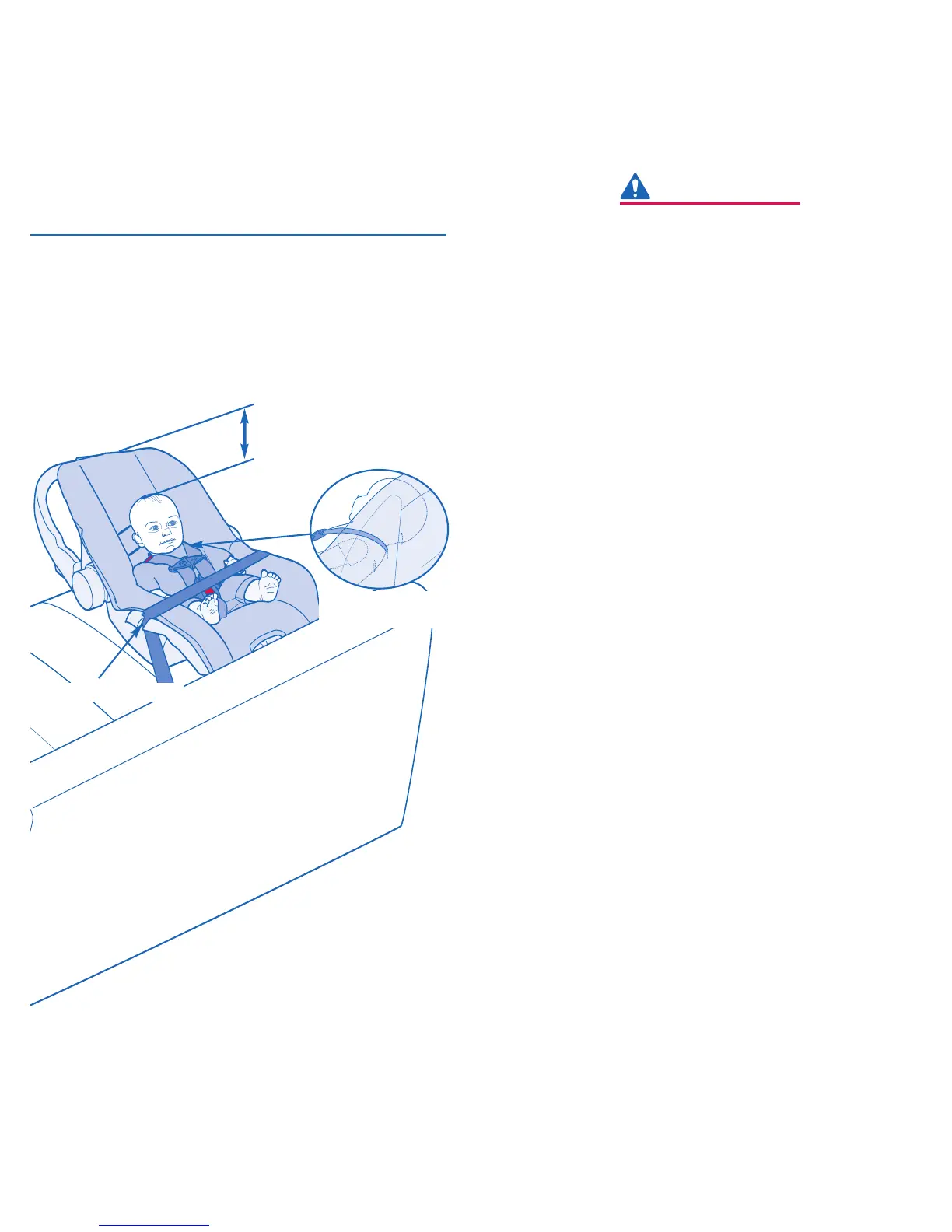
1. Place the child in the carrier.
a The child’s back and bottom are flat against the
back and bottom surfaces of the carrier.
a Top of child’s head is at least 1 inch (25 mm)
below the top of the child restraint seat back.
2. Secure the child in the carrier (p. 27).
a Harness straps MUST start as close as possible,
but NEVER above, the child’s shoulders (p. 30).
a Both buckle tongues are fastened (p. 27).
a Chest clip is securely fastened and at armpit
level (p. 28).
a Harness straps are snug against the child with no
more than two finger-widths between your child
and straps (p. 28).
a Crotch strap is snug against the child but NOT
under the child’s bottom (p. 32).
3. Secure child restraint to the vehicle seat.
a Carrier is securely installed with vehicle seat belt
(p. 24).
a The shoulder strap portion of the seat belt is lying
across the vehicle seat back, (p. 25).
a Locking clip is installed, if necessary (p. 34).
a The level line is level with ground (p. 26).
a If necessary, a towel/small blanket is rolled up and
placed beneath the front edge of the carrier so
the child’s head lies back comfortably (p. 26).
4. Check your work.
a To properly protect your child, the carrier MUST
NOT move more than 1 inch (25 mm) from side-
to-side or from front-to-back at the vehicle belt
path.
Child’s head MUST be at least 1 inch (25mm) below
the top of the carrier.
WARNING
22 23
Proper Installation WITHOUT
the Convenience Base
Child Requirements
Weight: 5 to 22 lbs (2.3 to 10 kg)
Height: 19 to 29 inches (48 to 74 cm)
Top of the child’s head must be at least 1 inch (25 mm)
below the top of the child restraint seat back.
Harness straps at, or
below
, the shoulder.
At least 1 inch
(25 mm)
Vehicle Seat Belt Path



 To Next Page