EasyManua.ls Logo

Fagor AD-48W - User Manual

Fagor AD-48W
29 pages
Print Icon
To Next Page IconTo Next Page
Loading...
SERVICEMANUAL
**********
2013
UNDERCOUNTER&ALLPURPOSEDISHWASHERS
UNDERCOUNTER
DISHWASHER
Models: AD48W
AD64CW
AD72W

Questions and Answers

  • T
    tiffanyjonesAug 18, 2025
    Why is my Fagor AD-48W Dishwasher not cleaning dishes properly?
    • R
      Regina BlackAug 18, 2025
      If dishes are not coming out clean enough from your Fagor Dishwasher, consider the following: * Review the proper loading techniques, avoiding overloading. * Inspect the washing and rinsing arms for any blockages or debris and ensure they rotate freely. Clean if necessary. * Check the drain for clogs and remove any obstructions. Ensure the drain hose isn't kinked. * Make sure the dishwasher is level by adjusting the legs.
  • T
    Thomas BanksAug 27, 2025
    Why is my Fagor AD-48W not filling with water?
    • A
      Albert MartinAug 27, 2025
      If your Fagor Dishwasher isn't filling or reaching the correct water level, and the power light is on, check the following: * Make sure the hose isn't blocked or kinked, the water valve is open, and the pressure is above 20 psi. * Ensure the machine is level by adjusting the legs. * Inspect the overflow tube and O-ring, ensuring they are properly attached and in good condition. * Check the wiring at the door switch for loose connections; if none, replace the switch or the door relay. * Verify voltage at terminal 2 (brown) and GND on the fill pressure switch (P1). If there's no voltage, P1 may be stuck. * Check the wiring and voltage at the rinse/fill valve; replace the fill valve if necessary.
  • J
    James Snyder MDAug 31, 2025
    How to troubleshoot slow filling and weak rinse in Fagor AD-48W?
    • N
      njenkinsAug 31, 2025
      If your Fagor Dishwasher fills slowly or has a weak rinse, consider these solutions: * Make sure the inlet water pressure is between 20 and 25 psi. * Inspect the hose strainer for clogs. * Disconnect the hose from the fill valve and inspect the filter screen inside for debris. Replace the rinse/fill valve if needed. * Check the temperature with a calibrated thermometer at the temperature sensor location. Replace the temperature gauge if needed.
  • F
    Frederick StoneSep 3, 2025
    What to do if Fagor AD-48W rinse water isn't reaching 180°F?
    • P
      Paula RamseySep 3, 2025
      If the rinse water in your Fagor Dishwasher isn't reaching 180°F, try these steps: * Check that the rinse temperature probe sensor is properly inserted inside the probe well. Replace the Tc thermostat and/or boiler element and heater relay. Reconnect or replace the temperature sensor if A4 or A5 is displayed. * Reset the high limit stat by pressing the red button. Replace it if necessary. Ensure the heater relay is working correctly and the Tc thermostat is cutting off below 195°F. * Verify voltage at the heater relay coil. If the solenoid isn't closing when receiving voltage, replace the heater relay. * Check the boiler element for continuity; if it's open, replace the heater.
  • J
    johnsonjonathonSep 7, 2025
    Why is the wash water in my Fagor Dishwasher not reaching 150°F?
    • A
      annettefarmerSep 7, 2025
      If the wash water in your Fagor Dishwasher isn't reaching 150°F, check the following: * Ensure the incoming water temperature is at least 120°F and the pressure is at least 20 psi. The optimal temperature is 140°F, and the optimal pressure is 25 psi. * Verify that there is power on violet coming from Tc to Tt. Reconnect or replace the temperature sensor if A4 or A5 is displayed. * Verify voltage to the t-stat. If voltage has been verified ok, check tank heater relay Ct. * Verify voltage at the heater relay coil. If the solenoid isn't closing when receiving voltage, replace the heater relay. * Check the tank heater for continuity; if it's open, replace the heater.
  • K
    Kimberly PowellSep 10, 2025
    How to fix Fagor Dishwasher that won't turn on?
    • M
      Mario Howard MDSep 10, 2025
      If your Fagor Dishwasher won't turn on and the power light isn't lit, try the following: * Reset the service breaker. If it trips again, contact an electrician. * Ensure the unit is connected to a live power feed, and verify the voltage and proper phasing. * Make sure power is being supplied to the circuit board. Check for loose wiring and the circuit board fuse. Verify voltage between R (brown) and N (blue). If 208V-240V is found, replace the circuit board.
  • R
    ritterjuanNov 13, 2025
    What to do if Fagor Dishwasher washes and rinses but does not drain?
    • J
      Jonathan StantonNov 13, 2025
      If your Fagor Dishwasher washes and rinses but doesn't drain, here are some things to check: * Ensure the door is open, and push the drain button for 3 seconds. * Remove the Front Right S/S Filter and the overflow tube. * Inspect the drain pump for clogs by opening the drain pump cover and removing any debris. * Check for kinks in the drain hose and flush out any accumulated debris. * Verify voltage to the drain pump; if it's receiving voltage, replace the drain pump. * Check the safety pressure switch and the black rubber pressure tube for kinks or damage; replace if necessary. * Ensure the sanitized rinsing temperature reaches a minimum of 180ºF, the incoming water temperature is 140°F, and the incoming water pressure is 20-25 psi. * Make sure detergent to dish ratio is ...
  • A
    Anna JacksonNov 20, 2025
    What to do if Fagor AD-48W Dishwasher runs continuously in the wash cycle?
    • J
      Jenna JohnsonNov 20, 2025
      If your Fagor Dishwasher runs continuously or doesn't rinse, check the following: * Ensure power is supplied to the circuit board, check wiring connections and the fuse. Verify voltage between R (brown) and N (blue). If 208V-240V is found, replace the circuit board. * Verify the rinse gauge temperature is above 180°F. If it is, replace the circuit board. If the rinse temperature is below 180°F, replace the Tc thermostat and/or boiler element and heater relay. Reconnect or replace the temperature sensor if A4 or A5 is displayed. * Check the wiring and voltage at the rinse/fill valve; replace the fill valve if necessary. * Make sure the hose isn't blocked or kinked and that the inlet water pressure is between 20 and 25 psi. * Remove and clean any clogged or obstructed rinse arms/n...
  • S
    susan37Nov 23, 2025
    What to do if my Fagor AD-48W will not run?
    • C
      Carol ColemanNov 23, 2025
      If your Fagor Dishwasher won't run after filling and heating, with the power light on, consider these steps: 1. Check the fill pressure switch (P1) to ensure it changes position. 2. Verify the connection between the digital start buttons and the circuit board. Reconnect if disconnected and check the circuit board fuse. Replace the Adhesive Trim if it's still not working. 3. Ensure power is supplied to the circuit board. Check for loose wiring and the circuit board fuse. Verify voltage between R (brown) and N (blue). Replace the circuit board if 208V-240V is found. 4. Rotate the wash pump from the shaft flat head slot counter-clockwise to check for free rotation. Confirm the wash pump is getting power; if so, replace the pump. 5. Wait for the rinsing temperature to reach at least 180º...

Summary

Undercounter and All-Purpose Dishwashers Service Manual

Dishwasher Specifications

AD-48 W Specifications

Performance and technical data for the AD-48 W model.

AD-64 CW Specifications

Performance and technical data for the AD-64 CW model.

AD-72 W Specifications

Performance and technical data for the AD-72 W model.

Installation Procedures

Visual Inspection

Guidance on checking the unit for damage before installation.

Installation Diagrams

Diagrams illustrating installation requirements for different models.

Data Plate and Positioning

Data Plate Information

Details on the machine's data plate and its importance.

Unit Positioning and Leveling

Instructions for correctly positioning and leveling the dishwasher.

Water Installation

Water Quality and Drainage

Requested Water Quality

Specifications for ideal water quality for optimal dishwasher performance.

Water Drainage Installation

Guidelines for proper installation of the water drainage system.

Electrical Connection

Phase Transformation

Installation Checklist

Operating the Dishwasher

Turning the Machine On

Step-by-step instructions for powering on the dishwasher.

Preparing the Machine

Procedures to prepare the dishwasher for the washing cycle.

Washing Cycle Operation

Details on the washing cycles and machine operation during washing.

Draining and Cleaning Procedures

Detergent and Rinse Aid Control

Ware Preparation and Deliming

Preparing the Ware for Washing

Guidelines for loading dishes, cutlery, and glassware correctly.

Deliming Process

Instructions for removing lime and corrosion deposits from the unit.

Troubleshooting Common Issues

Electrical Diagrams

Wiring Schematics

AD-48 W Wiring Schematics

Detailed wiring schematics specific to the AD-48 W model.

AD-64 CW; AD-72 W Wiring Schematics

Wiring schematics tailored for the AD-64 CW and AD-72 W models.

Recommended Spare Parts

Limited Warranty Information

Overview

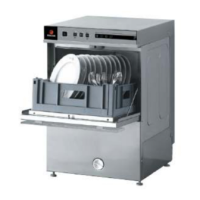
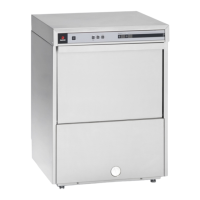
This document is a service manual for Fagor undercounter and all-purpose dishwashers, specifically covering models AD-48 W, AD-64 CW, and AD-72 W. It provides comprehensive information for installation, operation, maintenance, and troubleshooting of these commercial dishwashers.

Function Description

The Fagor undercounter dishwashers are designed for commercial use, efficiently cleaning dishes, glasses, and trays. They feature multiple wash cycles to accommodate varying levels of soil and optimize cleaning performance. The machines are equipped with heating elements for both the wash tank and booster heater to ensure proper wash and rinse temperatures, crucial for sanitization in commercial settings. Water is supplied to the machine, heated, and then circulated through wash arms to clean the ware. A final rinse cycle with hot water ensures sanitization before the items are removed. The dishwashers are designed with a pump system for water circulation during washing and drainage.

Usage Features

The operation of the Fagor dishwashers is straightforward, designed for ease of use in a busy commercial environment. To begin, the machine is turned on by pressing and holding the power button for five seconds, which initiates the filling process. Once filled, the machine heats the rinse and wash tanks to their optimal temperatures (180°F / 83°C for rinse and 160°F / 71°C for wash). The user must wait for these minimum temperatures to be reached before starting a wash cycle to ensure effective cleaning and sanitization.

The dishwashers offer three distinct wash cycles: P1 (60 seconds), P2 (90 seconds), and P3 (180 seconds), allowing operators to select the appropriate cycle duration based on the soil level of the items. An LED indicator illuminates to show which program is currently active. The machines incorporate a "Thermo-stop" feature, which ensures that the rinse cycle only proceeds once the required sanitizing temperature is met, even if it means extending the cycle time. This is a critical feature for maintaining hygiene standards.

Proper loading of the dishwasher is emphasized for optimal results. Users are instructed to pre-scrape and rinse all items to remove large food particles. Glassware should be washed first, and items like trays, plates, and cutlery should be placed in their designated baskets, ensuring they are not overcrowded and allowing water to circulate freely. Glasses should be placed upside down, and cutlery handles down, with spoons mixed with knives and forks to prevent nesting.

The dishwashers are equipped with internal detergent and rinse aid dispensers. Users need to place the detergent and rinse aid tubes into their respective containers. The clear tubing allows for visual confirmation that chemicals are being dispensed. The amount of chemical dispensed can be adjusted via controls located behind the bottom front panel of the machine, with a flow chart provided for precise regulation of detergent. The rinse aid can be adjusted by turning a button counterclockwise for more and clockwise for less. It's important to keep chemical tubing and filters submerged and ensure all connections to the dispenser are hand-tightened to prevent leaks. The detergent and rinse dispensing pumps operate only during the fill and rinse processes.

Maintenance Features

Regular maintenance is crucial for the longevity and efficient operation of the Fagor dishwashers. Daily draining and cleaning are recommended, especially after each meal rush or in high-application settings. The draining process involves several steps:

  1. Open the door and remove the Front Right S/S Filter.
  2. Remove the overflow tube by inserting a finger into its top. It is explicitly stated not to remove the scrap basket or lose its O-ring.
  3. Press and hold the P1 button for five seconds to initiate draining, indicated by an illuminating LED.
  4. Wait until the LED turns off (approximately 3 minutes 20 seconds).
  5. Remove the scrap basket for cleaning by twisting it to the left.
  6. Clean the scrap basket and replace it, locking it into position by twisting to the right.
  7. Replace the overflow tube with its O-ring and the S/S filter.
  8. Turn off the unit using the power switch.

To prevent oxidation and corrosion from chemicals, it is advisable to keep all steel surfaces clean and dry. Changing the tank water by refilling the machine is recommended at least every 40-50 washes or twice a day.

Deliming is another important maintenance task to remove lime and corrosion deposits, which should be performed frequently. Users are advised to obtain a deliming solution from their chemical supplier and follow its instructions. The process involves:

  1. Filling the machine with water.
  2. Adding the recommended amount of deliming solution.
  3. Removing detergent and rinsing tubes from containers to prevent chemical contamination.
  4. Running the machine for the recommended period, potentially multiple cycles.
  5. Turning off the machine and opening the door once clean.
  6. Draining and refilling the machine.
  7. Running 3-4 cycles with fresh water to remove any residual deliming solution.
  8. Draining the machine again.

The manual also includes a detailed troubleshooting guide to help identify and resolve common issues, such as the dishwasher not filling, not running, running continuously, filling slowly, having weak rinse, or not reaching required temperatures. This guide provides possible causes and corresponding actions to take, from checking circuit breakers and wiring to inspecting hoses, filters, and pressure switches. It also covers issues related to water quality, detergent usage, and proper loading, emphasizing the importance of maintaining water pressure and temperature, and ensuring correct chemical levels.

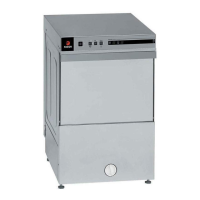
Fagor AD-48W Specifications

General IconGeneral
TypeBuilt-in
Number of Wash Cycles6
Energy Star QualifiedYes
Half LoadYes
Child LockYes
Delay StartYes

Related product manuals