Supplemental Owner’s Manual 11
Operation
Cutting Blade Principles
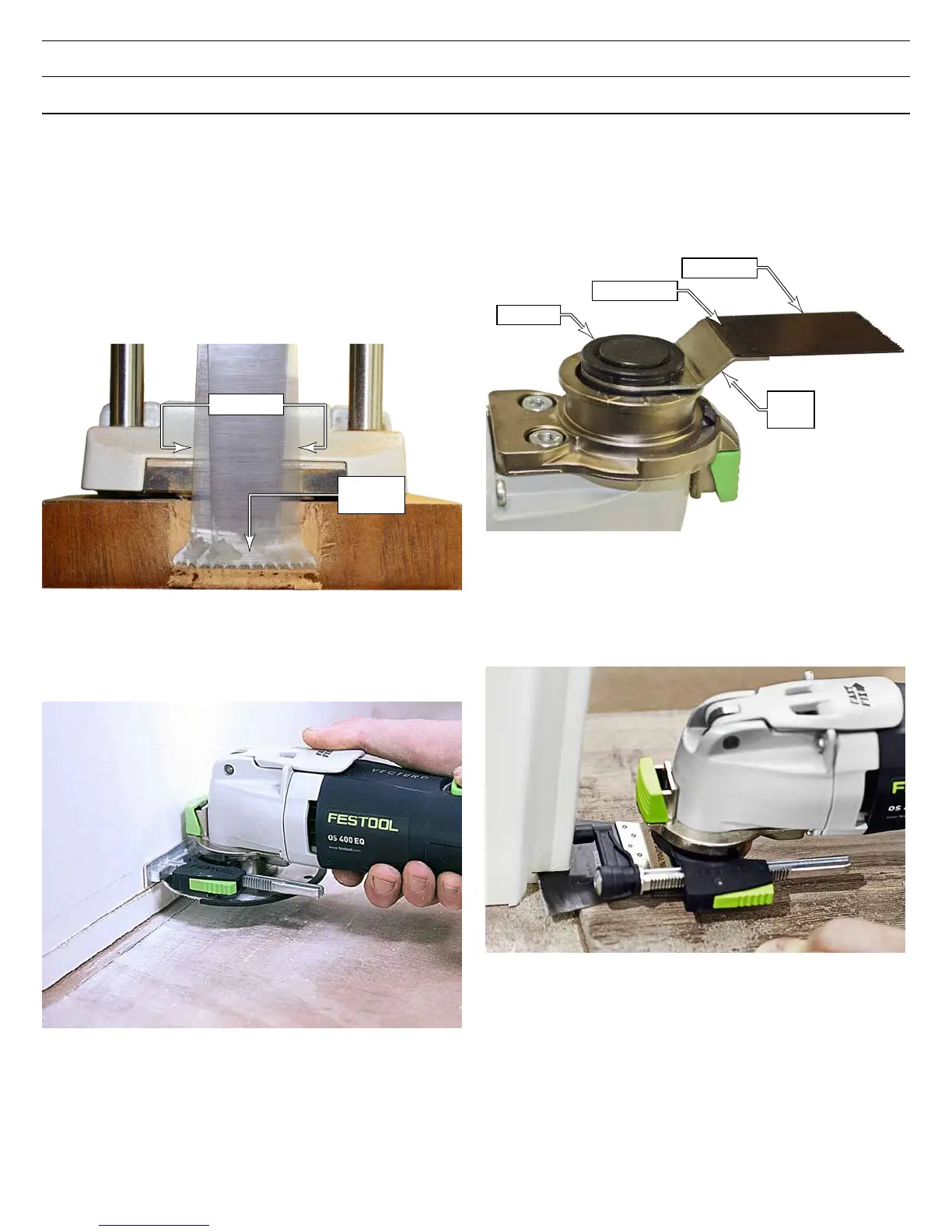
Even though a multi-tool is fairly unique in its cutting opera-
tion from other saw types, at the blade teeth it still resem-
bles a short-stroke reciprocating saw. The blade oscillates
through a 4° sweep at high speed. The cut is radial, but the
short 4° stroke has the effectiveness of a linear stroke.
As with a typical reciprocating saw, the cutting direction is
forward of the teeth, which represents a plunging cut in the
direction of the blade. Because the blade cannot cut laterally
on the non-thoothed edges, making a wider cut requires
successive partial plunge cuts or tilting the blade in the
lateral direction.
4° Sweep
Cutting
Direction
For linear cutting operations, the best method is to use a
semicircular blade. The blade can cut anywhere around the
circumference, including the forward edge for making a
linear cut.
One of the primary operations of a multi-tool is ush trim-
ming one workpiece relative to the surface of another. This
is why most blades have an offset in the main body, and the
blade itself is spot-welded to the offset plate. This provides
a at, smooth reference surface on the blade for controlling
the cut.
Flat Blade
Offset
Plate
Spot Welds
Mandrel
For making a ush-trim cut, rest the tool/blade on the refer-
ence surface for guidance. In the example below, a scrap of
ooring is used to control the height of the cut for trimming
casing and moulding so that the nished ooring can be
installed under the mouldings.







 To Next Page