12 Vecturo OS 400 EQ Multi-Tool
Cutting Blade Selection
A wide variety of cutting blades are available for the
Vecturo. Each blade has optimal performance for a variety
of applications.
One note about multi-tool blades is that by their nature and
the heat generated, they can become dull very quickly. So it
is always a good idea to have spare blades on hand.
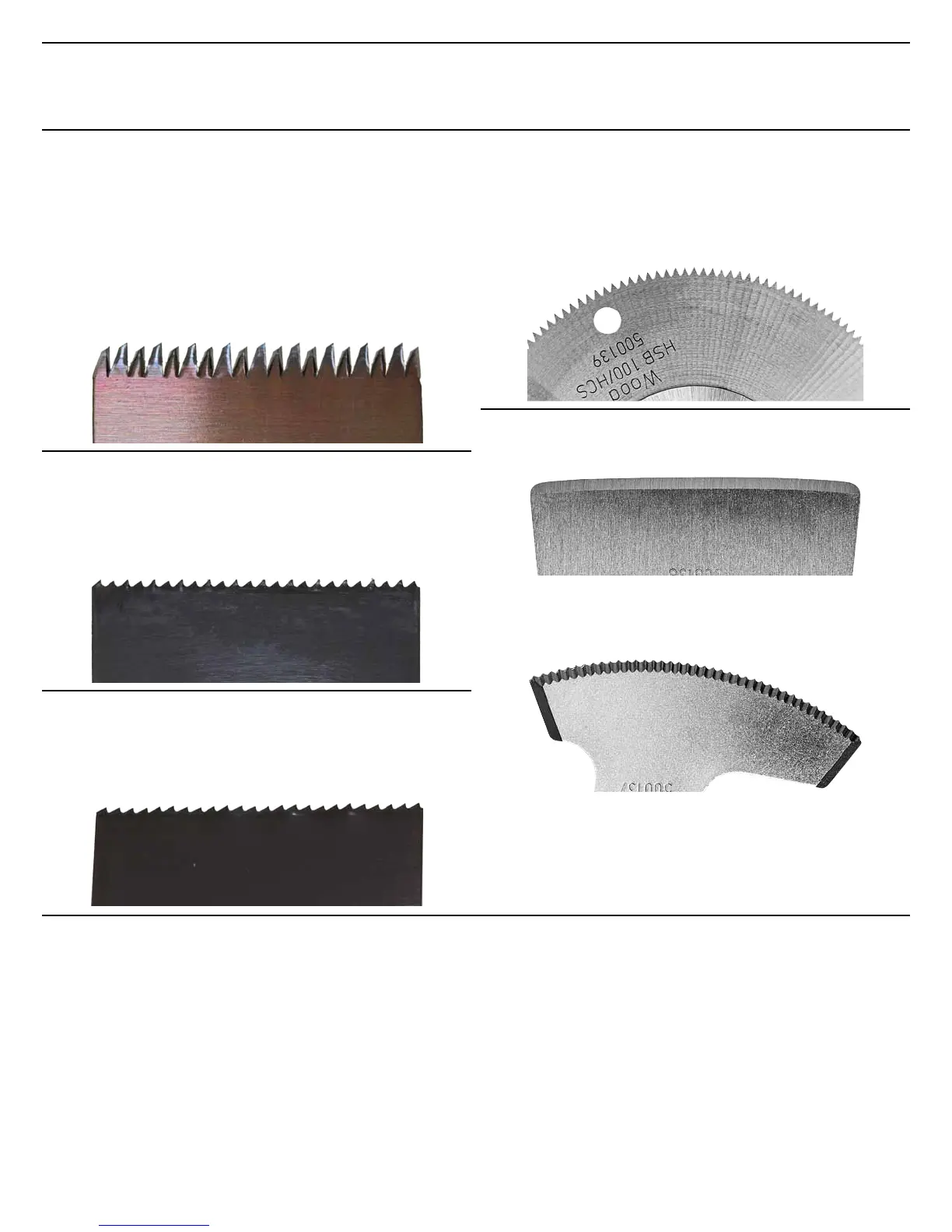
Wood-Cutting, Japanese-Style Blades
The wood cutting blades have a Jananese-style tooth grind.
This is an internal grind without a set to the teeth. This
results in crisp cuts and minimum kerf thickness. However,
the features that give the Japanese-style teeth its high
performance aren’t without cost. Because there isn’t a set to
the teeth, the blade can be more prone to binding on deeper
cuts. The rapid cutting afforded by the longer teeth, can
also result in more frequent tooth loss. For these reasons,
the Jananese-style blades should not be used for making
conned plunge cuts using the plunge base.
Universal Wood/Composite Blades
These blades have a moderate hook angle to the grind and
an alternating tooth set. This provides for good cutting
speed and clean kerf for cutting woods and composites
without binding. (The bimetal teeth are hard enough to cut
through periodic nails, but not intended for cutting metal.)
Metal Cutting Blades
The metal cutting blades have a higher tooth count, sharper
hook angle, and a wave tooth set. They are used for cutting
harder materials from hard plastics to light ferrous metals,
such as nails.
Linear Cutting Circular Blades
The circular blades are ideal for making linear cuts because
they always present forward cutting teeth in all directions.
The triangular ground teeth permit cutting equally in either
feed direction. The teeth have no side-set for a clean cut,
but this doesn’t pose a signicant binding problem unless
the cut is signicantly deep.
Scraper Blades
The smooth scraper blade has a knife edge for cutting or
scraping softer materials such as soft adhesives or lms.
The serrated scraper blade can cut more aggressively
with either hard or soft adhesives and lms. Additionally,
the radially curved blade permits linear cutting as well as
plunging.
Cutting Speed Selection
There are various factors that determine which cutting
speed is ideal for the application. However, due to the
nature of the cutting tool, the optimal speed is more subjec-
tive than other tools. Here are some pointers:
► The short sweep (4°) and high vibratory speed results in
signicant heat buildup at the blade. To keep the heat to a
minimum, a good rule of thumb is to use the lowest speed
that still provides the desired cutting results.
► Conversely, in many cases, greater control of the cutting
blade is achieved with higher speeds. If the tool jumps or
is jittery, especially at the beginning of a cut, try increas-
ing the speed. As the cut gets deeper, you may want to
reduce the speed to reduce the heat.
► Softer materials can generally be cut with lower speeds,
but if the material tends to grab the blade, consider a
higher speed or even a ner-toothed blade.
► Typically, harder materials are best cut with a higher
speed, but the trade off is higher heat build up.
► Friable materials, such as drywall, can be cut with any
speed. So the deciding factor on speed is achieving the
best control.
► All other things being equal, lower speeds may be used
with the plunge base versus a freehand cut.






 To Next Page