44 Capron - 04-17 - CAP-0017-01EN
Living
7
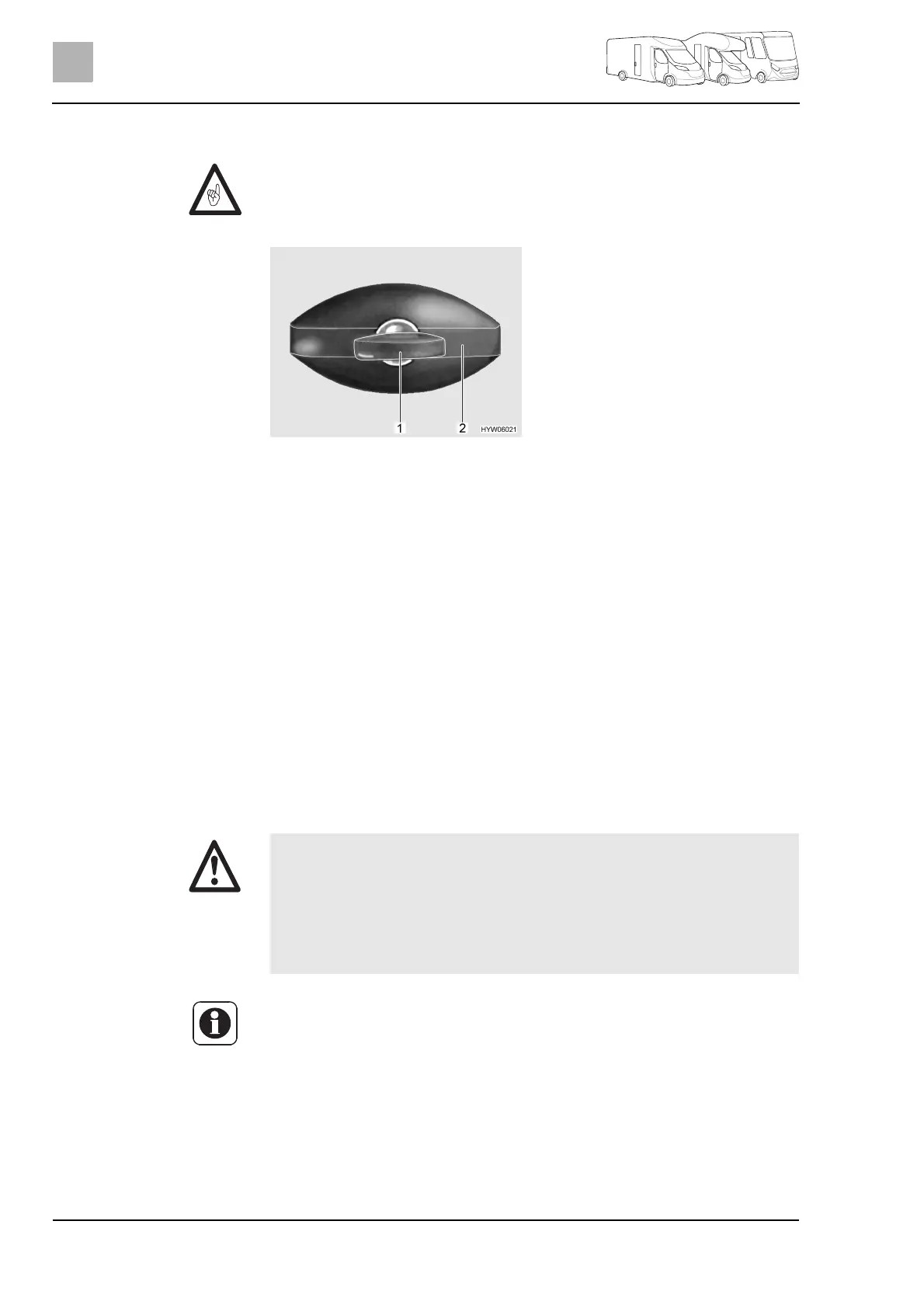
7.2.1 Flap lock, elliptical-shaped
Opening: Insert key into locking cylinder (Fig. 19,1) and turn a quarter turn in an anti-
clockwise direction. The lock handle (Fig. 19,2) snaps out.
Remove the key.
Turn lock handle one quarter turn in an anticlockwise direction. The flap
lock is open.
Closing:
Firmly close the external flap.
Turn lock handle in a clockwise direction until it is horizontal. The flap lock
is now engaged but not locked.
Insert key into locking cylinder.
Press down lock handle with key inserted and turn key a quarter turn in a
clockwise direction. The lock handle will stay bolted.
Remove the key.
7.3 Ventilation
Z During rain, water can penetrate the opened flap lock. Therefore close the
lock handle.
Fig. 19 Flap lock (elliptical-shaped,
closed)
X The oxygen in the vehicle interior is used up by breathing and the use of
gas operated appliances. That is why the used air must be replaced per-
manently. For this purpose, forced ventilation options (e.g. skylights with
forced ventilation) are fitted to the vehicle. Never cover or block forced
ventilations from the inside or outside with objects such as e.g. a winter
mat. Keep forced ventilations clear of snow and leaves. There is a
danger of suffocation due to increased CO
2
levels.
Z Although sufficient ventilation is provided, in certain weather conditions,
condensation can form on metal objects (e.g. screwed connections in the
floor).
Z Additional cold spots can occur at thermal "bridges" (e.g. skylight edges,
filler necks, flaps, etc.).



 To Next Page