
 Need help?
Do you have a question about the Fisher Research Labs Gold Bug Pro and is the answer not in the manual?
Ability to ignore ground minerals and detect metal.
Process of finding the exact location of a buried object.
Detector emitting different tones for different metals.
Audio method causing pitch/volume to rise with signal strength.
How to move the armrest for comfort.
Description of the optional armrest strap.
Expected battery life for alkaline and rechargeable batteries.
Explanation of the 3-segment battery indicator.
Guidelines for disposing of and recycling batteries.
List of items required for the demonstration.
Instructions on how to position the detector for demo.
Guide through signal detection and discrimination.
How soil minerals affect detection and need for calibration.
Ignoring unwanted items and classifying metal types.
Causes and effects of EMI on detector performance.
Initial steps to turn on the detector and check serial number.
Explanation of the detector's knobs and buttons.
Explanation of the OFF/ON/GAIN and DISC/ALL METAL/THRESHOLD knobs.
How Gain and Threshold affect signal amplification and audio response.
Explanation of the GG/PINPOINT and +/- buttons.
Procedure for automatic ground balancing.
Recommended initial settings for Gain and Threshold.
Interpretation of display indicators like Fe3O4 and GND PHASE.
Graphical classification of metal objects on the display.
Initial Gain, Mode, and Disc Level settings.
How to use Pinpoint mode to locate targets.
How to interpret Target-ID, Target Scale, and Signal.
How +/- buttons change detection parameters and segment status.
Explanation of why ground balancing is needed.
Step-by-step procedure for automatic ground balancing.
Types of ground mineralization and their indicators.
How incorrect ground balance affects mineral responses.
Explanation of signal strength and depth indicators.
Explanation of V.C.O. and Low Tone audio responses.
How the 2-digit indicator helps identify targets.
Table of common target IDs and corresponding objects.
Identifying suitable locations for finding gold.
Managing trash metal and hot rocks in gold areas.
Importance of sensitive operation and ground balance for gold.
Characteristics and detection of negative hot rocks.
Characteristics and detection of positive hot rocks.
Using a magnet to differentiate gold from hot rocks/iron.
How EMI affects performance and common sources.
Strategies to manage EMI using sensitivity controls.
How to distinguish EMI from detector issues.
Methods to confirm a detected target.
Step-by-step guide for pinpointing targets.
Procedure for pinpointing targets accurately.
Technique to refine target location.
Explanation of searchcoil drift and retuning.
Benefits of the larger searchcoil.
Drawbacks of the larger searchcoil.
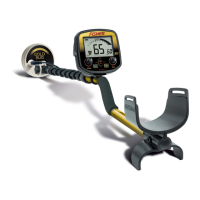
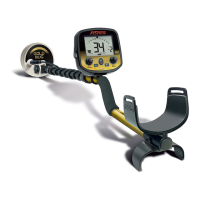
Physical construction details of the detector.
The technology and frequency behind the detector's operation.
The range of ground conditions supported.
Expected battery life and operating temperature range.
Instructions to register warranty online.
Requirement for proof of purchase and service return.
Warranty information for international customers.
Descriptions of padded carry bag and camo backpack.
Descriptions of headphones, sand scoop, and gold pick.
List of available replacement searchcoils.
Protective covers, rain cover, and gold prospecting kits.
 General
| Operating Frequency | 19 kHz |
|---|---|
| Headphone Jack | 1/4" |
| Discrimination | Yes |
| Search Modes | All Metal, Discrimination |
| Sensitivity | Adjustable |
| Waterproof | No |
| Audio Output | Speaker, Headphones |
| Battery | 9V |
| Weight | 2.5 lbs |
| Warranty | 5 years |
| Target ID | Yes |
| Ground Balance | Manual |
| Length | Adjustable |
| Search Coil | 5" x 10" Elliptical |




 To Next Page