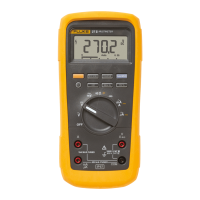
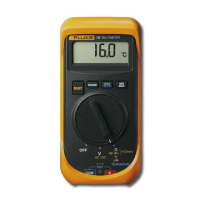
The Fluke 27/FM Multimeter is a robust, true RMS digital multimeter (DMM) designed for demanding work environments. It combines the precision of a digital meter with the responsiveness of an analog bar graph, offering enhanced performance and operator safety. The device meets MIL-T-28800 Type II, Class 2, Style A specifications, ensuring resilience against shock, vibration, humidity, and water. Powered by a 9V battery, it boasts an impressive battery life of 750 hours.
Function Description
The Fluke 27/FM provides a comprehensive suite of measurement capabilities, accessible via a rotary function selector switch. These include:
- Voltage Measurement (AC/DC): Measures both AC and DC voltages in Volts (V) and Millivolts (mV). The meter features five AC voltage ranges and five DC voltage ranges, with an input impedance of approximately 10 megohms in parallel with less than 100 pF. It can measure up to 1000V.
- Current Measurement (AC/DC): Measures AC and DC currents in Milliamps (mA), Amperes (A), and Microamps (µA). There are five AC current ranges and five DC current ranges, all fuse-protected. It can measure up to 10A continuously (20A for 30 seconds).
- Resistance Measurement (Ohms): Measures resistance in Ohms (Ω). The multimeter offers six resistance ranges and a conductance range.
- Conductance Measurement (nS): Measures conductance in nanosiemens (nS), which is the inverse of resistance (1/ohms). This function is particularly useful for measuring very high resistances (greater than 32 megohms) and for leakage testing on passive components.
- Continuity Test: Provides an audible indication for continuity, with a continuous tone for resistances below approximately 150 ohms.
- Diode Test: Tests diodes, displaying voltage drops across the component. It also provides an audible indication, with a continuous tone for inputs less than 0.1V and a single beep when the input descends through a 0.7V threshold.
The meter's true RMS capability allows for accurate measurement of effective AC voltages and currents, even for non-sinusoidal waveforms like square waves, sawtooths, and modulated signals. This is achieved through analog computation, providing reliable readings for complex AC signals.
Usage Features
The Fluke 27/FM is designed for ease of use with several operating features:
- Digital Display: A 3200-count Liquid Crystal Display (LCD) with automatic decimal point positioning, updated two times per second. During power-up, all display segments illuminate for a brief self-test.
- Analog Bar Graph Display: Composed of 31 segments, this display provides an analog representation of the input, illuminating from left to right as the input increases. It updates 25 times per second and is particularly useful for peaking, nulling, observing rapidly changing inputs, and diagnostic purposes. A minus sign (-) indicates reverse-polarity inputs.
- Rotary Function Selector Switch: Used to select one of ten functions (or OFF).
- Input Terminals: Dedicated terminals for Volts/Ohms/Diode Test (VΩ++), Common (COM), Milliamp/Microamp (mA/µA), and Amperes (A) measurements.
- Power-Up Self-Test and Battery Check: Upon turning the rotary switch from OFF to any ON position, the meter performs a self-test and checks the battery voltage. A low battery annunciator ( + ) indicates approximately 40 hours of battery life remaining.
- Autorange Mode: The meter powers up in autorange, automatically selecting the appropriate range for the measurement. The absence of a manual range annunciator indicates autorange mode.
- Manual Range Mode (RANGE Pushbutton): Allows the operator to manually select and increment ranges. Pressing and holding the RANGE button for two seconds returns the meter to autorange. Manual ranging can also be selected at power-up by holding the RANGE button while turning the function switch ON.
- Relative Mode (RELΔ Pushbutton): Stores the displayed reading and then displays the change (difference) between the stored reading and subsequent readings. The digital display reads zero upon entering this mode, while the analog bar graph continues to show the actual reading. This mode is useful for nulling out test lead resistance or comparing measurements.
- MIN/MAX Mode (MIN/MAX Pushbutton): Stores and displays the minimum and maximum digital readings taken since reset or entering the mode. The operator can toggle between MIN and MAX indications. Pressing and holding for two seconds exits the mode. This mode selects manual ranging.
- Touch-Hold Mode (HOLD Pushbutton): Captures a stable measurement and holds it on the display. The meter beeps and automatically updates the display with new stable measurements. Pressing momentarily manually updates the reading. Pressing and holding for two seconds exits the mode. This feature is useful for taking measurements in difficult or hazardous circuits, allowing the operator to view the display when convenient. Holding the HOLD button during power-up defeats automatic updates, requiring manual updates.
- Annunciators: Various indicators on the display, such as MIN, MAX, Δ, H, M, k, Ω, nS, 3, 30, 300, and OL/OF, provide information about the selected function, range, mode, and measurement status.
- Negative Polarity Annunciator: Automatically indicates negative inputs.
- Overload Indication (OL): Indicates that the input is too large for the input circuitry.
- Overflow Indication (OF): Indicates that the calculated difference in Relative mode exceeds 3999 counts, without overloading the input.
Maintenance Features
The Fluke 27/FM is designed for straightforward maintenance:
- Battery Installation and Replacement: The meter uses a single 9V battery (NEDA 1604, 6F22, or 006P). The procedure involves disconnecting test leads, turning the rotary switch to OFF, removing four screws from the battery cover, pulling out the cover, snapping the battery connector, sliding the battery into the holder, and reinserting the cover/holder.
- Fuse Test and Replacement: The meter's current ranges are fuse-protected. A procedure is provided to test the internal fuses (F3: 15A/600V fast and F1: 1A/600V fast) using the ohms function. If a fuse is open (indicated by OL), it should be replaced with one of the same size and amp/volt ratings. The fuse replacement procedure is similar to battery replacement, requiring removal of the battery cover.
- General Maintenance: The case can be cleaned with a damp cloth and detergent; abrasives or solvents should not be used. Annual calibration by a qualified technician is recommended to ensure specified performance.
- Tilt Stand Adjustment: The tilt stand on the back of the meter can be adjusted to serve as a handle by lifting it slightly, pulling out the ends, and inserting them into an alternate set of holes.

 Need help?
 General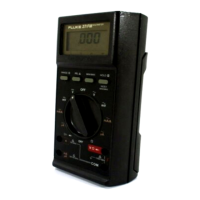

 To Next Page