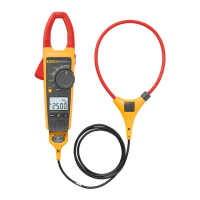
Need help?
Do you have a question about the Fluke 381 and is the answer not in the manual?
Provides telephone numbers for contacting Fluke for support and service.
Explains the wireless remote display functionality and its limitations.
Covers hazardous voltage indicator, flexible probe, and auto power off functions.
Details backlight, hold, min/max/avg modes, and DC current zeroing.
Explains inrush current measurement and low battery indications.
Explains how to view all segments on the display and what they mean.
Instructions for measuring AC and DC current using the meter's jaw.
How to measure AC current using the flexible current probe.
Instructions for measuring AC and DC voltage using test leads.
Instructions for measuring resistance and continuity using the meter.
How to measure inrush current with the jaw or flexible probe.
How to measure frequency using the jaw or flexible probe.
Instructions and warnings for cleaning the meter and probe.
Step-by-step guide for replacing batteries in the meter and display module.
Details electrical specifications for AC current via jaw and general electrical categories.
Specifications for AC current measurements using the flexible probe.
Information on how position affects measurement accuracy.
Specifications for DC current and AC voltage measurements.
Specifications for DC voltage and frequency measurements via jaw.
Specifications for resistance and frequency via flexible probe.
Physical dimensions and weight of the meter and probe.
Operating and storage conditions, humidity, and altitude limits.
Covers temperature coefficients, wireless frequency, safety compliance, and agency approvals.
 General
| Continuity | 60 Ω |
|---|---|
| Resistance (max) | 600 Ω |
| Resistance (min) | 6 Ω |
| Measuring category | CAT III 1000V, CAT IV 600V |
| AC voltage resolution (min) | 600 V |
| AC current maximum resolution (probe) | 2500 A |
| Product color | Yellow |
| Operating altitude | 0 - 2000 m |
| Non-operating altitude | 0 - 12000 m |
| Storage temperature (T-T) | -40 - 60 °C |
| Operating temperature (T-T) | -10 - 50 °C |
| Operating relative humidity (H-H) | 0 - 90 % |
| Probe length | 1800 mm |
| Carrying case | Yes |
| Probe diameter | 7.5 mm |
 Weight and Dimensions
| Depth | 277 mm |
|---|---|
| Width | 88 mm |
| Height | 43 mm |
| Weight | 350 g |

 To Next Page