EasyManua.ls Logo

Fluke 6070A - Local Operation; Remote Operation

Fluke 6070A
30 pages
Print Icon
To Next Page IconTo Next Page
To Previous Page IconTo Previous Page
Loading...
1-4.
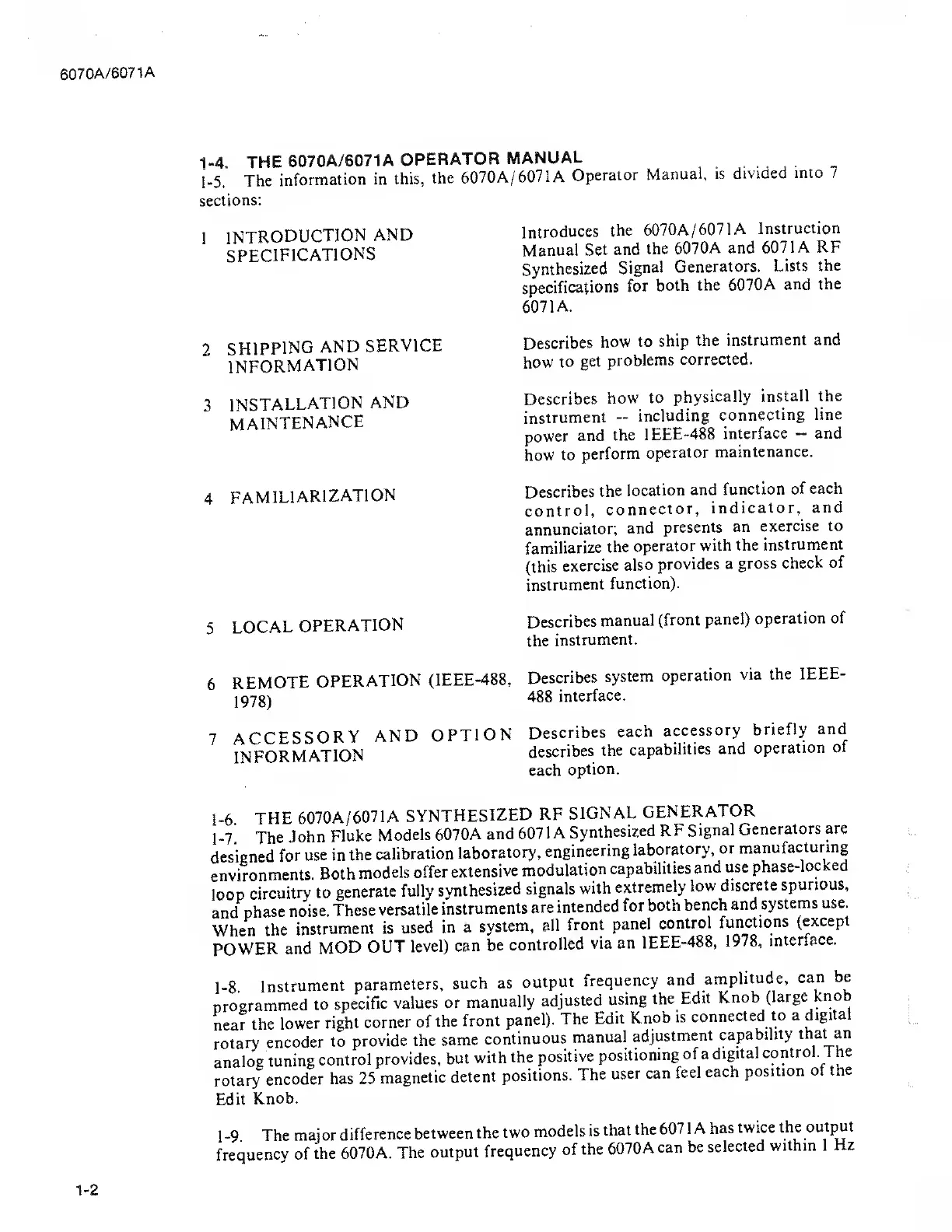
THE
6070A/6071A
OPERATOR
MANUAL
.
.
.
,
.
1-5.
The
information
in
this,
the
6070A/6071A
Operator
Manual,
is
divided
into
7
sections:
1
INTRODUCTION
AND
Introduces
the
6070A/6071A
Instruction
s:PFr!FirAT10NS
Manual
Set
and
the
6070A
and
6071A
RF
Synthesized
Signal
Generators.
Lists
the
specifications
for
both
the
6070A
and
the
6071
A.
2
SHIPPING
AND
SERVICE
INFORMATION
3
INSTALLATION
AND
MAINTENANCE
4
FAMILIARIZATION
5
LOCAL
OPERATION
Describes
how
to
ship
the
instrument
and
how
to
get
problems
corrected.
Describes
how
to
physically
install
the
instrument
--
including
connecting
line
power
and
the
IEEE-488
interface
-
and
how
to
perform
operator
maintenance.
Describes
the
location
and
function
of
each
control,
connector,
indicator,
and
annunciator;
and
presents
an
exercise
to
familiarize
the
operator
with
the
instrument
(this
exercise
also
provides
a
gross
check
of
instrument
function).
Describes
manual
(front
panel)
operation
of
the
instrument.
6
REMOTE
OPERATION
(IEEE-488,
1978)
7
ACCESSORY
AND
OPTION
INFORMATION
Describes
system
operation
via
the
IEEE-
488
interface.
Describes
each
accessory
briefly
and
describes
the
capabilities
and
operation
of
each
option.
1-6
THE
6070A/6071A
SYNTHESIZED
RF
SIGNAL
GENERATOR
1-7.
The
John
Fluke
Models
6070A
and
6071A
Synthesized
RF
Signal
Generators
are
designed
for
use
in
the
calibration
laboratory,
engineering
laboratory,
or
manufacturing
environments.
Both
models
offer
extensive
modulation
capabilities
and
use
phase-locked
loop
circuitry
to
generate
fully
synthesized
signals
with
extremely
low
discrete
spurious,
and
phase
noise.
These
versatile
instruments
are
intended
for
both
bench
and
systems
use.
When
the
instrument
is
used
in
a
system,
all
front
panel
control
functions
(except
POWER
and
MOD
OUT
level)
can
be
controlled
via
an
iEEE-488,
1978,
interface.
1-8.
Instrument
parameters,
such
as
output
frequency
and
amplitude,
can
be
programmed
to
specific
values
or
manually
adjusted
using
the
Edit
Knob
(large
knob
near
the
lower
right
corner
of
the
front
panel).
The
Edit
Knob
is
connected
to
a
digital
rotary
encoder
to
provide
the
same
continuous
manual
adjustment
capability
analog
tuning
control
provides,
but
with
the
positive
positioning
of
a
digital
control.
I
he
rotary
encoder
has
25
magnetic
detent
positions.
The
user
can
feel
each
position
of
the
Edit
Knob.
1-9.
The
major
difference
between
the
two
models
is
that
the
6071A
has
twice
the
output
frequency
of
the
6070A.
The
output
frequency
of
the
6070A
can
be
selected
within
Hz

Related product manuals