EasyManua.ls Logo

Fluke 80i-1010 - Operation

Fluke 80i-1010
12 pages
Print Icon
To Next Page IconTo Next Page
To Previous Page IconTo Previous Page
Loading...
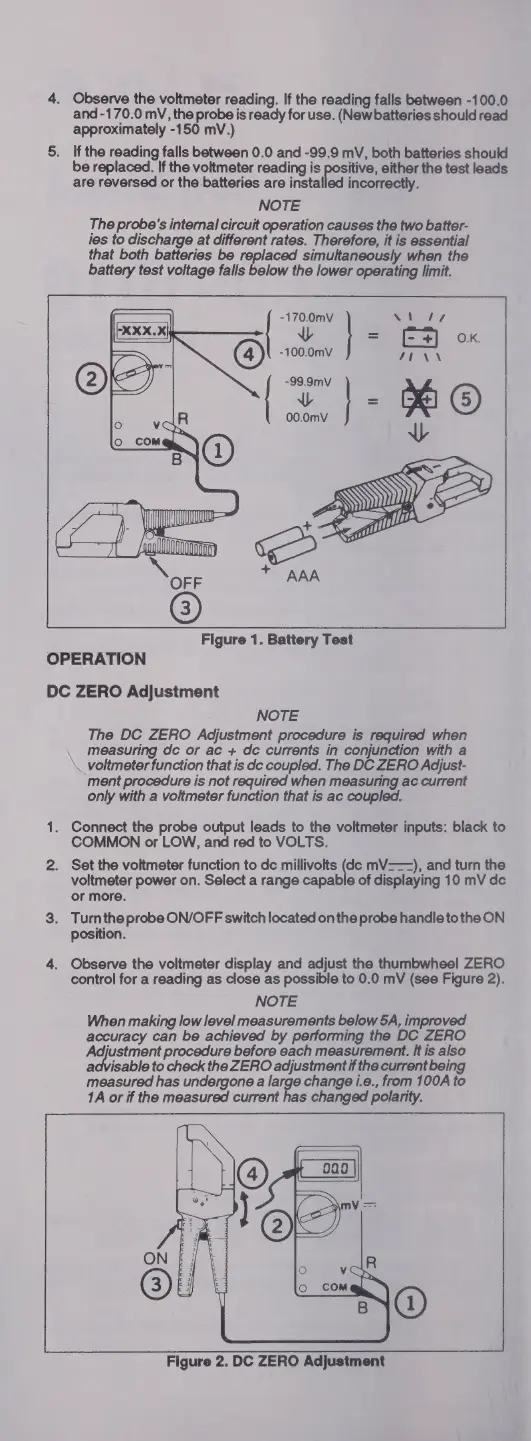
4.
Observe
the
voltmeter
reading.
If
the
reading
falls
between
-100.0
and
-170.0
mV,
the
probe
is
ready
for
use.
(Newbatteries
should
read
approximately
-150
mV.)
5.
If
the
reading
falls
between
0.0
and
-99.9
mV,
both
batteries
should
be
replaced.
If
the
voltmeter
reading
is
positive,
either
the
test
leads
are
reversed
or
the
batteries
are
installed
incorrectly.
NOTE
The
probe's
internal
circuit
operation
causes
the
two
batter-
les
to
discharge
at
different
rates.
Therefore,
it
is
essential
that
both
batteries
be
replaced
simultaneously
when
the
battery
test
voltage
falls
below
the
lower
operating
limit.
y
-100.0mV
-170.0mV
-99.9mV
Figure
1.
Battery
Test
OPERATION
DC
ZERO
Adjustment
NOTE
The
DC
ZERO
Adjustment
procedure
is
required
when
measuring
de
or
ac
+
de
currents
in
conjunction
with
a
voltmeter
function
that
is
de
coupled.
The
DC
ZERO
Adjust-
ment
procedure
is
not
required
when
measuring
ac
current
only
with
a
voltmeter
function
that
is
ac
coupled.
1.
Connect
the
probe
output
leads
to
the
voltmeter
inputs:
black
to
COMMON
or
LOW,
and
red
to
VOLTS.
2.
Set
the
voltmeter
function
to
de
millivolts
(de
mV===),
and
turn
the
voltmeter
power
on.
Select
a
range
capable
of
displaying
10
mV
de
or
more.
3.
Turntheprobe
ON/OFF
switch
located
onthe
probe
handle
tothe
ON
position.
4.
Observe
the
voltmeter
display
and
adjust
the
thumbwheel
ZERO
control
for
a
reading
as
close
as
possible
to
0.0
mV
(see
Figure
2).
NOTE
When
making
low
level
measurements
below
5A,
improved
accuracy
can
be
achieved
by
performing
the
DC
ZERO
Adjustment
procedure
before
each
measurement.
It
is
also
advisable
to
check
the
ZERO
adjustment
if
the
current
being
measured
has
undergone
a
bed
change
i.e.,
from
100A
to
1A
or
if
the
measured
current
has
changed
polarity.
Figure
2.
DC
ZERO
Adjustment

Related product manuals