EasyManua.ls Logo

Fluke 80i-1010 - Troubleshooting

Fluke 80i-1010
12 pages
Print Icon
To Next Page IconTo Next Page
To Previous Page IconTo Previous Page
Loading...
NOTE
When
measuring
ac
current,
and
using
a
meter
without
an
ac
mV
function,
use
the
ac
Volt
function.With
many
meters,
this
will
limit
resolution
to
1A
and
readings
will
appear
en
by
1000.
For
example,
a
15A
reading
will
appear
as
0.015V.
5.
Select
the
appropriate
ac
or
de
function
on
the
voltmeter.
6.
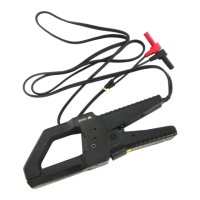
Clamp
the
jaws
of
the
probe
around
the
conductor
to
be
measured.
Position
the
probe
so
that
the
conductor
is
in
the
center
of
the
jaw
opening
for
the
most
accurate
reading.
NOTE
When
measuring
current
in
an
ac
line
cord,
the
jaws
should
be
clamped
around
oy
one
conductor
(the
black
or
hot
wire
in
a
three-wire
cord).
If
the
jaws
are
clamped
around
both
current
carrying
conductors,
the
currents
will
cancel
and
produce
a
zero
reading.
7.
Observe
the
voltmeter
display.
The
reading
in
millivolts
is
equivalent
to
the
current
in
amps
(i.e.,
5
mV
=
5A).
A
positive
polarity
reading
indicates
that
the
dc
current
is
flowing
in
the
direction
of
the
arrow
on
the
probe
(see
Figure
3.)
Low
Level
Measurements
The
80i-1010
is
specified
to
measure
currents
of
1A
or
greater.
Currents
below
1A
can
be
accurately
measured
by
looping
the
input
wire
through
the
jaws
of
the
probe
so
that
the
sum
of
the
amp-turns
through
the
jaws
is
greater
than
1A.
The
actual
current
can
then
be
calculated
by
dividing
the
meter
reading
by
the
number
of
turns
looped
through
the
jaws.(Refer
to
the
NOTE
at
the
end
of
the
DC
ZERO
Adjustment
procedure.)
TROUBLESHOOTING
If
the
80i-1010
does
not
perform
properly,
use
the
following
steps
to
help
isolate
the
problem:
1.
Inspect
the
jaw
mating
surface
for
cleanliness.
If
any
foreign
material
is
present,
the
jaws
will
not
close
properly
and
errors
will
result.
2.
Inspect
the
batteries
to
make
sure
they
are
installed
with
the
proper
polarity.
(Refer
to
the
BATTERY
INSTALLATION
procedure.)
3.
Test
the
batteries.
(Refer
to
the
BATTERY
TEST
procedure.)
4.
Verify
that
the
probe
leads
are
connected
to
the
VOLT
input
of
the
meter.
5.
Verify
that
the
function
selection
on
the
meter
is
correct,
i.e.,
dc
mV
for
de
current
or
ac
mV
for
ac
current.
CALIBRATION
Requlred
Equipment
The
equipment
required
to
calibrate
the
80i-1010
is
listed
in
Table
2.
If
you
do
not
have
all
the
required
equipment,
send
the
80i-1010
to
a
Fluke
echnical
Center
for
calibration.
Adjustments
and
Procedures
NOTE
The
following
procedures
are
interactive
and
must
be
per-
formed
in
the
order
given.
1.
Set
up
the
80i-1010
for
calibration
as
follows:
a.
Connect
the
10-turn
butterfly
coil
to
the
output
of
the
Transconductance
Amplifier.
b.
Connect
the
DC/AC
Voltage
Calibrator
output
to
the
amplifier
input.
c.
Turn
both
instruments
on
and
allow
sufficient
warm-up
time
for
stable
operation.
d.
Open
the
jaws
of
the
probe
and
inspect
the
mating
surfaces
for
foreign
material.
If
necessary,
clean
the
plates
with
a
dry
cloth.
e.
Perform
steps
1
through
4
of
the
BATTERY
TEST
procedure,

Related product manuals