RECORDER
OUTPUT
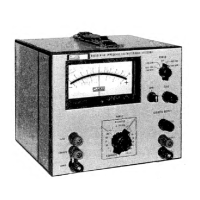
Figure 3-1. MODEL
893A/AR BLOCK DIAGRAM
Kelvin-Varley divider voltage polarity and the meter ter-
minals can be reversed through the contacts of the MODE
switch for ± dc voltage measurements.
3-11.
By placing the MODE switch
of Figure
3-1
to the
AC position. The instrument
circuitry is connected as
an ac differential voltmeter having
an inpvit Impedance
of
one megohm. The
ac converter operates
in the
same manner as on the AC TVM mode
and supplies
a
full-scale input
voltage
of
one volt dc to the
dc meas-
urement circuitry. The
remaining circuitry
operates
similar to the dc differential mode
with the only dif-
ference being the absence of the
polarity reversal
switching.
3-12.
OPTIONAL
RECORDER
OUTPUT
3-13.
The c^tional
recorder output provides isolation
between the ndll detector output and
recorder output. The
null detector aitput voltage is
modulai:ed by a 3 kHz drive
s^nai derived from the
reference supply. The modulated
signal is transformer
coupled to
a
demodulator driven
at
the same
3 kHz rate as the modulator. The s^nal is
then
demodulated,
and tlie
resulting dc voltage
applied
through
a variable resistor to the recorder
output terminals. The
variable resistor
provides adjustment of the full-scale
recorder output
voltage.
3-14.
CIRCUIT ANALYSIS
3-15. INTRODUCTION
3-16.
The circuitry contained in the Model
893
is com-
prised of
a
power
supply
/battery charger,
a
reference
amplifier and
a
reference inverter,
a
Kelvin-
Varley divid-
er, an ac
converter,
a
null detector, an
optional recorder
3-2
output,
a meter, a dc irput divider, and RANGE, NULL
SENS,
MODE and POWER switches.
These circuits
will
be described in detail in the following
paragraphs using
simplified
circuit diagrams in addition
to the functional
schematic
diagrams located at the
rear of the manual.
3-17. POWER
SUPPLY/BATTERY
CHARGER
3-18. The
input power transformer T1
receives 115
or
230 volts ac through the
contacts of the POWER
switch
S2BR-2. The
primary of T1 is
constructed in such
a
manner
as
to
allow the instrument to
be operated from
115 volts ac, windings in
parallel, or 230
volts ac, wind-
ings in series.
Switch
85
performs the required 115 or
230 volt
ac power connections
in the primary
of
Tl. Fuse
FI protects the circuitry
from overloads. The
secondary
of Tl has four t^s which
si
5
>ply ac voltages to the power
supply and battery
charger. The ac voltage
present at
pins 8 and
10 are full-wave rectified
by diodes
CRl
and
CR2
and capacitors Cl and C2 located
on
the
A2
Reference
Amplifier Assembly.
3-19. On
instruments equipped with
the
-01
option, the
ac voltage present at
pins 9 and 11 of
Tl
is fuHwave rec-
tified by diodes CR3
and CR4 and applied across R9 and
BTl. When the POWER
switch is placed to the BAT CHG
position, the
contacts of S2BF
by-pass
the
resistor
R9
to
provide
a
maximum charge current
for BTl. The lamp
DSl functions
as a ballast to limit charging current at an
optimum
value for rapid charging of BTl.
Resistor
R9
is placed in the circuit on
all
other POWER
switch pos-
itions
to provide trickle-charging
of
BTl wiien the
instru-
ment is operated
from line power. Checking
of
BTl
is
provided
when the
POWER switch
is
placed
to
the BAT
CHK position. Switches
S2BR-1, S2BR-2, S2BF, S2AF,
and
S2AR provide
the necessary circuit connections that
remove the ac volt^e applied to Tl
and place the meter
893A



 To Next Page