Need help?
Do you have a question about the Fluke T5-1000 and is the answer not in the manual?
Covers calibration, voltage, temperature, altitude, humidity, battery, shock, surge, and enclosure ratings.
Defines measurement resolution and accuracy for various functions like voltage, current, and resistance.
Details input protection and nominal input impedance for different measurement functions.
Covers calibration, voltage, temperature, altitude, humidity, battery, shock, surge, and enclosure ratings.
Procedure to test the AC current function using a butterfly coil and calibrator.
Procedure to verify the correct operation of the low battery indicator.
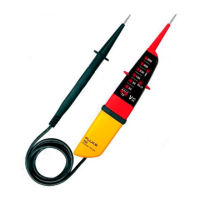
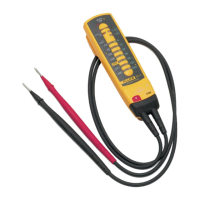
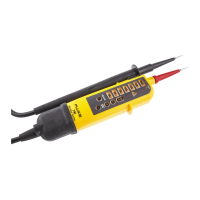
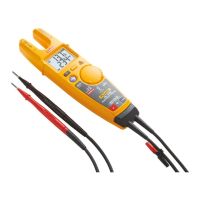
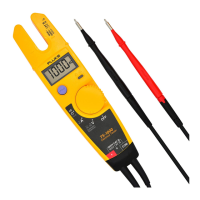
The Fluke T5-600/T5-1000 Electrical Tester is a versatile handheld instrument designed for electrical measurements and troubleshooting. It provides essential functions for electricians and technicians to safely and efficiently check electrical systems.
The electrical tester is capable of measuring AC and DC voltage, AC current, and resistance, and it also features a continuity function. The device automatically selects between AC and DC voltage modes, simplifying operation. For voltage measurements, the tester can handle up to 600 V rms for the T5-600 model and up to 1000 V rms for the T5-1000 model, with an input impedance of 1 MΩ. The AC current function utilizes a current fork, allowing for non-contact measurement of AC current up to 100.0 A. Resistance measurements are performed up to 1000 Ω, and the continuity function includes an audible beeper to indicate continuity. A hazardous voltage indicator LED provides an additional safety feature, illuminating when dangerous voltage levels are detected. The tester also incorporates a HOLD function, which allows the user to freeze the displayed reading for easier recording.
Safety is paramount when using the T5-600/T5-1000 Electrical Tester. Users are advised to always inspect the tester and test leads for any damage, such as cracks, missing plastic, exposed metal, or damaged insulation, before each use. Damaged test leads must be replaced immediately. The battery door must be securely closed and latched to ensure proper operation and safety. To verify the tester's functionality, it is recommended to measure a known voltage before use. The low battery indicator (+) signals when batteries need replacement, and it is crucial to replace them promptly to maintain accurate readings. The tester should not be used in environments with explosive gas, vapor, or dust. Users must ensure that the applied voltage does not exceed the rated voltage marked on the tester, both between terminals and between any terminal and earth ground. When working with voltages above 30 V ac rms, 42 V ac peak, or 60 V dc, extreme caution is necessary. The probes are designed with finger guards, and users should always keep their fingers behind these guards. For safe measurement, the common test lead should be connected first, followed by the live test lead, and disconnected in the reverse order (live test lead first). It's important to note that the display will not show hazardous voltages when the HOLD function is active, but the voltage indicator LED will continue to operate, providing a critical safety alert.
The T5-600/T5-1000 Electrical Tester is designed for durability and ease of maintenance. The device is warranted to be free from defects in material and workmanship under normal use. For cleaning, the tester should be wiped down with a cloth lightly dampened with water or a mild detergent. It is crucial to prevent water from entering the case to avoid electric shock or damage to the tester. Solvents, aromatic hydrocarbons, chlorinated solvents, or methanol-based fluids should never be used for cleaning, as they can damage the tester's case. Battery replacement is a straightforward process; users need to observe the polarity markings inside the battery compartment when inserting new batteries. The tester uses two AA batteries, with alkaline batteries providing longer continuous operation compared to carbon-zinc batteries. The instruction sheet provides detailed guidance on battery replacement and other operational aspects. Servicing beyond basic cleaning and battery replacement should be referred to qualified personnel to ensure the integrity and safety of the device. Regular performance tests, as outlined in the service information, can help verify the tester's accuracy and functionality, ensuring it remains a reliable tool for electrical measurements.
 General
| Safety Rating | CAT III 1000 V, CAT IV 600 V |
|---|---|
| Display Type | Digital |
| Continuity Beeper | Yes |
| OpenJaw Current Measurement | Yes |
| Resistance Measurement Range | 1000 Ω |
| Dimensions | 203 x 51 x 30 mm (8.0 x 2.0 x 1.2 in) |

 To Next Page