nents. The vehicle is lifted high enough when the
beam ends are off of the saddles.
Inspect the walking beam for cracks or other
damage. If damage is found, replace the walking
beam.
Keep the vehicle supported by the jack stands
for the next operation.
5. Manipulate the walking beam so that a microm-
eter, vernier, or dial caliper can be used to deter-
mine the wear area thickness on the bottom
face. See
Fig. 8. Measurements should be taken
a minimum of 1/2 inch from the beam flange
edges to eliminate any edge wear that may have
occurred. Subtract the wear area thickness (see
Fig. 8, Ref. B) from the thickness at the non-
wear area (see
Fig. 8, Ref. A) to determine the
amount of wear.
If the beams show any wear greater than 0.062
inch (1.5 mm), a Chalmers wear plate must be
installed, or the walking beam must be replaced.
6. Rotate the restrictor cans 360 degrees and visu-
ally inspect the cans for cracks, severe corro-
sion, and distortion. If any of these conditions are
present, or the restrictor can is missing, replace
the restrictor can.
WARNING
Replace all cracked or missing restrictor cans.
Failure to do so could lead to loss of vehicle con-
trol, which could result in property damage, seri-
ous personal injury, or death.
Hendrickson RS Series
1. Inspect the frame hanger to frame attaching fas-
teners for the proper torque. See
Group 00 of
this manual for torque specifications.
WARNING
Be sure that fasteners are torqued correctly. Fas-
teners that do not provide a tightly clamped joint
between the frame and the hanger can cause pre-
mature fracture of the frame hanger, separation of
08/16/96
f320453
A
1
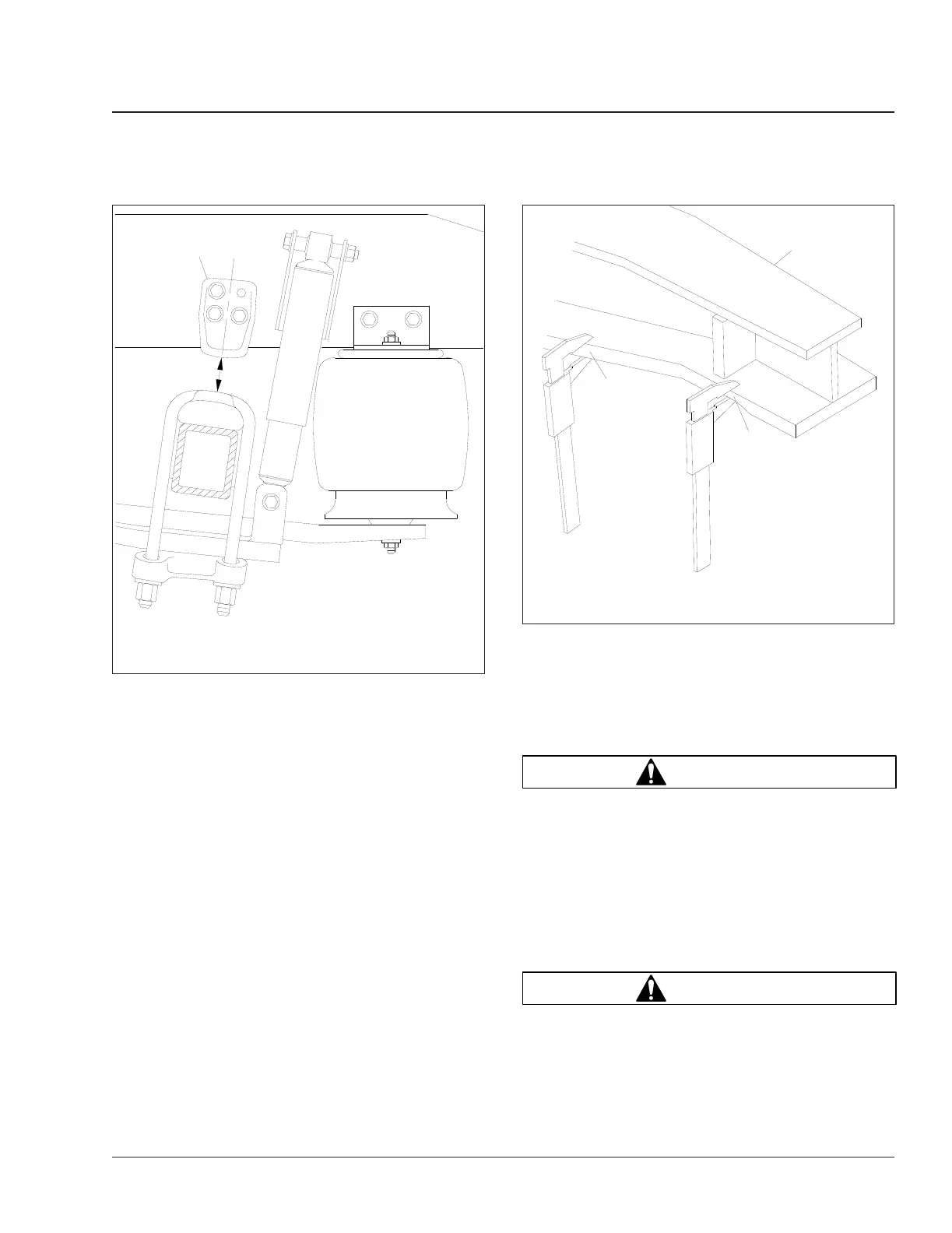
A. Measure height here.
1. Left Forwardmost Axle Stop
Fig. 7, AirLiner Axle Stop Measurement
09/27/95
f320432
1
A
B
A. Non-Wear Area B. Wear Area
1. Walking Beam
Fig. 8, Walking Beam End Wear Thickness
Suspension 32
Century Class Trucks Maintenance Manual, January 2016 32/5




 To Next Page