EasyManua.ls Logo

Furuno 1830 - Indirect Echoes and Radar Picture Comparison

Furuno 1830
66 pages
Print Icon
To Next Page IconTo Next Page
To Previous Page IconTo Previous Page
Loading...
range
marked
on
the
screen.
Not
only
does
Ihe
sensitivity
of
Ihe
receiver
and
power
of
the
transmitter
but
also
the
height
above
the
water
of
both
the
scanner
and
target,
the
size,
shape
and
composition
of
the
targei,
and
atcnospheric
conditions
contribute
to
increase
or
decrease
the
maximum
detectable
range.
Radar
Horizon
Radar
is
by
its
very
nature
essentially
a
"line-of-sight"
phenomenon.
That
means
that
you
have
just
ahout
the
same
range
to
the
horizon
with
a
radar
as
you
do
with
your
own
eyes,
However
under
normal
atmospheric
conditions,
the
radar
horizon
is
6%
greater
than
the
optical
horizon.
Therefore,
if
the
target
does
not
rise
above
the
horizon
the
radar
beam
cannot
be
refiecied
from
the
target-
Just
as
you
can
see
a
low-to-the-water
speedboat
only
up
relatively
close
to
your
boat,
the
radar
can
ses
a
target
high
off
the
water
farther
than
it
can
see
an
object
which
is
close
to
the
water.
Further,
the
higher
the
antenna
is
mounted
over
the
water
the
farther
il
is
capable
of
seeing
other
targets.
However
a
possible
negative
effeet
with
mounting
the
antenna
too
high
off
the
water
is
that
due
to
the
finite
vertical
beamwidth
of
the
scanner,
the
amount
of
sea
dutter
due
to
reflections
from
nearby
waves
is
inereased
to
a
greater
distance
from
the
boat.
Thus
it
is
not
at
all
xincommon
to
see
a
3000
foot
high
mountain
50
miles
away
(provided
the
radar
has
a
SOnm
detection
capability),
while
at
the
same
time
being
only
able
to
see
a
small
power
boat
3
or
4
miles
away.
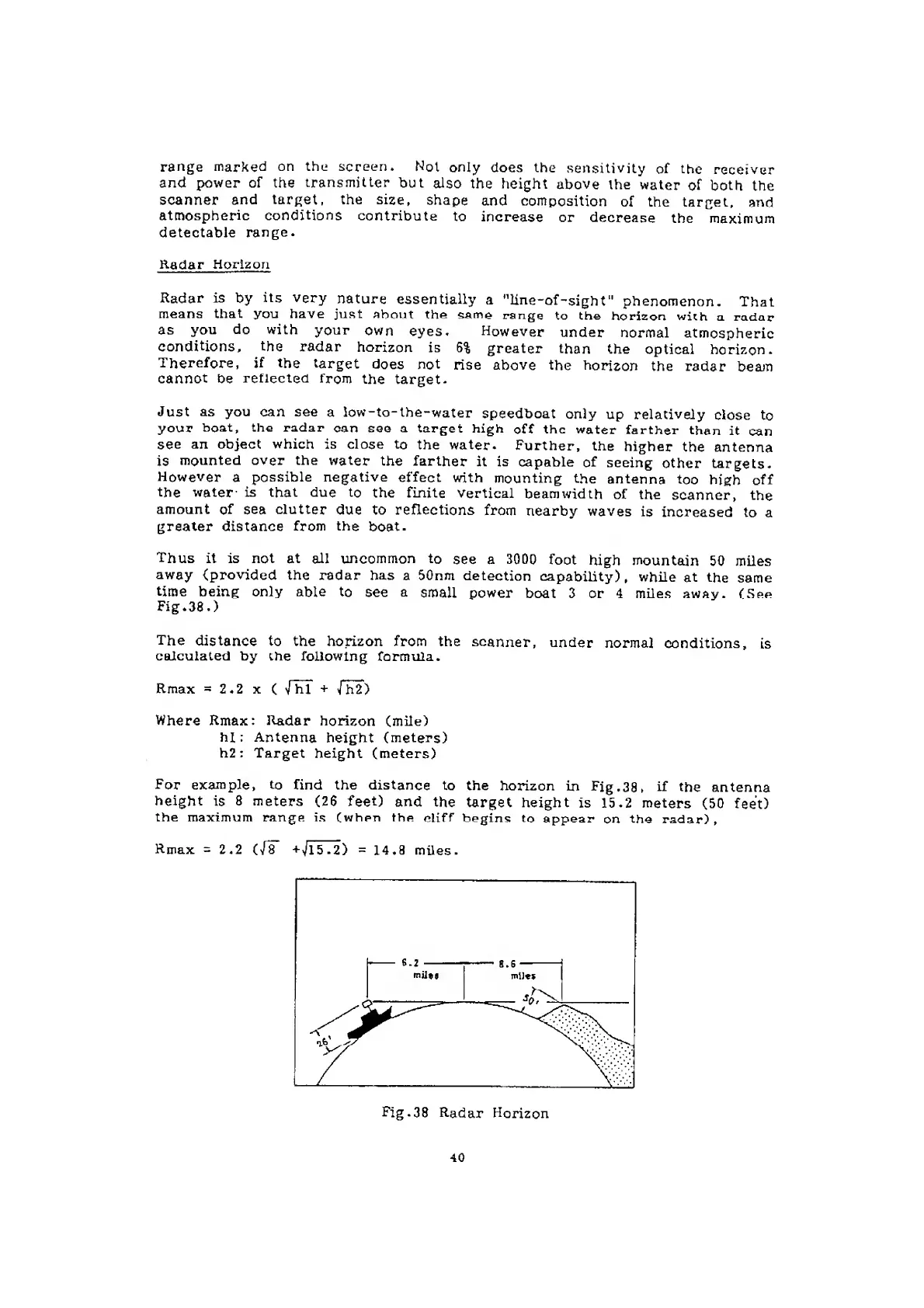
(Se«
Fig.38.)
The
distance
to
the
horizon
from
the
scanner,
under
normal
conditions,
is
calcuiaLed
by
the
foliowlng
formula.
Rmax
=5
2.2
x
(
<1
hl
+
Ih2)
Where
Rmax:
Radar
horizon
(mile)
hl:
Antenna
height
(meters)
h2:
Target
height
(meters)
For
example,
to
find
the
distance
to
the
horizon
in
Fig.38,
if
the
antenna
height
is
8
meters
(26
feet)
and
the
target
height
is
15.2
meters
(50
feet)
the
maximum
ranga
is
(when
the
eliff
begins
to
appear
on
the
radar),
Rmax
=
2.2
(/S*
+Jl5.2)
=
14.8
miles.
40