0MNLIBRAPROK10NPENUA 01 Pag. 11 / 57
2.3 Cooling of the premises
The recommended operating temperature for the lifetime of the UPS and of the batteries is between 20 and 25°C.
The lifespan of the battery depends on the operating temperature; with an operating temperature of between 20°C
and 30°C, the lifespan of the batteries is halved.
A heat dissipation system is required to keep the temperature of the
premises housing the equipment within the field 20÷25°C.
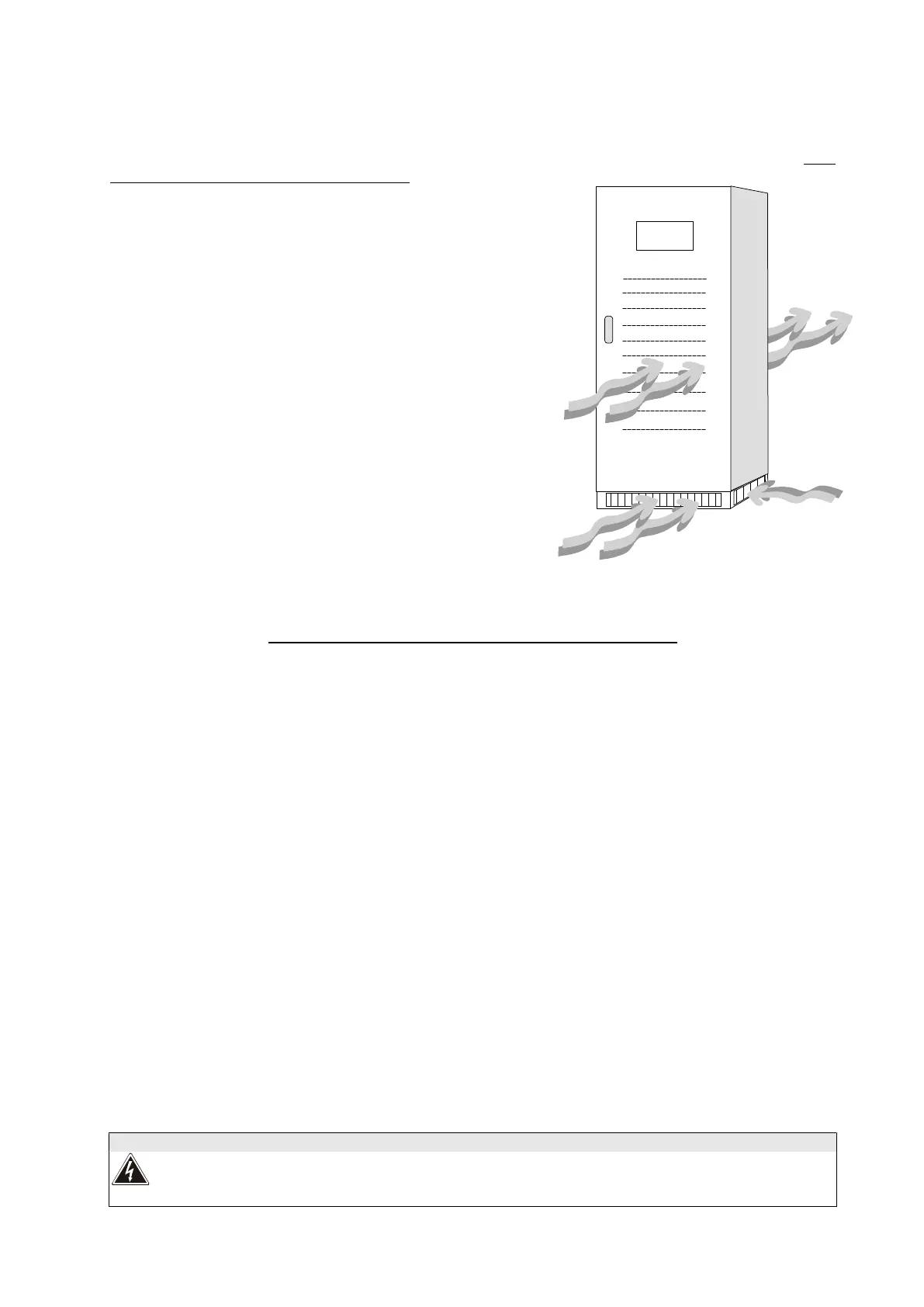
The heat dissipation needed for the correct operation of the UPS is
brought about by the air current made by the fans located inside the
UPS (forced convection) and by the air around the side panels
(natural convection).
In order to ensure proper air circulation, and therefore the correct
operation of the UPS, measures must be taken during installation to
avoid any obstructions to the free circulation of air. These include
the following:
Leave a free space of at least 20 cm. must be left between the
back of the UPS and the wall so as not to block the flow of air
from the fans, and at least 40 cm. for maintenance operations
on the fans.
leave a free space of at least one metre at the front of the
equipment to ensure both the circulation of the air and
installation and maintenance operations;
With natural convection the thermal load is dissipated to the
outside through the walls; thus a cabinet placed against a wall or in a hollow dissipates less heat than one located
in a free environment.
The following rule must be observed:
leave at least one of the three side walls free: right, left or back.
the side strips must not be mounted for installations where cabinets are placed side by side.
2.4 Air change for battery premises
The premises housing the battery cabinet must have sufficient air circulation to ensure that the concentration of
hydrogen issued during battery charging is kept below the danger limit.
The air change in the premises should preferably be provided by natural ventilation, otherwise by forced ventilation.
The standard EN 50272-2 for air change envisages that the minimum opening must satisfy the following equation:
A = 28 x Q = 28 x 0.05 x n x Igas x C10 (1/10³) [cm²]
where: A = free opening for air intake and outlet
Q = flow of air to be removed [m³/h]
n = number of battery elements;
C10 = battery capacity over 10 hours [Ah]
Igas = current that produces gas [mA//Ah]
in accordance with the standard: Igas = 1 VRLA type battery (*)
(*) for open vase or nickel batteries, contact the battery manufacturer.
When the equation is applied for 240 element (40 battery) hermetically-sealed lead batteries:
A = 336 x C10 / 10³ [cm²]
When using 120Ah batteries, the minimum aperture should be approximately:
A = 41 [cm²]
The air intake and outlet must be positioned to ensure the best possible circulation; for example:
- apertures on opposite walls,
- a minimum distance of 2 m when they are on the same wall.


 To Next Page