Your
Driving
and
the
Road
deaths are the result of someone who
was drinking and driving. Over 25,000
motor vehicle-related deaths occur each
year because
of
alcohol, and thousands
of people are injured.
Just how much alcohol is too much if a
person plans to drive? Ideally, no one
should drink alcohol and then drive. But
if
one does, then what’s “too much”? It
can be a lot less than many might think.
Although it depends on each person and
situation, here is some general
information on the problem.
The Blood Alcohol Content (BAC) of
someone who is drinking depends upon
four things:
How much alcohol
is
in
the
drink.
The drinker’s body weight.
The amount of food that is consumed
before and during drinking.
The length of time it has taken the
drinker to consume the alcohol.
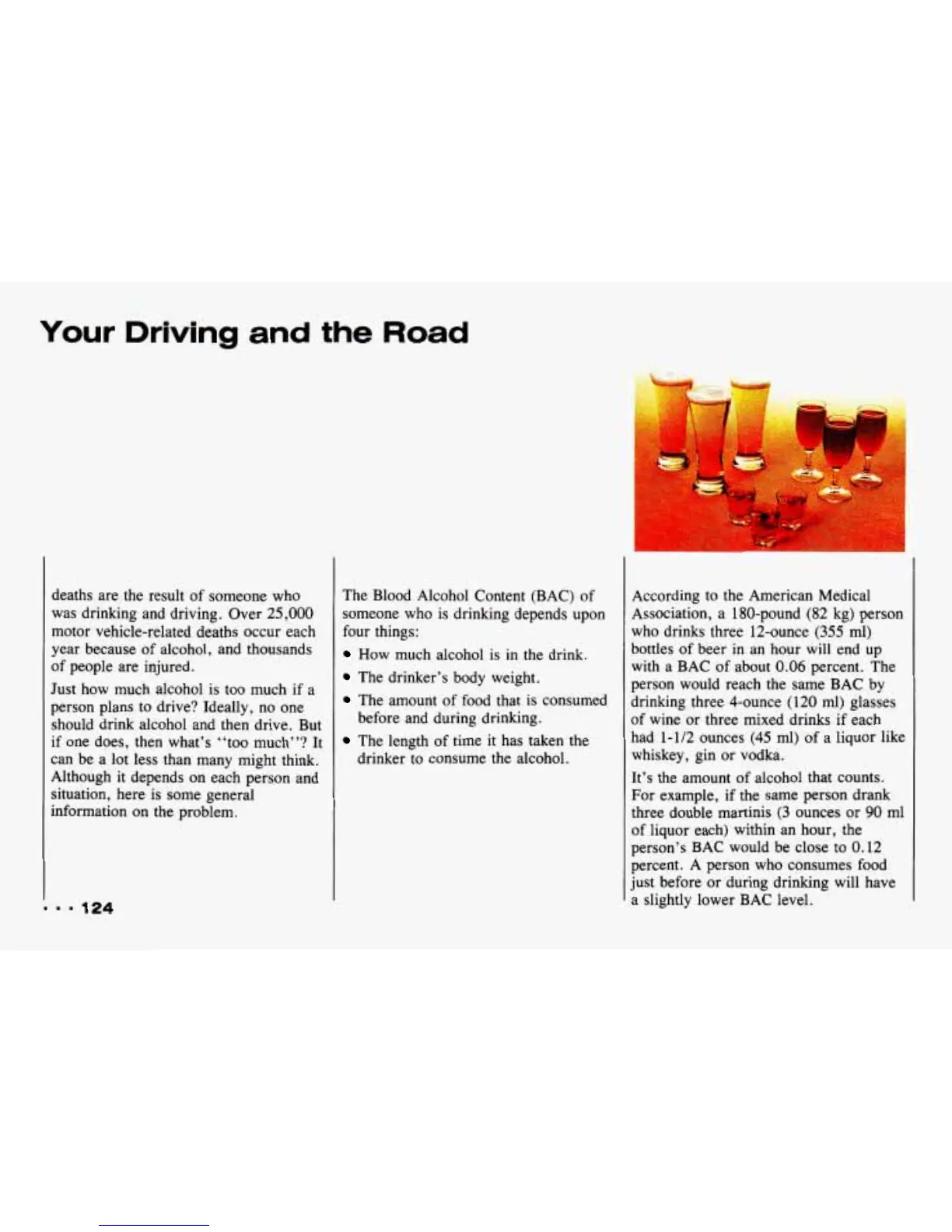
According to
the
American Medical
Association, a 180-pound (82 kg) person
who drinks three 12-ounce
(355
ml)
bottles of beer in an hour will end up
with
a
BAC of about
0.06
percent. The
person would reach the same BAC by
drinking three 4-ounce (120
ml)
glasses
of
wine or three mixed drinks if each
had 1- 1/2 ounces (45 ml)
of
a liquor like
whiskey, gin or vodka.
It’s the amount
of
alcohol that counts.
For example, if the same person drank
three double martinis
(3
ounces or
90
ml
of
liquor each) within an hour, the
person’s BAC would be close to 0.12
percent. A person who consumes food
just before or during drinking will have
a
slightly lower BAC level.


 To Next Page