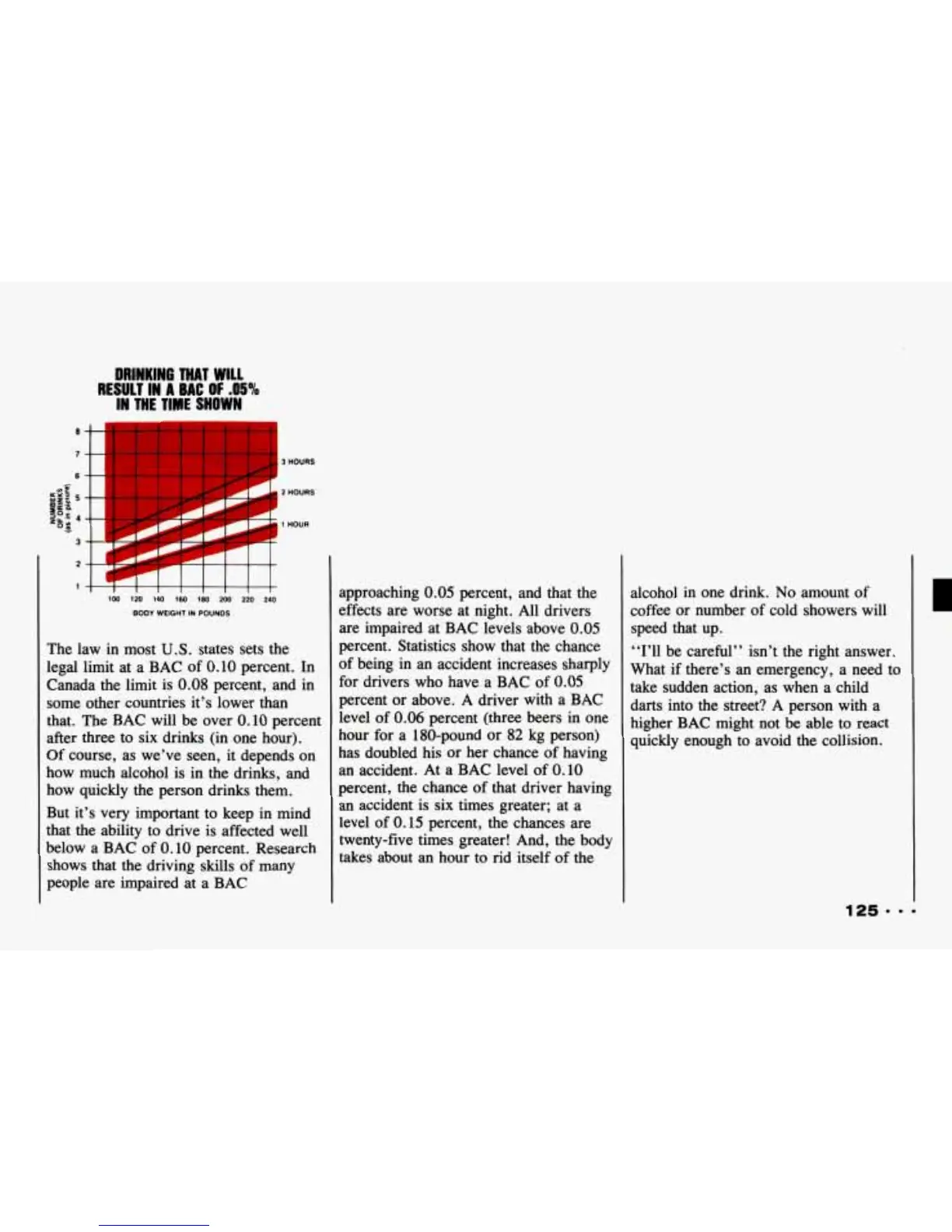
DRINKING
THAT
WILL
IN
THE TIME
SHOWN
RESULT
IN
A
BAC
OF
.05%
i
I
I
-1
4
IVJ
120 140
160
180
Mo
220
240
I
=
1
2
HOURS
i
noUR
aoov
WEIGHT
IN
POUNDS
The law
in
most
U.S.
states sets the
legal limit at a BAC of
0.10
percent. In
Canada the limit is
0.08
percent, and in
some other countries it’s lower than
that. The RAC
will
be over
0.10
percent
after three to six drinks (in one hour).
Of course, as we’ve seen, it depends on
how much alcohol is in the drinks, and
how quickly the person drinks them.
But it’s very important to keep in mind
that the ability to drive is affected well
below a BAC of 0.10 percent. Research
shows that
the
driving skills of many
people are impaired at a BAC
approaching
0.05
percent, and that the
effects are worse at night. All drivers
are impaired at BAC levels above
0.05
percent. Statistics show that the chance
of being in an accident increases sharply
for drivers who have a BAC of
0.05
percent or above. A driver with a BAC
level of
0.06
percent (three beers in one
hour for a 180-pound or
82
kg person)
has doubled his or her chance of having
an
accident. At
a
BAC level of
0.10
percent, the chance of that driver having
an
accident is six times greater; at a
level
of
0.15
percent, the chances
are
twenty-five times greater! And, the body
takes about an hour to rid itself of the
alcohol in one drink.
No
amount of
coffee or number of cold showers will
speed that up.
“I’ll be careful” isn’t
the
right answer.
What if there’s an emergency, a need to
take sudden action, as when a child
darts into the street?
A
person with a
higher BAC might
not
be able to react
quickly enough to avoid the collision.


 To Next Page