Need help?
Do you have a question about the Globalstar ST100 and is the answer not in the manual?
Outlines the document's purpose and lists relevant Globalstar and external references.
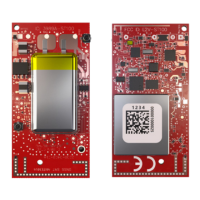
Details the ST100 board as a simplex satellite transmitter for LEO networks.
Lists product certifications and displays board physical dimensions.
Explains how the ST100 operates within the Globalstar LEO satellite network.
Details the ST100's lifecycle states: Pre-operational, Operational, and End-of-Life.
Covers Configuration, Staged for Activation, and Activating modes.
Describes activation procedures and operational modes like Normal and Low Battery.
Explains the hibernate state when battery voltage drops below 3.4 volts.
Describes the device's behavior and limitations when it reaches its programmed end of life.
Provides guidelines to prevent damage from electrostatic discharge to components.
Covers wiring practices, noise sources, unused pins, and antenna obstruction considerations.
Details options for external antennas and how to connect batteries and power sources.
Lists specifications for various solar panels suitable for charging the ST100.
Describes the functions of each pin on the 14-pin connector for interface and programming.
Provides expected battery life based on different battery sizes and track modes.
Explains factory setup for accelerometer use and custom configuration options.
Lists operating temperatures, power requirements, and current drain for the ST100.
Step-by-step guide on how to access the diagnostics screen via the ST100 app.
Demonstrates how to connect to the device and enter commands in the diagnostics menu.
Defines the syntax for issuing ASCII commands to the ST100 board.
Provides a comprehensive list of supported ASCII commands for the ST100.
Explains 'auth' for privileged commands and 'data' for raw transmission.
Commands for logs, ESN, fuel gauge, and firmware versions.
Commands for modem diagnostics, device lifetime, and GPS timestamps.
Commands to get transmission rates and query operational modes.
Commands for dumping GPS data and getting GPS section snapshots.
Commands for tracking status, device UID, and hardware versions.
Commands for queue operations and rebooting the Nordic processor.
Commands for self-test and configuring transmission parameters.
Commands to bypass activation and configure battery temperature thresholds.
Commands to set or get BLE advertising interval and transmit power.
Commands for setting message interval and logging parameters.
Commands to set low battery voltage thresholds and start tracking.
Defines the structure of binary serial packets, including preamble, length, command, data, and CRC.
Commands for sending data and querying the Electronic Serial Number via binary packets.
Commands to query firmware version and set device parameters.
Commands to retrieve setup parameters and hardware versions.
Commands to set and query the maximum time for obtaining a GPS fix.
Details for initiating proprietary track mode with user-defined data.
Response format for proprietary track initiation and payload details.
Initiates periodic track with user data; suspends tracking when device is not moving.
Compares standby currents for different motion activated tracking intervals.
Defines the command format for initiating proprietary motion activated tracking.
Commands to update track data and terminate tracking sessions.
Command to query the status of proprietary track modes and intervals.
Command to retrieve detailed tracking statistics like suspended state and messages transmitted.
Command to query GPS fix attempts, failures, mean fix time, and fix quality.
Commands for transmitter stats and controlling accelerometer power.
Commands to query accelerometer state and send redundant GPS bursts.
Format of the response to the Send Redundant Burst with GPS command.
Command to retrieve the device's most recent GPS coordinates and timestamp.
Command to set the device's operational lifetime in months.
Command to query the current lifetime status and expiration details.
Commands to set and query the minimum track rate for tracking modes.
Command to suspend or unsuspend tracking based on battery status or activation state.
Commands to set and query the transmission rate for low battery conditions.
Commands to activate and deactivate the GPS engine for location acquisition.
Commands to enable/disable output of NMEA messages via Bluetooth GATT.
Command to disable GPS engine and cease NMEA message output.
Command to initiate an internal self-test of the ST100 board's subsystems.
Defines the format and fields for health status messages.
Outlines firmware update times and details Nordic update via bootloader.
Details ASIC update via BLE and entering the bootloader.
Commands for flashing data and executing the loaded application.
Command to check if the bootloader or application is currently running.
Describes programming Nordic via JTAG and ASIC via AXSEM interface.
Provides example C code for calculating CRC for serial packets.
Provides example Java code for calculating CRC for serial packets.
Explains how to convert 24-bit hex data to latitude and longitude degrees.
Displays the memory map of Nordic nRF52832, nRF52840, and nRF52810.
Details flash memory allocation for logging, application code, and debug data.
Visual representation of the ST100's flash memory layout.
Describes activating test modes by grounding specific pins on the ST100 board.
Defines test modes and channel selection based on pin states.
Using the smartphone app to enable and control regulatory test modes.
Steps to disable test modes and restore default configuration.
Specifies power requirements for external antennas to meet Globalstar EIRP standards.
Guidance on tuning GPS/Satellite antennas using a Vector Network Analyzer.
Identifies specific components on the PCB used for antenna matching.
Instructions for connecting the VNA and performing initial calibration.
Details VNA frequency settings, impedance, and marker placement for antenna tuning.
Steps for moving impedance towards the center point and selecting matching components.
Explains the process for tuning the Bluetooth antenna, similar to GPS/Sat.
Outlines the steps for customer product certification on the Globalstar network.
Covers modifications, battery safety, blasting areas, explosive atmospheres, and pacemakers.
Details SAR compliance for FCC, Canada, and European Union regulations.
Compliance with FCC CFR25.213 for radio astronomy site avoidance.
States compliance with FCC Part 15 and Canadian ICES-003 rules.
Information on RF exposure limits and required separation distances.
Lists common acronyms and their definitions from A to M.
Lists common acronyms and their definitions from M to W.
 General
| Brand | Globalstar |
|---|---|
| Model | ST100 |
| Category | GPS |
| Language | English |

 To Next Page