If you have excellent height up wind, but lack
boat speed and the boat won’t accelerate in
the wind gusts, then you need more rake. This
helps the mast bend fore and aft which allows
the sail to flatten and the leech to open in the
wind gusts. (Also see notes on diamond
tension.)
If you are lacking height and "grunt" in light to
medium weather, then you have too much
spreader rake.
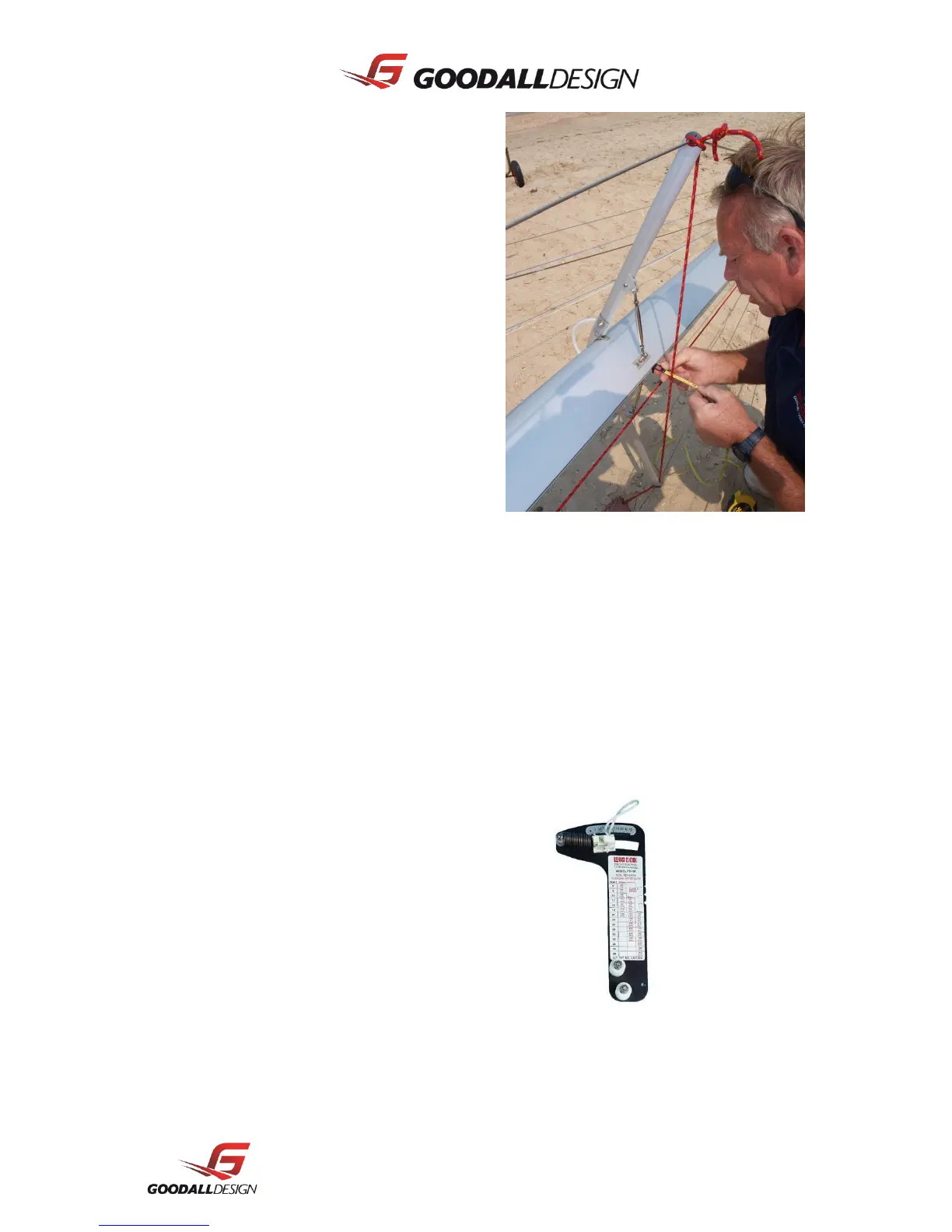
The spreader rake is measured by placing a
straight edge or string-line between the
diamond wires at the spreaders and measure
the distance to the back of the mast.
Settings depend heavily on the weight of the
crew, with heavier crews generally carrying
less rake than lighter crews. The factory
setting is 38mm. The range is between (30mm
– 45mm)
4.4.7 DIAMOND TENSION
The tension on the diamond wires primarily controls the side bends of your mast. Upwind loose
diamonds allow the middle of the mast to bend to leeward and the top of the mast to hook to
windward. This tends to cause the boat to heel very easily in wind gusts. Generally speaking,
diamond tension is a way of powering or depowering your rig. Wind the tension on to depower and
wind them off to power up.
Turning the bolt on the mast
base will adjust your diamond
tension; this can also be done
once the boat if fully rigged.
Diamond tension is run
between 32 and 40 on the
loose gauge, with the factory
setting at 35.



 To Next Page