7
WARNING
a) Do not store combustible materials or use gasoline or other flammable liquids or vapors in the vicinity of
this appliance so as to prevent the risk of property damage or personal injury.
b) Have your contractor point out and identify the various cut-off devices, switches, etc., that serve your
comfort equipment. There is a switch that will cut off energy to your heating system. Know where they are
so that you may cut off the flow of energy in the event of overheating.
4) Periodic Checkup and Service - This product is designed to provide many years of dependable, trouble-free comfort
when properly maintained. Proper maintenance will consist of annual checkups and cleaning of the internal electrical
and heat transfer components by a qualified service technician. Failure to provide periodic checkup and cleaning can
result in excessive operating cost and/or equipment malfunction.
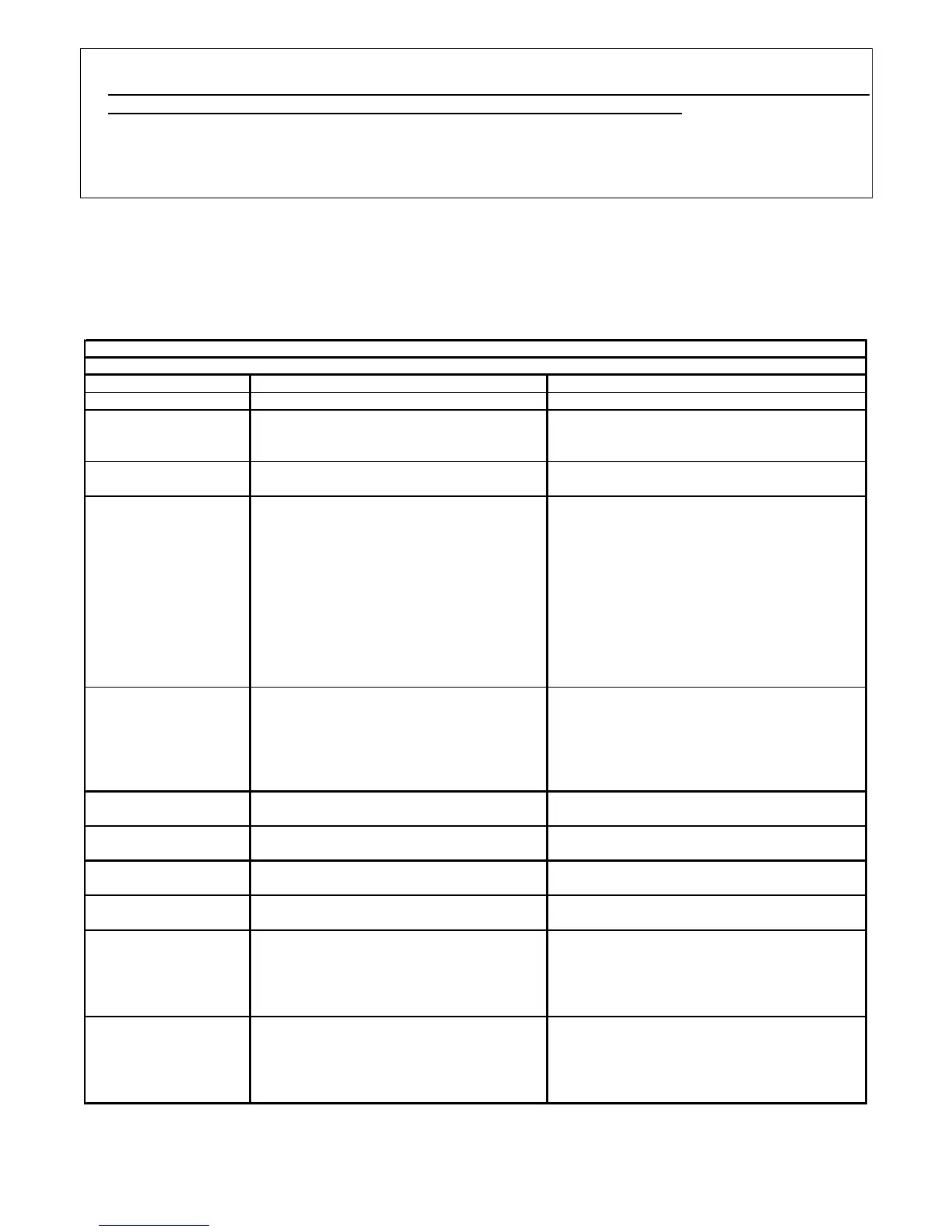
SYMPTOM POSSIBLE CAUSE REMEDY
High head-low suction a. Restriction in liquid line or capillary tube a. Remove or replace defective component
High head-high or normal
suction
b. Overcharged
c.Condenser fan not running
c. repair or replace
Low head-high suction
a. Incorrect capillary tube
b. Defective compressor valves
a. Replace evaporator assembly
b. Replace compressor
Unit will not run
a. Power off or loose electrical connection
b. Thermostat cut off calibration set too high
d. Blown fuses or tripped breaker
f. High or low pressure control open (Optional)
g. Compressor overload contacts open
a. Check for unit voltage at contactor in unit
c. Check for 24 volts at contactor coil replace if
d. Replace fuse or reset breaker
e. Check wiring-replace transformer
f. Reset high pressure control or check unit charge
High pressure control opens at 425psi
Low pressure control opens at 25psi
NOTE: Wait at least 2 hours for overload to reset
Condenser fan runs,
compressor does not
b. Compressor stuck, grounded or open
winding/open internal overload
c. Low voltage connection
a. Check for unit voltage at compressor check and
b. Wait at least 2 hours for overload to reset if still
open, replace the compressor
c. At compressor terminals, voltage must be within
10% of nameplate voltage when unit is operating
Low suction-cool
compressor
a. Low indoor airflow a. Increase speed of blower or reduce restriction-
replace air filters
Compressor short cycles
a. Defective overload protector
b. Unit cycling on low pressure control
a. Check for correct voltage/replace overload
b. Check refrigerant charge and airflow
Registers sweat a. Low airflow a. Increase speed of blower or reduce restriction-
High suction pressure
b. Deffective compressor
a. Recheck load calculation
b. Replace
Insufficient cooling
c. Incorrect refrigerant charge
d. Incorrect voltage
b. Check (should be approximately 400 cfm/ton)
c. Charge per unit service panel
d. At compressor terminals, voltage must be within
10% of nameplate voltage when unit is operating
Evaporator coil freezing or
frosting
b. Low refrigerant charge
c. Operating unit in cooling mode below 65
degrees F outdoor temperature
a. Check (should be approximately 400 cfm/ton),
dirty air filters, all duct outlets open
c. Install or check low ambient control, should be
open below 65 degrees F outdoor temperature
TROUBLESHOOTING CHART
WARNING: DISCONNECT ALL POWER TO UNIT BEFORE SERVICING


 To Previous Page
 Loading...