13
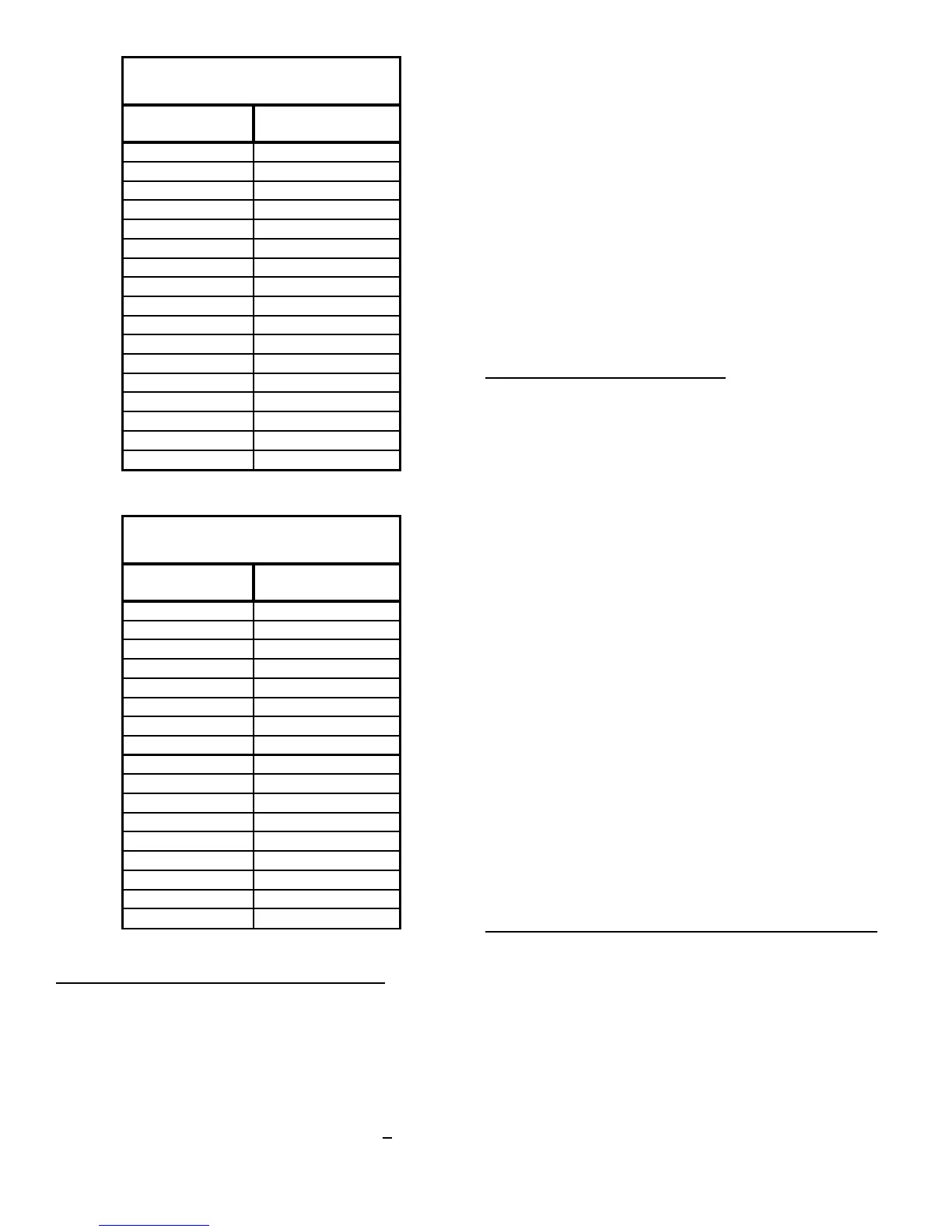
Suction
Pressure
Saturated Suction
Tem
erature °F
PSIG R-410A
50 1
52 3
54 4
56 6
58 7
60 8
62 10
64 11
66 13
68 14
70 15
72 16
71 17
76 19
78 20
80 21
SATURATED SUCTION PRESSURE
TEMPERATURE CHART
SUBCOOLING = SAT. LIQUID TEMP. - LIQUID LINE TEMP.
Liquid
Pressure
Saturated Liquid
Tem
erature °F
PSIG R-410A
200 70
210 73
220 76
225 78
235 80
245 83
255 85
265 88
275 90
285 92
295 95
305 97
325 101
355 108
375 112
405 118
SATURATED LIQUID PRESSURE
TEMPERATURE CHART
EXPANSION VALVE (TXV) SYSTEM
Single Speed Application (*PH1524/43 and GPC15)
1. Purge gauge lines. Connect service gauge manifold to
access fittings. Run system at least 10 minutes to allow
pressure to stabilize.
2. Temporarily install thermometer on liquid (small) line near
liquid line access fitting with adequate contact and insulate
for best possible reading.
3. Check subcooling and superheat. Systems with TXV
application should have a subcooling of 10 + 2°F and
superheat of 15 to 18ºF.
a. If subcooling and superheat are low, adjust TXV to 15
- 18ºF then check subcooling.
b. If subcooling is low and superheat is high, add charge
to raise subcooling to 10 ± 2ºF then check superheat.
c. If subcooling and superheat are high, adjust TXV valve
to 15 - 18ºF then check subcooling.
d. If subcooling is high and superheat is low, adjust TXV
valve to 15 to 18ºF superheat and remove charge to
lower the subcooling to 10 ± 2ºF.
The TXV should NOT be adjusted at light load conditions 55º
to 60ºF, under such conditions only the subcooling can be
evaluated. This is because suction pressure is dependent
on indoor air flow, and wet bulb temperature.
NOTE: Do NOT adjust charge based on suction pressure
unless there is a gross undercharge.
4. Disconnect manifold set. Installation is complete.
Two Speed Application (*PH1549/60)
Run the unit on low stage cooling for 10 minutes until
refrigerant pressures stabilize. Follow the guidelines and
methods below to check unit operation and ensure that the
refrigerant charge is within limits. Charge the unit on low
stage.
1. Purge gauge lines. Connect service gauge manifold to
access fittings. Run system at least 10 minutes to allow
pressure to stabilize.
2. Temporarily install thermometer on liquid (small) line near
liquid line access fitting with adequate contact and insulate
for best possible reading.
3. Check subcooling and superheat. Two stage systems
running on low stage with TXV application should have a
subcooling of 5 to 7 ºF and superheat of 15 to 18ºF.
a. If subcooling and superheat are low, adjust TXV to 15
to 18ºF superheat, then check subcooling.
NOTE: To adjust superheat, turn the valve stem
clockwise to increase and counter clockwise to
decrease.
b. If subcooling is low and superheat is high, add charge
to raise subcooling to 5 to 7 ºF then check superheat.
c. If subcooling and superheat are high, adjust TXV valve
to 15 to 18ºF superheat, then check subcooling.
d. If subcooling is high and superheat is low, adjust TXV
valve to 15 to 18ºF superheat and remove charge to
lower the subcooling to 5 to 7 ºF.
NOTE: Do NOT adjust the charge based on suction
pressure unless there is a gross undercharge.
4. Disconnect manifold set, installation is complete.
Refrigerant Charge Check (Units with Fixed Orifice Devices)
After completing airflow measurements and adjustments the
unit’s refrigerant charge must be checked. The unit comes
factory charged, but this charge is based on 325 CFM per ton
and minimum ESP per ARI test conditions (generally between
.15 -.25 ESP). When air quantity or ESP is different than above,
the refrigerant charge must be adjusted to the proper amount.
All package units with fixed orifice devices are charged using
the super heat method at the compressor suction line.
For charging in the warmer months, 8 ± 3ºF superheat at the
compressor is required at conditions 95ºF outdoor ambient
(dry bulb temperature), 80ºF dry bulb / 67ºF wet bulb indoor
ambient, approximately 50% humidity. This superheat varies
when conditions vary from the conditions described.



 To Next Page