
 Need help?
Do you have a question about the GRAUPNER HoTT GR-18 and is the answer not in the manual?
Specifies the receiver is for RC multicopter models only.
Lists operational temperature, range, dimensions, and power requirements.
Critical safety guidelines for product operation and handling.
Details on physically mounting the receiver within the copter.
Step-by-step instructions for pairing the receiver with a transmitter.
Guidance on connecting servos, ESCs, and power to the receiver.
Configuring the transmitter for flight modes and channel directions.
Selecting copter type (e.g., Quadro X) and operational mode (Normal).
Calibrating and assigning Roll, Nick, and Yaw axes for gyro operation.
Adjusting Proportional and Derivative gains for Roll/Nick in Attitude mode.
Adjusting Proportional, Integral, and Derivative gains for yaw control.
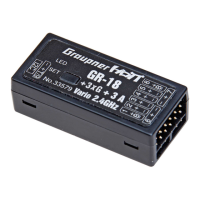
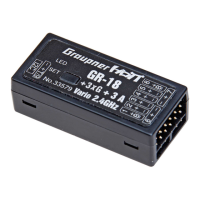
The Graupner HoTT GR-18 receiver with Copterfirmware (No. 33579) is a highly versatile radio-controlled (RC) receiver specifically designed for multicopter models. It provides essential stabilization and control functionalities, making it suitable for both beginners and experienced modellers.
The primary function of the GR-18 receiver is to receive control signals from a Graupner HoTT transmitter and translate them into commands for the multicopter's motors and servos. It incorporates a specific multicopter firmware, which means it's optimized for drone flight and does not support Surface/Heli model types directly (though firmware for those models can be used, only one firmware can be active at a time). A key feature is its 3-axis copter stabilization, which significantly enhances flight performance and stability, even for aerobatic maneuvers.
The receiver includes an altitude sensor, providing vario and altitude data, which can be crucial for flight monitoring and safety. It also supports telemetry, allowing for real-time transmission of various flight parameters back to the transmitter or a connected Smart-Box. This telemetry data includes receiver voltage, temperature, and, when an optional OSD module is connected, vario and Euler angle data.
The GR-18 operates on the 2.4 GHz FHSS modulation, ensuring a robust and reliable radio link. It features multiple servo sockets for connecting speed controllers and servos, with clear polarity markings to prevent incorrect connections. One socket (T/9) is multifunctional, allowing for either telemetry sensor connection or an additional control channel. Another socket (channel 8 or K6 in GR-18) can be programmed to deliver a digital sum signal (SUMD), which is useful for advanced flybarless systems and heavy-duty airborne power supplies.
Before use, the receiver requires binding to a Graupner HoTT transmitter. This process involves switching the receiver into bind mode by pressing the SET button and then initiating the binding from the transmitter's "Basic setting" menu. A successful bind is indicated by the green LED lighting up.
The receiver's settings are configured via the "Telemetry" menu on the transmitter or a Smart-Box. This includes crucial parameters like:
Gyro initialization is a critical step after powering on the copter. The receiver's gyros need to be calibrated by holding the copter still for at least 3 seconds until beeps from the motors confirm successful calibration. This ensures accurate horizontal alignment in attitude mode.
Transmitter pre-setting involves selecting a "surface model" type in the transmitter and configuring channel 1 for motor off at -100% power. Flight modes, such as Attitude mode (for stable flight with angle limits, recommended for beginners) and Rate mode (for aerobatic maneuvers without angle limits), are assigned to channel 5 via a two-way switch.
The "Main settings" menu allows selection of the multicopter type (e.g., Quadro X, Hexa I, Tri L) and mode. It also includes:
Axis assignment is performed in the "Axis assign" menu, where users briefly move transmitter sticks and tilt the copter to identify and assign roll, nick, and yaw axes. After assignment, it's crucial to verify the operating directions by removing propellers, applying a small amount of throttle, and tilting the copter to ensure motors respond correctly.
Roll and Nick settings, applicable to both Attitude and Rate modes, include:
For Attitude mode, ROLL/NICK I (Integral) is set to prevent slow swings or oscillations after commands. AGILITY determines the yaw rate. For Rate mode, R/N RATE I sets the integral component of rotation, and RATE sets the maximum potential rotation rate.
Multicopter Yaw settings include:
The GR-18 receiver is designed for durability, but proper care is essential. It should be protected from dust, dirt, moisture, and foreign parts, and not exposed to excessive vibration, heat, or cold. Operation is specified for ambient temperatures between -10°C and +55°C.
Regular checks for damage to the housing and cables after each flight are recommended. Damaged or wet electronic components, even if re-dried, should not be used.
Firmware updates are a key maintenance feature, allowing users to keep their receiver up-to-date with the latest software versions. Updates are performed via a PC running Windows XP, Vista, or 7, using a USB interface (order no. 7168.6) and an adapter lead (order no. 7168.6A or 7168.S). The necessary programs and firmware files are available on the Graupner website. The update process involves connecting the adapter lead to the USB interface and the receiver's telemetry socket, then using the "Slowflyer/Gyro receiver downloader" program to load the firmware file. The progress bar indicates the transfer, and successful completion is shown by the receiver's LEDs.
For power supply, it's recommended to connect the battery to sockets close to the servos. If multiple batteries are used, they must have the same nominal voltage and capacity to avoid short-circuit-like effects. A voltage stabilizer unit (e.g., PRX-5A, Order No. 4136) is recommended in such cases.
The product is covered by a 24-month warranty from the date of purchase, covering material or operational defects present at the time of purchase. Damage due to wear, overloading, incompetent handling, or the use of incorrect accessories is not covered. Users are advised to check the product carefully for defects before making a claim.
Environmental protection is also considered, with instructions for proper disposal of the product and batteries at designated recycling collection points, emphasizing the importance of recycling electronic apparatus and removing batteries separately.
 General
| Frequency | 2.4 GHz |
|---|---|
| Telemetry | Yes |
| Compatibility | Graupner HoTT transmitters |
| Modulation | HoTT (Graupner) |
| Antenna | Diversity Antenna |



 To Next Page