Before you start to fell a tree, make sure that
• The minimum distance between the areas of bucking and
felling is two times the height of the tree.
• The operation does not
• Cause injury to personnel.
• Hit utility lines. If the tree touches utility lines,
immediately tell the utility company.
• Cause losses in property.
• The user is not in the danger area (24), for example, the
downhill side of the area.
• The escape paths (25) that extend back and diagonally
behind the felling direction (23) are clear. The felling
direction is controlled by
• The natural lean of the tree.
• The location of larger branches.
• The wind direction.
• Ensure there is no dirt, stones, loose bark, nails, and
staples on the tree.
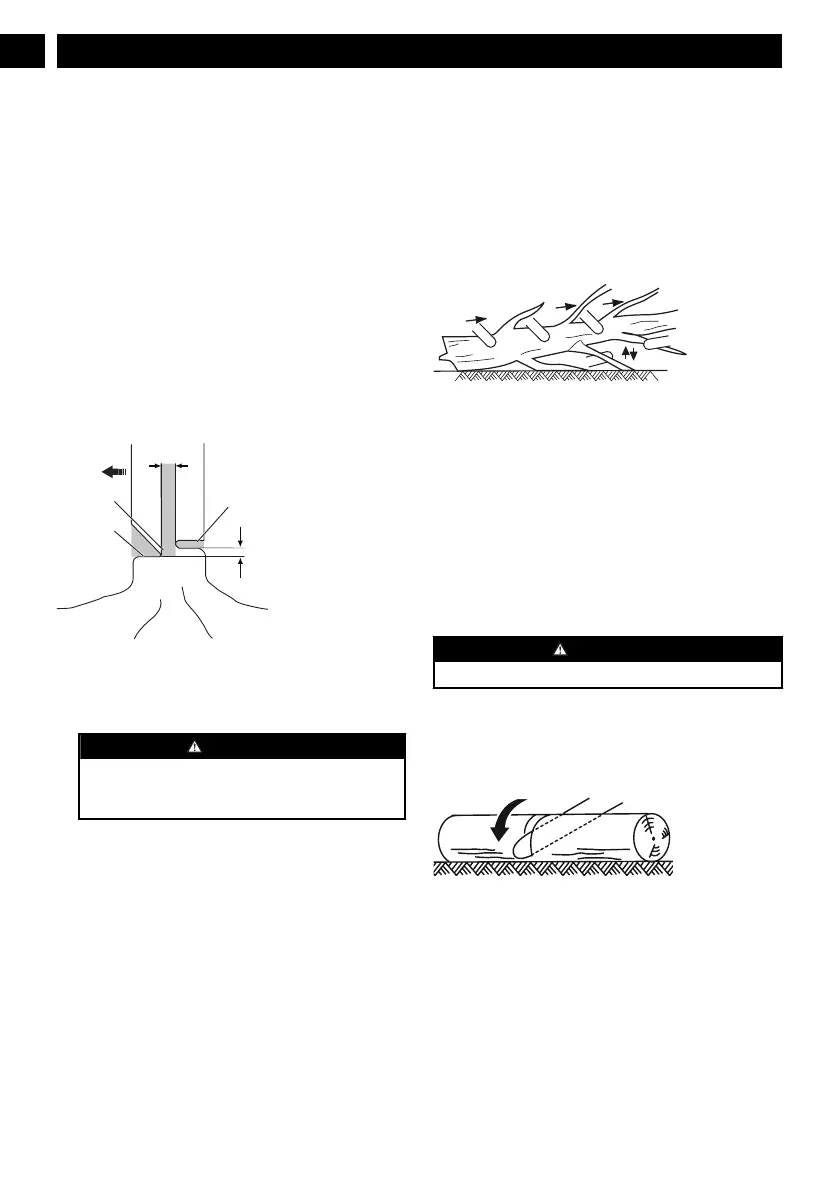
27
28
29
2’’(50mm)
26
2’’(50mm)
1. Make a lower level notching cut (27). Make sure that
this cut is
a) 1/3 wide of the diameter of the tree.
b) Perpendicular to the felling direction.
CAUTION
The level notching cut helps prevent pinching of the
saw chain or the guide bar when you make the second
notch.
2. Make the felling cut no less than 2 in. (50 mm) and
higher than the level notching cut. Make sure that this
cut
a) Is parallel to the level notching cut.
b) Keeps sufficient wood to become a hinge (29) which
prevents the tree from twisting and felling in the
wrong direction.
When the felling cut (28) gets near the hinge (29), the tree
falls. Stop the felling cut if the tree
• Does not fall in the correct direction or
• Moves backwards, causing the cutting bar and chain
to become stuck in the cut.
3. Use felling wedge to open the cut and let the tree fall
in the correct direction.
4.
When the tree starts to fall,
a) Remove the chainsaw from the cut.
b) Stop the machine.
c) Put the machine down.
d) Move away from the tree via the escape path (25).
Always keep watching the tree to see it's direction of
fall, be careful with overhead branches and your
footing.
10.6 LIMB A TREE
Limbing is the removal of the branches from a fallen tree.
1. Keep the larger lower branches to hold the log off the
ground (31).
2. Remove the small limbs (30) in one cut.
3. Limb the branches with tension from the bottom to top.
4. Keep the larger lower branches as a support until the log
is limbed.
10.7 BUCK A LOG
To buck is to cut a log into lengths.
CAUTION
Do not let the chain saw touch the ground.
It is important to make sure your footing is secure and your
weight is evenly distributed. If possible, lift the log and hold
it with branches, logs or chock. Obey the instructions below:
When the log is held along the full length (32), cut it from the
top (33).
10
English
EN




 To Next Page