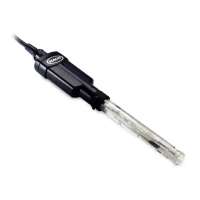
The Hach PHC201 series pH probes are digital, combination electrodes designed for measuring the pH of various clean water samples. These probes feature a non-refillable, semi-liquid gel-filled electrolyte and an integrated temperature sensor. They are not recommended for use with organic solvents, wastewater, samples with high solid content, ultrapure samples of low ionic strength, or very alkaline samples, as these conditions may compromise accuracy.
Technical Specifications
Probe Type: Digital combination pH probe with non-refillable, semi-liquid gel electrolyte and built-in temperature sensor.
pH Range: 0 to 14 pH.
pH Accuracy: ±0.02 pH.
Reference Type: Ag/AgCl.
Reference Junction: Ceramic porous pin.
Slope: -59 mV/pH (85 to 115% at 25 °C (77 °F) per Nernstian theoretical value).
Isopotential Point: 0 (±30) mV at 7.0 (±0.5) pH.
Sodium (Alkalinity) Error: <20% at pH 14 in 1 M NaCl.
Temperature Accuracy: ±0.3 °C (±0.54 °F).
Temperature Sensor Type: 30 kΩ NTC thermistor.
Operating Temperature: 0 to 80 °C (32 to 176 °F).
Storage Temperature: 5 to 40 °C (41 to 104 °F).
Minimum Immersion Depth: 15 mm (0.59 in.).
Body Material (Standard): Epoxy.
Electrolyte: Non-refillable gel reference element, semi-liquid gel.
Storage Solution: Hach pH electrode storage solution or 3 M KCl (use of other storage solutions can cause permanent damage).
Cable Connection: M12 digital output and connector.
Dimensions:
- Diameter: 12 mm (0.47 in.).
- Length: 175 mm (6.9 in.) total; 103 mm (4.1 in.) below head.
- Cable length: PHC20101: 1 m (3.3 ft); PHC20103: 3 m (9.8 ft).
Weight (Includes Cable): PHCxxx01: ~0.4 kg (0.9 lb); PHCxxx03: ~0.45 kg (1 lb).
Warranty: 6 months on the probe, covering manufacturing defects but not improper use or wear.
Certifications: CE, FCC/ISED.
Usage Features
Preparation for Use:
New probes are supplied with a soaker bottle containing storage solution to keep the glass bulb and reference junction hydrated. Before first use:
- Loosen the cap and remove the soaker bottle from the probe.
- Rinse the reference junction and glass bulb with deionized water and blot dry with a lint-free cloth.
- For faster stabilization, soak the probe in the sample for 3 or more minutes before use.
- Ensure the meter has correct date and time settings, as the probe's service-life time stamp is derived from these.
- Connect the probe to the meter.
Calibration:
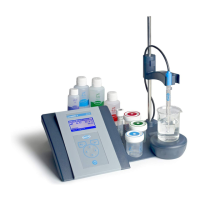
The PHC201 probes are compatible with Intellical pH meters. Calibration data is stored within the probe itself, meaning a new calibration is not required if the probe is moved to a different meter with the same calibration options.
- Buffer Solutions: Use two or three pH buffer solutions for best results, ideally 2 or more pH units apart. Two buffers are sufficient if the expected sample pH falls between their values. For one-point calibration, use a buffer near the expected sample pH. Always use fresh buffer solutions and discard them after each calibration.
- Procedure:
- Access the calibrate menu on the meter.
- Prepare or pour pH buffer solutions into separate beakers.
- Rinse the probe with deionized water and dry with a lint-free cloth.
- Immerse the probe in the first pH buffer solution, ensuring the sensor and reference junction are fully submerged without touching the bottom or sides of the beaker.
- Shake the probe gently from side to side to refresh the reference junction and remove air bubbles.
- Stir slowly until the pH reading stabilizes, then read the temperature-corrected pH value.
- Repeat for additional buffers or select "Done."
- Save the calibration.
- Notes: Air bubbles below the sensor can cause slow response or errors. The meter uses mV and temperature readings to calculate a calibration slope, which is then adjusted for sample temperature during measurements.
Sample Measurement:
- Collect the sample.
- Rinse the probe with deionized water and dry with a lint-free cloth between measurements to prevent contamination.
- Immerse the probe in the sample, ensuring the sensor and reference junction are fully submerged without touching the bottom or sides of the beaker.
- Shake the probe gently from side to side to refresh the reference junction and remove air bubbles.
- Stir gently until the pH reading stabilizes, then read the temperature-compensated pH value.
- Notes: The meter automatically saves data when manually read or at regular intervals. Manual saving is required for continuous readings. Entering sample and operator IDs may be necessary for complete traceability.
Calibration Verification:
To ensure accuracy, verify calibration by measuring a fresh pH buffer solution. The meter compares the measured value to the selected buffer value and accepts or rejects the measurement.
- Procedure:
- Access the verification menu on the meter (e.g., "Run check standard" on HQd meters).
- Prepare or pour the pH buffer solution into a beaker.
- Rinse the probe with deionized water and dry with a lint-free cloth.
- Immerse the probe in the pH buffer solution, ensuring full submersion of the sensor and reference junction.
- Shake the probe gently to refresh the reference junction and remove air bubbles.
- Stir gently and read the pH value; the meter will indicate acceptance or rejection.
Maintenance Features
Cleaning the Probe:
Regular cleaning is essential for optimal accuracy, stabilization time, and probe lifespan. Contamination can lead to incorrect readings, slow stabilization, and calibration errors.
- Rinse the probe with warm (35–45 °C / 95–113 °F) deionized water to remove dried storage solution. Dry the probe body with a lint-free cloth.
- Soak the glass bulb and reference junction in the appropriate cleaning solution for the specified time (refer to the cleaning solution table in the manual).
- General Contamination: Electrode cleaning solution for regular maintenance (KATHON™ CG, DECONEX®11) for 12–16 hours.
- Minerals/Inorganic Contamination: Electrode cleaning solution for minerals/inorganic contamination (Phosphoric acid ~10%) for 10–15 minutes.
- Fats, Grease, and Oils: Electrode cleaning solution for fats, oils, and grease contamination (KATHON™ CG, TRITON® X) for 2 hours maximum.
- Proteins/Organic Contamination: Electrode cleaning solution for proteins/organic contamination (Pepsin in HCl) for 3 hours maximum.
- Wastewater and Organic Compounds: Electrode cleaning solution, extra strong (Sodium hypochlorite) for 5–10 minutes.
- Blockage of Porous Pin/Diaphragm Reference Junctions: Electrode cleaning solution for porous pin/diaphragm reference junctions (Thiourea) for 3 hours with stirring or until the porous plug becomes white.
- Rinse or soak the probe in deionized water for 1 minute. Dry the probe body with a lint-free cloth.
- Soak the probe in pH 4 buffer for 20 minutes.
- Rinse the probe with deionized water and dry the probe body with a lint-free cloth.
Soak Procedure for Dry Probes:
If the glass bulb becomes dry, hydrate the probe as follows:
- Soak the probe tip in pH 4 and pH 7 buffer solutions for 5 minutes in each solution.
- Rinse the probe with deionized water and blot dry with a lint-free cloth.
- Calibrate the probe.
Storage:
Always store the probe in the recommended storage solution (Hach pH electrode storage solution or 3 M KCl) when not in use.
- Crucial Note: Probes can be permanently damaged if stored in deionized water or samples of low ionic strength.
- For short-term storage (maximum 2 hours), the probe can remain in the sample if the sample pH is not high.
- When not in use, place the soaker bottle containing storage solution onto the probe. Keep the probe in a vertical position with the sensor and reference junction below the liquid level in the soaker bottle. Add storage solution if necessary.
Troubleshooting
- Decreased probe performance (slow stabilization, inaccurate calibrations/measurements):
- Possible Cause: Dirty glass sensor.
- Solution: Clean and condition the probe (refer to "Clean the probe" section).
- Possible Cause: Dry glass sensor.
- Solution: Clean and condition the probe (refer to "Maintenance" section).
- Possible Cause: Changed calibration slope.
- Solution: Increase accepted slope limit settings if possible, or contact technical support.
- Sample properties cause slow stabilization or inaccurate measurements:
- Possible Cause: Sample absorbs CO2 from air, causing pH to slowly decrease in low ionic strength (LIS) or high purity samples.
- Solution: Use an LIS chamber for LIS/high purity samples to prevent CO2 absorption.
- Possible Cause: Low sample temperature or large temperature difference between samples.
- Solution: Increase sample temperature or adjust temperatures of different samples to be within 2 °C (3.6 °F).
- Procedure problem causes slow stabilization and prevents accurate calibrations/measurements:
- Possible Cause: Probe not conditioned to the sample.
- Solution: Soak the probe in the sample before measurements (refer to "Preparation for use" section).
- Possible Cause: Air bubbles around or below the probe tip.
- Solution: Carefully tap or shake the probe to remove air bubbles.
- Possible Cause: Insufficient electrical connection through the reference junction.
- Solution: Shake the probe in the solution from side to side to refresh the reference junction.
- Possible Cause: Stir speed too slow or too fast.
- Solution: Try a different stir speed.
- Possible Cause: Incorrect or contaminated buffer solution.
- Solution: Use specified, good quality buffer solutions.
Consumables and Accessories
A range of consumables and accessories are available for the PHC201 probe, including:
- Storage Solutions: Hach pH electrode storage solution (500 mL, Item no. 2756549) and 3 M KCl solution (50 mL, Item no. 2756559).
- Cleaning Solutions:
- For regular maintenance (500 mL, Item no. 2965249).
- For minerals/inorganic contamination (500 mL, Item no. 2975149).
- For proteins/organic contamination (250 mL, Item no. C20C370).
- For fats, oils, and grease contamination (500 mL, Item no. 2964449).
- For porous pin/diaphragm reference junctions (250 mL, Item no. C20C380).
- pH Buffer Solutions (Singlet one-use packets, 20 mL each):
- pH 4.01 (20/pkg, Item no. 2770020).
- pH 7.00 (20/pkg, Item no. 2770120).
- pH 10.01 (20/pkg, Item no. 2770220).
- Kits for pH 4.01 & 7.00 (2x10/pkg, Item no. 2769920) and pH 7.00 & 10.01 (2x10/pkg, Item no. 2769820).
- pH Color-Coded Buffer Solution Kit (NIST, 500 mL, Item no. 2947600): Includes pH 4.01, 7.00, and 10.01 buffers.
- pH Buffer Powder Pillows (NIST, 50/pkg): pH 4.01 (Item no. 2226966), pH 7.00 (Item no. 2227066), pH 10.01 (Item no. 2227166).
- Radiometer Analytical (IUPAC Series certified pH standards, 500 mL): Various pH values from 1.679 to 12.45.
- Technical pH Buffers (500 mL): pH 1.09, 4.65, 9.23.
- General Accessories:
- Beakers (30 mL plastic, various colors, 80/pkg, Item nos. SM5010-SM5014).
- Beaker dispenser and holder (30 mL, Item no. 923-656).
- Beaker holder (30 mL, Item no. 923-556).
- Beaker (100 mL, polypropylene, Item no. 108042).
- Disposable wipes (11 x 22 cm, 280/pkg, Item no. 2097000).
- Wash bottle (polyethylene, 500 mL, Item no. 62011).
- Probe stand for standard Intellical probes (Item no. 8508850).
- Soaker bottle for probe storage (Item no. 5192900).

 Need help?
 General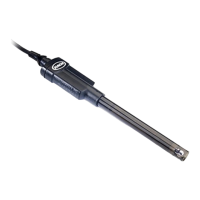

 To Next Page