Section 8 Maintenance
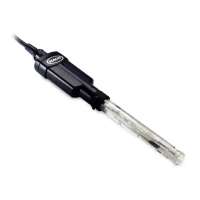
Regular maintenance is necessary for the best accuracy, stabilization time and life of the probe.
Keep the probe in the recommended storage solution between measurements.
8.1 Clean the probe
Clean the probe regularly to remove contamination and to keep the reference junction open.
Symptoms of contamination:
• Incorrect or irregular readings
• Slow stabilization times
• Calibration errors
• Sample material stays on the probe
1. Rinse the probe with deionized water. Use warm (35–45 °C (95–113 °F)) deionized water to
remove storage solution that dries on the probe. Dry the probe body with a lint-free cloth.
2. Soak the glass bulb and reference junction in the applicable cleaning solution for the specified
time. Refer to Table 1 and Consumables on page 11.
3. Rinse or soak the probe for 1 minute in deionized water. Dry the probe body with a lint-free cloth.
4. Soak the probe in pH 4 buffer for 20 minutes.
5. Rinse the probe with deionized water. Dry the probe body with a lint-free cloth.
Table 1 Cleaning solution
Contamination Cleaning solution Active component Soak time
General
contamination
Electrode cleaning solution
for regular maintenance
KATHON
™
CG,
DECONEX
®
11
12–16 hours
Minerals Electrode cleaning solution
for minerals/inorganic
contamination
Phosphoric acid
(~10%)
10–15 minutes
Fats, grease and oils Electrode cleaning solution
for fats, oils and grease
contamination
KATHON
™
CG,
TRITON
®
X
2 hours maximum
Proteins Electrode cleaning solution
for proteins/organic
contamination
Pepsin in HCl 3 hours maximum
Wastewater and
organic compounds
Electrode cleaning solution,
extra strong
Sodium hypochlorite 5–10 minutes
Blockage of porous
pin/diaphragm
reference junctions
Electrode cleaning solution
for porous pin/diaphragm
reference junctions
Thiourea 3 hours with stirring
or until the porous
plug becomes white
8.2 Soak procedure for dry probes
If the glass bulb becomes dry, complete the steps that follow to hydrate the probe.
1. Soak the probe tip in pH 4 and pH 7 buffer solutions for 5 minutes in each solution.
2. Rinse the probe with deionized water. Blot dry with a lint-free cloth.
3. Calibrate the probe.
English
9


 To Next Page