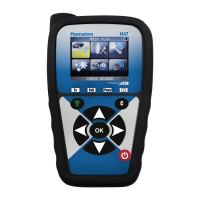
UM-365HaD-U H46 TPMS TOOL User Guide
User Guide Hamaton H46 Page 36/38
The Lithium-Polymer battery elements must be
neutralized to be made unusable. The
neutralization process must be performed under
strict safety conditions. It is recommended that
you return the tool to us. We will extract the
battery and give it to a specialized recycler.
Do not dispose of Lithium-Polymer batteries
with your general waste.
The Lithium-Polymer battery is not suitable for
children under 14 years. Keep all Lithium-Polymer
batteries out of the reach of children
To prevent leakage or other hazards, do not store
batteries above 60°C (140°F). Never leave the
battery inside a car (for example) where the
temperature could be very high or in a place
where temperatures could exceed 60°C (140°F).
Store the battery in a dry place to avoid contact
with liquid, whatever the type. Only store the
battery on a non-flammable, heat resistant, non-
conductive surface and away from all flammable
materials or sources. Always store the battery out
of the reach of children.
A Lithium-Polymer battery should be stored with
a minimum charge of 30%. If you store it
completely discharged, it will quickly become
unusable.
Failure to follow these safety precautions may
cause serious personal injury and damage to
property. You may even cause a fire!
The Hamaton Company disclaims any
responsibility for damage sustained in the event
of non compliance with these safety instructions.
Using a Lithium-Polymer battery has a high risk of
fire and can cause serious damage to property
and persons. The user agrees to accept the risk
and responsibility.
The Hamaton Company is not able to monitor the
proper use of the battery with each customer
(charge, discharge, storage etc.). It cannot be
held responsible for any damage to persons or
property.
6. FCC STATEMENTS
Federal Communication Commission
Interference Statement
This equipment has been tested and found to
comply with the limits for a Class B digital device,
pursuant to Part 15 of the FCC Rules. These limits
are designed to provide reasonable protection
against harmful interference in a residential
installation. This equipment generates, uses and
can radiate radio frequency energy and, if not
installed and used in accordance with the
instructions, may cause harmful interference to
radio communications. However, there is no
guarantee that interference will not occur in a
particular installation. If this equipment does
cause harmful interference to radio or television
reception, which can be determined by turning
the equipment off and on, the user is encouraged
to try to correct the interference by one of the
following measures:
- Reorient or relocate the receiving antenna.
- Increase the separation between the equipment
and receiver.
- Connect the equipment into an outlet on a
circuit different from that to which the receiver is
connected.
- Consult the dealer or an experienced radio/TV
technician for help.
FCC Caution: Any changes or modifications not
expressly approved by the party responsible for
compliance could void the user's authority to
operate this equipment.
This device complies with Part 15 of the FCC
Rules. Operation is subject to the following two
conditions: (1) This device may not cause harmful
interference, and (2) this device must accept any
interference received, including interference that
may cause undesired operation.


 To Next Page