
 Need help?
Do you have a question about the Hanna Instruments HI 93703 and is the answer not in the manual?
Step-by-step guide on how to perform turbidity measurements with the instrument.
Detailed steps for performing calibration using standard solutions.
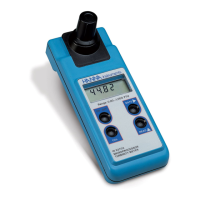
The HI 93703 is a portable, microprocessor-based turbidity meter designed for high-precision measurements in both field and laboratory settings. It is specifically engineered to determine the turbidity of water and wastewater, adhering to the ISO 7027 International Standard. The device measures turbidity in Formazine Turbidity Units (FTU), which are equivalent to Nephelometric Turbidity Units (NTU). The meter features an auto-ranging capability, covering a broad range from 0 to 1000 FTU across two scales: 0.00 to 50.00 FTU and 50 to 1000 FTU, automatically selecting the appropriate range for each measurement.
The HI 93703 operates by passing a beam of infrared light through a sample contained in a vial. The light source is a High Emission Infrared LED with a wavelength peaking at 890 nm. This specific wavelength is chosen to minimize interference from colored samples, a common issue with instruments operating in the visible light range. A sensor, positioned at a 90-degree angle to the light's direction, detects the amount of light scattered by undissolved particles within the sample. The internal microprocessor then converts these readings into FTU values.
The device's housing is rugged and lightweight, making it suitable for portable use. It features an easy-to-read Liquid Crystal Display (LCD) for clear presentation of measurements and operational messages. All functions are controlled via a simple four-key interface, ensuring ease of use. For troubleshooting, the meter displays error codes that guide the user.
A key feature of the HI 93703 is its exclusive positive-locking system, which ensures that the cuvette is securely and correctly placed in the measurement cell, contributing to measurement accuracy. The keypad is water-resistant, allowing for easy cleaning with a moist cloth.
To begin using the HI 93703, users must first install the batteries and then power on the instrument using the ON/OFF key. The meter performs a self-test upon startup, displaying a full set of figures before transitioning to measurement mode, indicated by "----" on the LCD.
For measurement, a clean cuvette should be filled with the thoroughly agitated sample, leaving approximately one-quarter inch (0.5 cm) from the rim. It is crucial to allow sufficient time for any air bubbles to escape before securing the cap. Before inserting the cuvette into the measurement cell, it must be thoroughly wiped with a lint-free tissue (HI 93703-70) to ensure it is free of fingerprints, oil, or dirt, especially in the area where light passes through (the bottom 2 cm/1 inch of the cuvette). The cuvette is then placed into the cell, ensuring the notch on the cap aligns securely with the groove and the mark on the cap points towards the LCD.
Measurements are initiated by pressing the READ/▲ key. The LCD will display a blinking "SIP" (Sampling in Process) message, indicating that the measurement is underway. The turbidity value will appear after approximately 25 seconds.
For samples exceeding 40 FTU, Standard Methods recommend dilution for accurate measurements. The manual provides a calculation method to determine the correct amount of HI 93703-0 (turbidity-free water) to add to the sample to achieve a final volume of 100 mL. After dilution, a sample of this solution is measured, and a formula is provided to calculate the correct turbidity value of the original sample.
The HI 93703 also features a one-point calibration at 10 FTU, which can be easily performed using the provided standard. This calibration point is chosen for its relevance to water turbidity measurements across various applications, from drinking water to wastewater treatment. The meter can store and retrieve the last calibration date, enhancing user convenience.
To ensure accurate measurements and prolong the instrument's life, several maintenance practices are recommended. Each time a cuvette is used, the cap should be tightened to the same degree. Samples should be discarded promptly after reading to prevent permanent clouding of the glass. All glassware used for standards and samples must be kept clean, washed with HI 93703-50 cleaning solution, and rinsed with HI 93703-0 or turbidity-free water.
Samples should be collected in clean glass or plastic bottles, stoppered, and analyzed quickly. If storage is unavoidable, samples should be kept in a cool, dark place for no longer than 24 hours, and brought to room temperature before analysis. Before taking samples, they should be gently but thoroughly mixed to ensure representativeness, avoiding shaking to prevent air bubbles and allowing no settling.
Monthly calibration with the supplied HI 93703-10 @10 FTU standard is recommended for optimal accuracy, or more frequently if needed. As mentioned earlier, cuvettes must be wiped with a lint-free tissue (HI 93703-70) before insertion, and handled carefully to avoid fingerprints on the light path area.
The HI 93703 utilizes AMCO-AEPA-1 as its primary standard, which offers superior stability and a longer shelf life (approximately six months if uncontaminated) compared to formazine. AMCO-AEPA-1 standards are reusable and do not require special handling or disposal.
The instrument is equipped with an automatic shut-off feature that activates after 4 minutes of non-use to conserve battery life. It operates on four 1.5V AA alkaline batteries, providing approximately 60 hours of use or 900 measurements. The meter continuously monitors battery power to ensure accurate readings. A "LO BAT" indicator appears on the lower right corner of the display when batteries are weak, allowing for approximately 50 more measurements. A "-BA-" message indicates critically low battery power, after which the meter automatically switches off, requiring immediate battery replacement. Battery replacement should only occur in a safe area, using the specified battery types. To replace batteries, the unit is turned off, two screws on the back are unscrewed, the cover is removed, and new batteries are inserted with correct polarity before re-securing the cover and screws.
 General
| Model | HI 93703 |
|---|---|
| Category | Measuring Instruments |
| Type | Photometer |
| Measurement Range (as Iron) | 0.00 to 5.00 mg/L |
| Resolution | 0.01 mg/L |
| Light Detector | Silicon Photocell |
| Environment | 0 to 50°C (32 to 122°F); RH max 95% non-condensing |
| Display | LCD |
| Resolution (as CaCO3) | 1 mg/L |
| Accuracy (as CaCO3) | ±5 mg/L ±5% of reading (as CaCO3) |
| Light Source | LED |


 To Next Page