13
English
GB
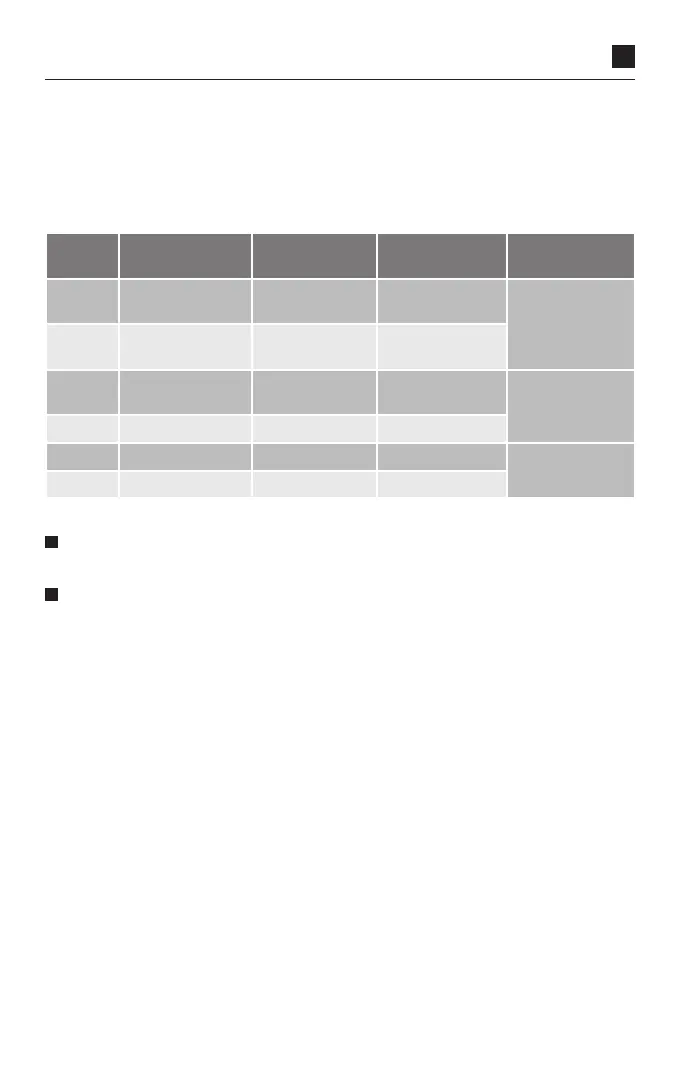
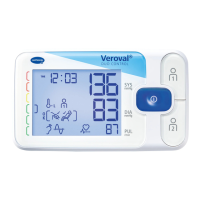
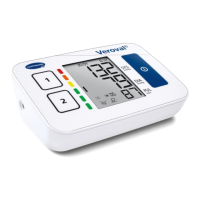
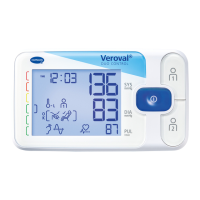
So that you can more easily assess your results, a trac-light system is available
on the left side of the Veroval
®
upper arm blood pressure monitor that directly
indicates the result, making it easier to categorise the measured value. The World
Health Organization (WHO) and the International Blood Pressure Society (ISH) have
developed the following summary for the classification of blood pressure values:
Results
indicator
Evaluation Systolic pressure Diastolic pressure Recommendation
red Grade 3 hyperten-
sion
above 179 mmHg above 109 mmHg Consult a doctor
orange Grade 2 hyperten-
sion
160–179 mmHg 100–109 mmHg
yellow Grade 1 hyperten-
sion
140–159 mmHg 90–99 mmHg Regular examina-
tions by a doctor
green Normal limit values 130–139 mmHg 85–89 mmHg
green Normal 120–129 mmHg 80–84 mmHg Self-assessment
green Optimal up to 119 mmHg up to 79 mmHg
Source: WHO, 1999 (World Health Organization)
Established hypertension (high blood pressure) is defined as having a systolic
value of at least 140 mmHg and/or a diastolic value of at least 90 mmHg.
In general, low blood pressure (hypotension) is defined as a systolic value
below 105 mmHg and a diastolic value of 60mmHg. However, the threshold
between normal and low blood pressure (hypotension) is not as accurately
specified as the threshold for hypertension. Hypotension may be associated
with symptoms such as dizziness, fatigue, tendency to faint, visual disturbanc-
es or high pulse rate. In order to ensure that hypotension or the corresponding
symptoms are not attendant symptoms of serious illness, a doctor should be
consulted in case of doubt.



 To Next Page