EasyManua.ls Logo

Heathkit AR-14 - Page 59

Heathkit AR-14
90 pages
Print Icon
To Next Page IconTo Next Page
To Previous Page IconTo Previous Page
Loading...
Page
52
Speaker Placement
Generally,
for
stereo
listening,
the
two
speakers
should
be
spaced
four
to
eight
feet
apart.
They
should
be
placed
along
a
wall
either
facing
straight
ahead
or
"firing
in"
slightly
toward
each
other's
axis.
The
optimum
positions
can
best
be
determined
by
experiment.
A
great
deal
depends
upon
the
size
and
acoustics
of
the
room
and
upon
the
high
frequency
dispersion
characteristics
of
the
speakers.
Identical
speakers
or
speaker
systems
are
recommended.
Correct
speaker
spacing
also
depends
to
some
extent
upon
the
listener's
position
and
distance
from
the
speakers.
In
other
words,
if
the
listen-
ing
position
is
restricted
to
one
that
is
rela-
tively
close
to
the
speakers,
some
improvement
could
probably
be
obtained
by
moving
the
speak-
ers
closer
together.
Remember
that
stereophonic
reproduction
is
striving
to
recreate,
as
accurately
in
position
as
possible,
not
only
the
sounds
that
originate
at
the
"right"
or
"left",
but
also
those
near
the
center.
Best
results
will
be
obtained
if you
experiment
with
speaker
and
listening
positions;
this
will
help
you
arrive
at
the
best
set
of
con-
ditions
for
your
installation.
Stereo Headphone Jack
A
set
of
stereo
headphones
can
be
plugged
directly
into
this
jack.
The
external
speakers
are
disconnected
when the..
switch
on
the
BASS
control
is
pulled
out.
Program
material
can
be
tape
recorded
by
plugging
the
high
level
input
of
the
tape
recorder
into
this
jack.
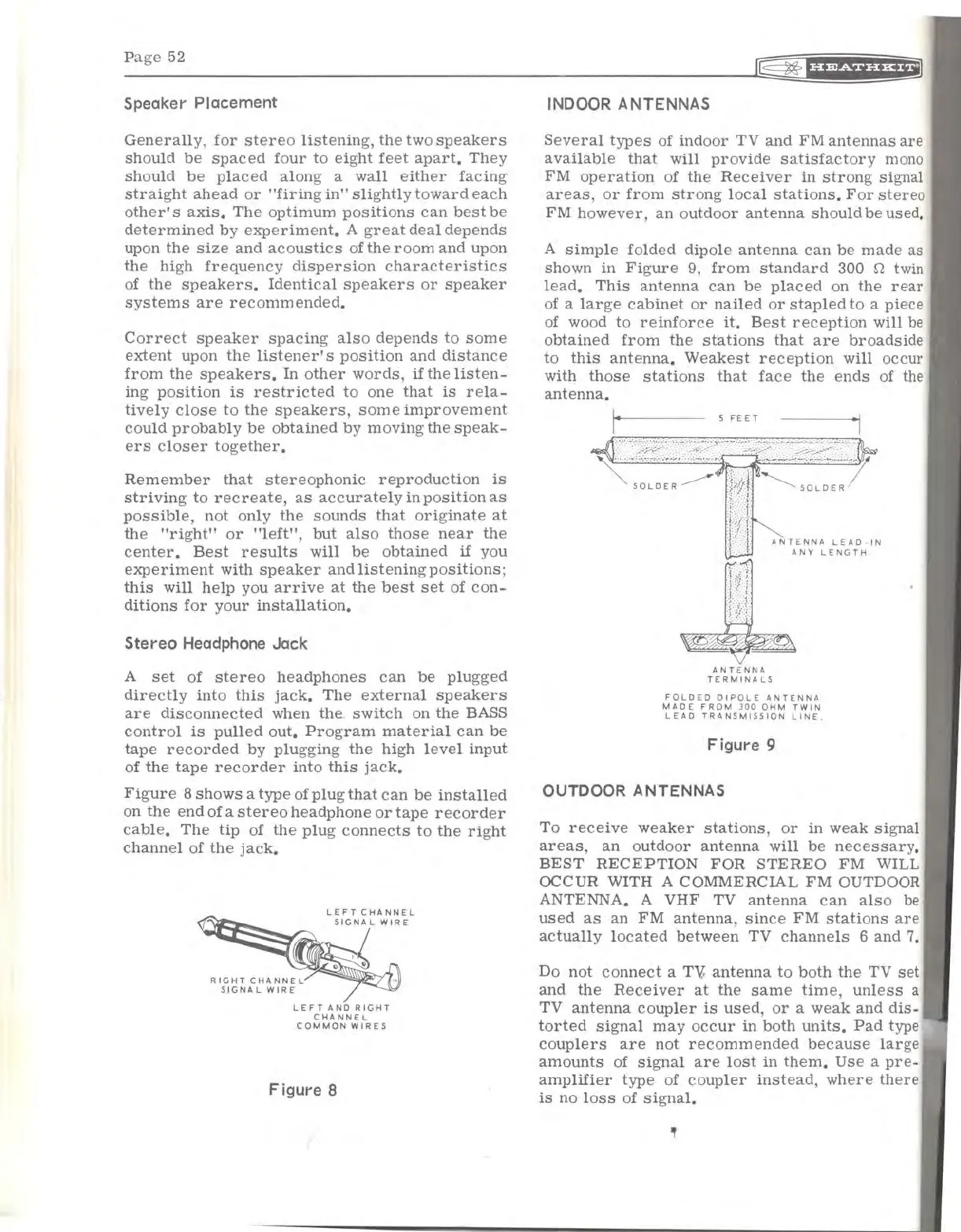
Figure
8
shows
a
type
of
plug
that
can
be
installed
on
the
end
of a
stereo
headphone
or
tape
recorder
cable.
The
tip
of
the
plug
connects
to
the
right
channel
of
the
jack.
LEFT
AND
RIGHT
CHANNEL
COMMON
WIRES
Figure
8
I
INDOOR ANTENNAS
Several
types
of
indoor
TV
and
FM
antennas
are
available
that
will
provide
satisfactory
mono
FM
operation
of
the
Receiver
in
strong
signal
areas,
or
from
strong
local
stations.
For
stereo
FM
however,
an
outdoor
antenna
should
be
used,
A
simple
folded
dipole
antenna
can
be
made
as
shown
in
Figure
9,
from
standard
300 n twin
lead.
This
antenna
can
be
placed
on
the
rear
of a
large
cabinet
or
nailed
or
stapled
to
a piece
of wood
to
reinforce
it.
Best
reception
will
be
obtained
from
the
stations
that
are
broadside
to
this
antenna.
Weakest
reception
will occur
with
those
stations
that
face
the
ends
of the
antenna.
5
FEET
ANTENNA
ANTENNA
LEAD
-
IN
ANY
LENGTH
TERMINALS
FOLDED
DIPOLE
ANTENNA
MADE
FROM
300
OHM
TWIN
LEAD
TRANSMISSION
LINE
.
Figure
9
OUTDOOR ANTENNAS
To
receive
weaker
stations,
or
in
weak
signal
areas,
an
outdoor
antenna
will
be
necessary,
BEST
RECEPTION
FOR
STEREO
FM
WILL
OCCUR WITH A COMMERCIAL
FM
OUTDOOR
ANTENNA. A VHF TV
antenna
can
also
be
used
as
an
FM
antenna,
since
FM
stations
are
actually
located
between
TV
channels
6
and
7.
Do
not
connect
a T"J
antenna
to
both
the
TV
set
and
the
Receiver
at
the
same
time,
unless
a
TV
antenna
coupler
is
used,
or
a
weak
and
dis-
torted
signal
may
occur
in
both
units.
Pad
type
couplers
are
not
recommended
because
large
amounts
of
signal
are
lost
in
them.
Use
a
pre-
amplifier
type
of
coupler
instead,
where
there
is
no
loss
of
signal.

Related product manuals