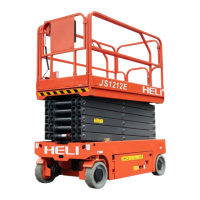
JS07N·JS07·JS08·JS12·JS14
43
Maintenance
13. Check each battery pack and verify that
the batteries are wired correctly.
14. Inspect the battery charger plug and pig-
tail for damage or excessive insulation
wear. Replace as required.
15. Connect the battery charger to the 110-
240V 50/60HZ AC power.
⊙Result: The charger should operate and
begin charging the batteries.
¤ Result: the charger alarm sounds and the
LEDs blink one time, correct the charger con-
nections at the fuse and battery. Ensure that
the charger operates correctly and begin
charging the batteries.
Note: For best results, use an extension cord
of adequate size with a length no longer than
50 feet/ 15 m.
Note: If you have any further questions regard-
ing the battery charger operation, please con-
tact the Scissor Service Department.
B-2
Inspect the Electrical Wiring
This procedure should be performed every 250
hours or quarterly, whichever comes first.
Maintaining electrical wiring in good condition
is essential to safe operation and good ma-
chine performance. Failure to find and replace
burnt, chafed, corroded or pinched wires could
result in unsafe operating conditions and may
cause component damage.
Electrocution/explosion hazard.
Contact with electrically charged circuits could
result in death or serious injury. Remove all
rings, watches and other jewelry.
1. Inspect the underside of the chassis for
damaged or missing ground strap(s).
2. Inspect the following areas for burnt,
chafed, corroded and loose wires:
• Inside ground control panel wires
• Hydraulic power unit module tray wires
• Battery tray(s) wires
• Platform control wires
3. Turn the key switch to ground control and
pull out the red Emergency Stop button
to the on position at both the ground and
platform controls.
4. Raise the platform approximately 8 feet /
2.5 m from the ground.
5. Rotate the safety arm away from the ma-
chine and let it hang down.
6. Lower the platform onto the safety arm.
Crushing hazard.
Keep hands clear of the safety arm when low-
ering the platform.
7. Inspect the center chassis area and scis-
sor arms for burnt, chafed and pinched
cables.
8. Inspect the following areas for burnt,
chafed, corroded, pinched and loose
wires:
• Scissor arms wires
• ECU to platform controls wires
• Power to platform wires
9. Inspect the insulating oil coating at the
following position:
•The link between the ECU and wiring
harness connector of the platform con-
troller
•all the wiring harness connector of link-
ing level sensor
10. Raise the platform and return the safety
arm to the stowed position.
11. Lower the platform to the stowed position
and turn the machine off.
B-3
Inspect the Tires and Wheels
This procedure should be performed every 250
hours or quarterly, whichever comes first.
Maintaining the tires and wheels in good con-
dition is essential to safe operation and good
performance. Tire and/or wheel failure could
result in a machine tip-over. Component dam-
age may also result if problems are not discov-
ered and repaired in a timely fashion.
1. Check the tire surface and sidewalls for
cuts, cracks, punctures and unusual
wear.
2. Check each wheel for damage, bends
and cracks.


 To Next Page
 Loading...