Rev. B 08-2017
12
MTEC.4680.GB-B-1 Operation and maintenance manual GH serie English
GH Dehumidifiers for radiant cooling system
3. TECHNICAL CHARACTERISTICS
3.1 Unit description
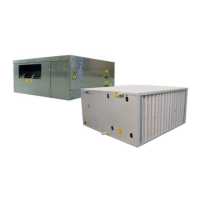
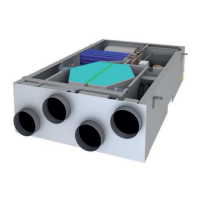
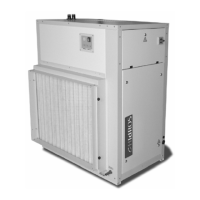
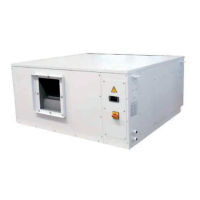
The dehumidifiers are high performance units, equipped with robust galvanised steel frame, properly designed to operate in combination
with radiant cooling systems.
The units are suitable for false ceiling applications and ductable too.
The full range of dehumidifier have pre and post cooling coil able to grant high level of air temperature control.
The units, can operate even without pre and post cooling coils, this option could be very useful in middle seasons when it is necessary to
dry but the air conditioning system is not in operation.
All units are fully in compliance with the European norms and provided with CE marks and dedicated conformity certificate.
3.1.1 Frame
All units are made from hot-galvanised thick sheet metal, to ensure the best resistance against the corrosions.
The cabinet frame is made by removable panels to allow an easy inspection and internal maintenance.
The condensing drip tray is supply as standrad in all models. It is made in plastic material for model 25 and galvanized metal sheet for
model 50-100-200.
3.1.2 Refrigerant Circuit
The refrigerant circuit is made by using international primary brands components and according to ISO 97/23 concerning welding pro-
cedures. The refrigerant gas used in these units is R134a for the model 25 and R407C for the models 50-100-200.The refrigerant circuit
includes: filter drier, capillary expansion device, Schrader valves for maintenance and control, pressure safety device (according to PED
regulation).
3.1.3 Compressor
The compressor is reciprocating type (mod. 25) and rotative type for all other models, equipped with crankcase heater and thermal overload
protection by a klixon embedded in the motor winding. It’s mounted on rubber vibration dampers and, by request, it can be supplied with
some jackets to reduce the noise (accessory).
3.1.4 Condensers and Evaporators
The condensers and evaporators are made of copper pipes and aluminium fins. The diameter of the copper pipes is 3/8” and the thickness
of the aluminium fins is 0,1 mm.The tubes are mechanically expanded into the aluminium fins to improve the heat exchange factor. The ge-
ometry of these condensers guarantees a low air side pressure drop and then the use of low rotation (and low noise emission) fans. All the
units have a stainless steel drip tray. All WZ units configuration, in addition to these exchanger, use a third brazed plate heat exchanger
made of stainless steel AISI 316 as condenser in cooling mode.
3.1.5 Pre and post cold water coils
The pre and post cold water coils are made of copper pipes and aluminium fins. The diameter of the copper pipes is 3/8” and the thickness
of the aluminium fins is 0,1 mm. The tubes are mechanically expanded into the aluminium fins to improve the heat exchange factor. The pre-
cooling coil is used to increase the dehumidification capacity of the unit, while the post-cooling coil is used to keep the outlet air temperature
at the same inlet value. In WZ version the pre-treatment coil only is present.
3.1.6 Water condenser (only for WZ version)
Type-brazed plate, made of stainless steel AISI 316; The water condenser is used in the summer season as cooling integration.
3.1.7 Supply fan
The supply fan is centrifugal type, double inlet with forwards blades, dynamically and statically balanced and directly connected to a 3 speed
fan motor. Installed into the unit by interposed ant-vibration kit.
3.1.8 Air Filter
For the model 50 it’s supplied standard with the unit and it’s built in nylon. It can be removed for differential disposal, class G2, according to
EN 779:2002. Regarding the model 100-200 instead, it’s made of filtering material in synthetic fibre without electrostatic charge. It can be
2.6.5 Further medical treatment
Treat symptoms and carry out support therapy as indicated. Do not administer adrenaline or similar sympathomimetic drugs following
exposure, due to the risk of cardiac arrhythmia.



 To Next Page