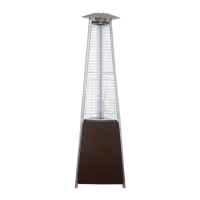
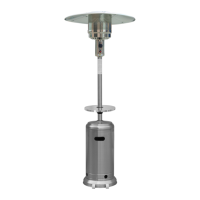
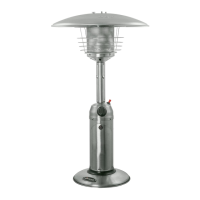
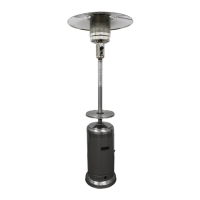
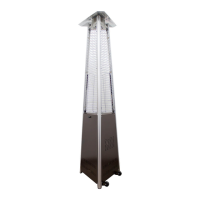
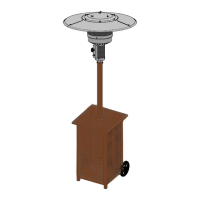
This document is a comprehensive manual for the Hiland Premium Series Outdoor Commercial Patio Heater, providing detailed instructions for assembly, operation, safety, and maintenance.
Function Description
The Hiland Premium Series Outdoor Commercial Patio Heater is a gas-fired infrared appliance designed for outdoor use only. Its primary function is to provide warmth in outdoor settings, making it suitable for commercial and residential patios. The heater operates on propane gas, which is an invisible, odorless, and flammable fuel. An odorant, typically described as a "rotten egg" smell, is added to help detect leaks, although this odorant can fade over time. The heater produces heat through a combustion process, generating extremely minute, non-hazardous amounts of carbon monoxide (CO) when used and maintained according to the instructions. It is designed to be a standalone heating unit, not to be altered or used with any other device.
Usage Features
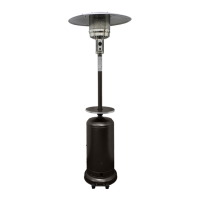
The patio heater is designed for straightforward assembly and operation. The assembly process involves attaching wheel brackets to the base, securing support brackets, fastening the post, sliding on the cylinder housing, and installing the burner head assembly and reflector panel. A standard 20 lb. propane cylinder (not included) is required for operation, and it must be connected using the supplied pressure regulator and hose assembly. The cylinder should be stored outdoors in a well-ventilated area, out of reach of children, and never in an enclosed space.
Before lighting, users must perform a leak test outdoors using a soapy water solution to ensure all gas connections are secure. The heater should be placed on a hard, level surface, at least 24 inches from the sides of the reflector and 18 inches from above the reflector to combustible materials. It must be kept clear of gasoline, flammable liquids, and vapors.
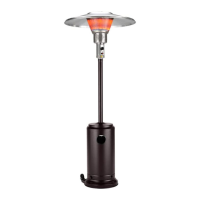
To light the heater, the user turns on the gas cylinder valve, then presses and turns the control knob to the HIGH position (anti-clockwise 90°). While holding the control knob down, the igniter button is pressed several times until the main flame ignites. The control knob is held for 10 seconds after ignition, then turned to LOW for at least 5 minutes before adjusting to the desired temperature. The emitter screen will become bright red when the heater is on, and the burner will display blue and yellow flames. Excessive yellow flame or thick black smoke indicates an airflow obstruction. If the burner flame goes out, the heater should be turned off, and the user must wait at least 5 minutes for gas to dissipate before re-lighting.
The heater is equipped with safety warnings to prevent hazards such as fire, explosion, burns, asphyxiation, and carbon monoxide poisoning. It is crucial to ensure adequate clearances from combustible materials and to avoid using the heater in unventilated or enclosed areas, as it consumes oxygen. Children and adults should be alerted to the high surface temperatures, and young children should be carefully supervised when near the heater. Clothing or other flammable materials should not be hung from or placed near the heater.
Maintenance Features
Regular maintenance is essential for the heater's longevity and performance. Exterior surfaces should be kept clean using warm soapy water; flammable or corrosive cleaning agents should not be used. The area around the burner and pilot assembly must be kept dry, and the control valve assembly should never be submerged in water.
The appliance area must be kept clear of combustible materials, gasoline, and other flammable vapors and liquids. The flow of combustion and ventilation air should not be obstructed, and the ventilation openings of the cylinder enclosure must be free of debris. Controls, burner, and circulating air passageways need to be kept clean. Signs of possible blockage include gas odor with extreme yellow flame tipping, the heater not reaching the desired temperature, uneven glow, or popping noises. Spiders and insects can nest in burner orifices, requiring cleaning with a heavy-duty pipe cleaner or compressed air. Carbon deposits on the dome and burner screen should be cleaned with warm soapy water.
In salt-air environments, corrosion can occur more quickly, so frequent checks and prompt repairs of corroded areas are recommended. High-quality automobile wax can be applied to exterior surfaces (from the pole down, avoiding the emitter screen or domes) to maintain appearance.
For storage between uses or during extended inactivity, the control knob should be turned OFF, and the LP source disconnected. The heater should be stored upright in a secure, well-ventilated outdoor location, sheltered from inclement weather. It can be covered to protect exterior surfaces and prevent build-up in air passages, but only after it has cooled. The LP cylinder should never be left exposed to direct sunlight or excessive heat.
Installation and repair should only be performed by a qualified service person. The heater should be inspected before each use and annually by a qualified service person. More frequent cleaning may be necessary depending on usage. Any guard or protective device removed for servicing must be replaced before operating the heater. The manual also provides a troubleshooting guide for common issues like the burner not lighting, low flame, thick black smoke, gas odor, uneven glow, and popping noises, offering corrective actions for each problem.


 To Next Page
 General