Need help?
Do you have a question about the Hilti C4 and is the answer not in the manual?
Explains warning and caution levels for safety information.
Covers essential safety precautions for operating the charger.
Details specific safety measures for battery chargers and personal safety.
Addresses risks related to power cords, wet conditions, and grounding.
Explains how to insert a battery and initiate the charging process.
Describes the meaning of the green LED light on the charger.
Explains battery LED signals for charging status and temperature.
Details how to identify a faulty battery based on LED signals.
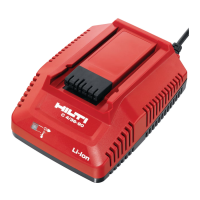
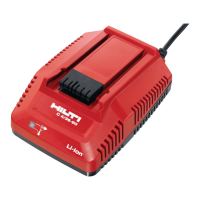
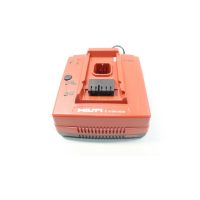
The Hilti C 4/36 and C 4/36-ACS chargers are designed for professional use, specifically for charging Hilti Li-ion batteries with a rated voltage ranging from 4 to 36 volts. These chargers are suitable for various working environments, including construction sites, workshops, and during renovation or new construction projects. It is crucial to read the operating instructions thoroughly before using the appliance for the first time, and these instructions should always be kept with the appliance, especially when it is given to other persons.
The chargers feature a battery compartment for inserting the Li-ion batteries, an indicator LED to display the charging status, and a supply cord with a plug for connecting to a power outlet. The C 4/36-ACS model also includes additional features for the Hilti TPS (Theft Protection System), such as a TPS indicator for the battery, a TPS indicator for the charger, a signal receiving area for the TPS key, and a TPS battery activation button. A Company Card and TPS key are provided with the TPS-equipped model for activating and deactivating the theft protection system.
For optimal and safe operation, the appliance must be used indoors in a clean, dry, and cool location, protected from frost. Adequate ventilation is essential, so the ventilation slots must remain unobstructed, and the charger should not be operated inside a closed container. Before inserting a battery, ensure that the contacts are clean and free from grease. Charging begins automatically once the battery is correctly inserted into the charger, provided the battery and charger interfaces match. The indicator LEDs on the charger and battery provide visual feedback on the charging process and status.
The charger is designed to charge batteries fully before their first use. To maximize battery life, it is recommended to stop discharging the battery as soon as a significant drop in performance is noticed. The charger automatically stops further battery discharge to prevent damage to the battery cells. Unlike NiCd or NiMH batteries, Hilti Li-ion batteries do not require a conditioning charge, and interrupting the charging procedure or starting charging at any time does not negatively affect battery life or cause a memory effect. For best results, batteries should be stored fully charged in a cool, dry place, away from direct sunlight or high ambient temperatures, which can adversely affect battery life and increase self-discharge. If a battery no longer reaches full charge, it may have lost capacity due to aging or overstressing and should be replaced in due course.
The TPS theft protection system, available on the C 4/36-ACS model, adds an extra layer of security. This system can only be activated and made ready for operation using the corresponding activation key. To set the TPS code for the appliance, ensure no battery is in the charger, plug the supply cord into a power outlet, and hold the Company Card against the lock symbol within one minute. The yellow TPS LED will blink rapidly, indicating programming mode. After removing the Company Card, unplugging the supply cord and waiting for the green lamp to go out completes the code-setting operation. The process for canceling the code is similar.
To activate the TPS battery theft protection system, follow a similar procedure: ensure no battery is in the charger, plug in the supply cord, and hold the Company Card against the lock symbol. Once the yellow TPS lamp blinks rapidly, remove the Company Card. Then, insert the battery into the interface and press the TPS battery activation button on the charger. The yellow TPS battery lamp will light up, indicating activation. This process needs to be repeated for each battery to be coded. After coding, the batteries can be charged as usual in any Hilti charger with TPS and the corresponding code.
Maintenance of the appliance is straightforward. The outer casing, made from impact-resistant plastic, should be cleaned regularly with a slightly damp cloth. It is important not to use sprays, steam pressure cleaning equipment, or running water, as this can negatively affect electrical safety. The ventilation slots should be kept clean using a dry brush, and foreign objects must not enter the interior of the appliance. The grip surfaces should be kept free from oil and grease, and silicone-containing cleaning agents should be avoided.
For safety, any repairs to electrical parts or replacement of the supply cord must be carried out only by trained electrical specialists. All external parts of the appliance should be checked for damage at regular intervals, and all controls should operate faultlessly. If any parts are damaged or controls malfunction, the appliance should be repaired by Hilti Service. After any care or maintenance work, it is essential to check that all protective and safety devices are correctly fitted and functioning properly.
Proper disposal of the equipment and batteries is crucial to prevent environmental pollution and health hazards. Defective batteries should be disposed of without delay, kept out of reach of children, and never opened, dismantled, or incinerated. Batteries and the appliance itself should be disposed of in accordance with national regulations or returned to Hilti for recycling. Hilti has arrangements in many countries for taking back old tools and appliances for recycling, and customers can contact Hilti customer service or a representative for further information. For EC countries, electric tools must not be disposed of with municipal waste but collected separately and returned to an environmentally compatible recycling facility in observance of European Directive 2002/96/EC.
 General
| Charging Current | 4 A |
|---|---|
| Battery Type | Li-Ion |
| Output Current | 4 A |
| Input Frequency | 50/60 Hz |
| Charging Time (approx.) | 30 min |
| Compatible Batteries | Hilti 14.4V Li-Ion batteries |

 To Next Page