Need help?
Do you have a question about the Hitachi IJ and is the answer not in the manual?
Guidelines for storing ink and makeup, including temperature and opening deadlines for optimal quality.
Conditions requiring air purge installation for stable printer operation, especially in humid or dusty environments.
Precautions and methods for cleaning the print head, including drying and handling ink splashes.
Procedure for cleaning the gutter and ink recovery route to prevent accumulation of ink and dust.
Determining the correct ink replacement timing based on operating hours and time since filling/opening.
Guidance on printer shutdown periods and procedures for long-term storage to prevent ink issues.
Minimum operating hours required after startup to maintain stable ink viscosity and prevent issues.
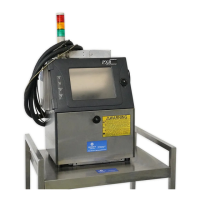
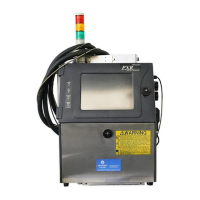
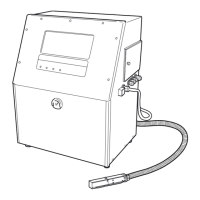
This document outlines the handling guidance and precautions for Hitachi Ink Jet Printers used for industrial marking, focusing on the ink and its related operational aspects.
The primary function of the Hitachi Ink Jet Printer is industrial marking, utilizing ink to print information on various surfaces. The manual emphasizes the importance of proper ink handling and printer maintenance to ensure stable and reliable operation.
The manual provides detailed instructions on the storage and usage of ink and makeup (solvent). Inks and makeups should be stored in a cold, dark place, specifically between 0 to 20°C, both before and after opening the cartridge or bottle. It is crucial to use these consumables before their "Expiration date," which is defined as the "Opening deadline." Once a cartridge or bottle is opened, the ink begins to deteriorate, even if stored correctly. Therefore, it should be disposed of if the "Ink Replacement Cycle" guideline has passed. The document strictly warns against draining waste ink or makeup solution into public sewer systems, emphasizing that disposal must comply with all appropriate regulations, typically through an industrial waste processor.
The concept of "Air purge" installation is introduced as a necessary consideration depending on the usage environment. Air purge is required in high-humidity environments (85% RH or higher), when a water drainage blow sequence is performed before printing, in environments with significant paper powder or dust, and when the print head becomes dirty due due to close proximity to the target or ink splashing. Some inks may always require air purge, while for others, installation might not be available.
The document also addresses the "Ink Replacement Cycle," which is essential because the ink circulating within the printer deteriorates over time due to interaction with atmospheric elements. The replacement cycle varies based on the printer's operating environmental conditions, such as temperature, humidity, and dust. Users are advised to determine the optimal replacement cycle based on printing results and replace all ink in the printer with new ink. Makeup, however, generally does not require replacement once filled into the printer, but it must be filled within one year of opening the cartridge. The guideline for ink replacement timing is determined by whichever comes first: the "Hours operating on IJ printer" or "Months since filling ink (or opening bottle)." These durations are specific to each ink model.
Another critical aspect of usage is the "Stoppable Period and Long-term Shutdown." If the IJ printer is not operated regularly, ink can stick in the circulation system, leading to errors like ink not ejecting or difficulties in recovery. To prevent this, the printer should be operated (ink ejected from the nozzle) regularly. The maximum continuous shutdown period without operation depends on the storage temperature, with shorter periods at higher temperatures. For extended shutdowns beyond the recommended stoppable period, a "Long-term shutdown" procedure is necessary. This involves draining the ink and filling the printer with makeup (solvent) to prevent sticking. Special operations are required when restarting after a long-term shutdown.
Finally, the manual highlights the "Required Operating Minimum Hours to Prevent Ink Viscosity Decrease." When the printer stops, it automatically cleans the circulation system with makeup, which can increase the solvent amount in the ink tank and decrease ink viscosity. During operation, ink viscosity is automatically adjusted. However, repeated short-term shutdowns can lead to an excessive accumulation of solvent, making it difficult to control ink viscosity normally. To counteract this, the printer must be operated for a certain minimum period after starting, which varies based on ambient temperature and ink model. For stable operation, the number of shutdowns should be limited to two at a time.
Maintenance is a key focus, with detailed instructions for "Print Head Cleaning" and "Gutter Cleaning."
For print head cleaning, the end of the print head should be faced downward, and makeup should be poured onto the dirty parts, catching it in a beaker. It is crucial not to pour makeup over specific sections and to wipe the print head clean with a makeup-dampened wiping paper. After cleaning, the print head, including the nozzle orifice, charge electrode, deflection electrode, mounting base, and gutter fringe, must be thoroughly dried before operation, as operating while wet can prevent normal startup. The print head should not be oriented upward while wet, and it should never be immersed in makeup. Frequent printing or short distances between the print material and print head can cause ink splashes, leading to staining on the print head and cover. If this occurs, it can result in print errors or emergency stops. In such cases, the print head (around the nozzle, charge electrode, deflection electrode, mounting base, and gutter) and print head cover must be cleaned immediately, in addition to the daily end-of-work cleaning. Air purging of the print head is also effective against staining from ink splashing.
"Gutter Cleaning" is also essential. The gutter collects ink, atmospheric gas, dust, and other matter. If these substances mix with the ink, undissolved components can accumulate in the gutter, potentially causing errors due to a dirty head. To prevent this, the gutter and its perimeters should be cleaned periodically with makeup. If these actions do not resolve the issue, users are advised to contact their distributor. The manual refers to specific sections in the Technical Manual for detailed procedures on cleaning the gutter and the ink recovery route.
For the "Long-term shutdown storage work," which is a special procedure, it is recommended to contact a local distributor for assistance.
 General
| Print Resolution | 1200 x 1200 dpi |
|---|---|
| Ink Type | Dye-based ink |
| Power Supply | AC 100-240V, 50/60Hz |
| Connectivity | USB |
| Interface | USB |

 To Next Page