
 Need help?
Do you have a question about the Honeywell RM7895A1014 and is the answer not in the manual?
Provides critical steps and warnings for safe and correct installation of the relay module.
Guides on selecting an appropriate installation location based on environmental conditions.
Verifies power supply voltage and frequency match module requirements and ensures disconnect means are present.
Ensures all wiring is correct and static checkout is completed before installing the module.
Lists conditions that will cause a safety shutdown or lockout for the relay module.
Advises on securing the device from unauthorized access and tampering, recommending enclosures and seals.
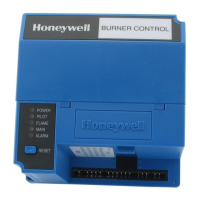
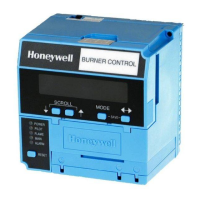
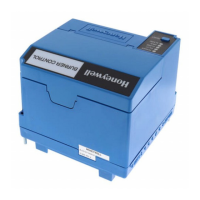
The Honeywell RM7895A,B,C,D/EC7895A,C; RM7896A,C,D 7800 Series Relay Modules are microprocessor-based integrated burner controls designed for automatically fired gas, oil, or combination fuel single burner applications. These modules are intended as replacements for the R4795 and R7795 Primary Controls. The systems comprise a relay module, subbase, amplifier, and purge card, with the RM7896 models additionally providing a postpurge function.
The core function of these relay modules is to provide automatic burner sequencing, flame supervision, system status indication, and system or self-diagnostics for troubleshooting. They manage the entire burner operation from initiation through shutdown.
The operating sequence begins with an INITIATE period when the relay module is powered or when voltage/frequency fluctuations are detected. This period ensures stable power conditions before proceeding. If conditions are not met, a hold condition is initiated, and prolonged issues lead to lockout. The INITIATE sequence also delays the burner motor starter to prevent erratic operation from intermittent AC line input.
Following INITIATE, the system enters the STANDBY period, awaiting a call for heat. Once a call for heat is present and all monitored circuits are in the correct state, the system transitions to the PREPURGE sequence. During PREPURGE, the burner motor output (terminal 4) is powered, and the Airflow Interlock input must close within a specified time. Failure to do so results in a recycle to PREPURGE or lockout, depending on the Airflow Switch jumper configuration.
After PREPURGE, the system proceeds to the IGNITION TRIALS, starting with the Pilot Flame Establishing Period (PFEP). During PFEP, the pilot valve and ignition transformer (terminals 8 and 10) are energized. Flame must be proven within the PFEP duration (ten seconds, or four seconds if Configuration Jumper JR1 is clipped) to continue the sequence. If flame is not proven, a safety shutdown occurs. Once flame is proven, the ignition (terminal 10) is de-energized. For specific models (RM7895C1020/2020 and RM7896C1036/2036), terminal 10 de-energizes within the first 8 seconds of PFEP if a flame signal is detected, and re-energizes if the signal is lost.
The Main Flame Establishing Period (MFEP) follows PFEP. With flame present, the main fuel valve (terminal 9) is powered. If a flameout occurs, the relay module locks out or recycles based on the JR2 jumper status and the Flame Failure Response Time (FFRT) of the amplifier. For EC7895C, RM7895C,D, and RM7896C,D models, MFEP lasts ten seconds, and the pilot valve (terminal 8) is de-energized after Ignition Trials.
Finally, the system enters the RUN period, where it remains until the controller input (terminal 6) opens, indicating that the demand is satisfied or a limit has opened. For EC7895C, RM7895C,D, and RM7896C,D, a delayed main valve is energized once RUN is entered.
For RM7896A,B,C,D models, a POST PURGE function is activated after demand is satisfied or a limit opens. During this period, the Ignition/Pilot valve, main valve, and delayed main valve (terminals 8, 9, and 21) are de-energized, while the blower motor (terminal 4) remains powered for 15 seconds.
Safety shutdowns (lockouts) can occur during various periods due to issues such as missing or bad purge cards, configuration jumper changes after 200 hours (Fault Code 110), AC line power errors, exceeding the INITIATE period, airflow switch failures, flame signal issues, internal system faults, or removal of the purge card.
The relay modules offer several features to enhance usability and system management:
 General
| Termination Type | Screw Terminal |
|---|---|
| Operating Temperature | -40°C to 70°C |
| Voltage | 24 V AC |
| Frequency | 60 Hz |
| Approvals | UL, CSA |
| Contact Rating | 10 A |
| Mounting Type | DIN Rail |
| Operating Temperature Range | -40°C to 70°C |



 To Next Page