Server software and configuration utilities 33
Required hardware
Installing the SATA RAID driver requires a diskette drive and CD-ROM drive. Some servers do not ship
with these drives as standard hardware.
NOTE: Systems with Microsoft® Windows Server™ 2003 and HP embedded drivers do not require
additional hardware.
Diskette and CD-ROM drive options
To acquire a diskette drive option or CD-ROM drive option for a server, contact an HP authorized reseller.
For the name of the nearest HP authorized reseller:
• In the United States, call 1-800-345-1518.
• In Canada, call 1-800-263-5868.
• In other locations, refer to the HP website (http://www.hp.com).
HP Integrated Lights-Out Virtual Floppy and CD-ROM drives
iLO Advanced provides diskette drive and CD-ROM drive functionality through the iLO Virtual Floppy and
CD-ROM features.
For detailed information about iLO Advanced, refer to the HP Integrated Lights-Out User Guide on the HP
website (http://www.hp.com/servers/lights-out
).
Configuring the SATA RAID feature
To configure the SATA RAID feature, do the following:
1. Enable SATA RAID functionality in the BIOS Setup Utility ("Enabling SATA RAID functionality in the
BIOS Setup Utility" on page 33).
2. Create a RAID volume ("Creating a RAID volume" on page 34).
Enabling SATA RAID functionality in the BIOS Setup Utility
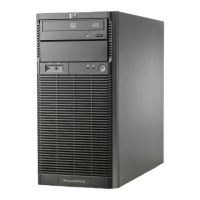
ProLiant ML110 Generation 3 Server
CAUTION: Back up any data stored on the hard drives before proceeding. The configuration process
erases all data on the hard drives.
1. Power up the server. If the server is already powered, save all data, exit all open applications, and
restart.
NOTE: Enabling the RAID option in BIOS Setup Utility is only necessary for installation of the RAID driver. If
this option is not enabled, the OS loads the standard ATA driver from the OS media.
2. During POST, press the F10 key to launch BIOS Setup Utility. If you fail to press F10 before POST,
you will need to restart the server.
3. In the Advanced menu screen, select IDE Configuration.
4. Select the ATA/IDE Configuration>Enhanced field.
5. Set the Configure SATA field to Enabled.
6. Press F10, then select Yes to save the changes and close BIOS Setup Utility. The server
automatically reboots.
7. Create a RAID volume ("Creating a RAID volume" on page 34).




 To Next Page