The provided document is an installation guide for the Huawei RRU3262, a DC blade Remote Radio Unit (RRU). This document outlines the installation process, necessary preparations, technical information, and cabling requirements for the device.
Function Description
The RRU3262 is a DC blade Remote Radio Unit designed for use in base station installations. Its primary function is to transmit and receive radio frequency (RF) signals, connecting to a Baseband Unit (BBU) via CPRI optical cables. The RRU supports various installation scenarios, including mounting on poles, U-steel, angle steel, walls, or an IFS06 integrated outdoor cabinet. It is designed to operate in both single-mode and multi-mode scenarios, with specific port configurations for each. The RRU also supports Remote Electrical Tilt (RET) signal transmission for antenna control and includes an alarm monitoring port for RS485 and dry contact signals.
Important Technical Specifications
Dimensions:
- Height: 400 mm
- Width: 300 mm
- Depth: 120 mm
Installation Scenarios and Requirements:
- Pole Installation:
- Supported pole diameter: 60 mm (2.36 in.) to 114 mm (4.49 in.).
- Recommended pole diameter: 80 mm (3.15 in.).
- Recommended pole wall thickness: 3.5 mm (0.14 in.) or above.
- For pole diameters 60-76 mm, a maximum of three RRUs can be installed, with side-mounted installation recommended.
- For pole diameters 76-114 mm, more than three RRUs are supported.
- Vertical deviation angle of an RRU must be ≤ 10 degrees to ensure proper heat dissipation and waterproofing.
- U-steel Installation:
- Supports standard or reverse installation of a single RRU.
- Supported U-steel dimensions: 50-100 mm width, 30-50 mm height.
- If the narrower edges of the U-steel are less than 40 mm, only specific installation modes (a and b) are supported.
- Angle Steel Installation:
- Supports standard or reverse installation of a single RRU.
- Supported angle steel dimensions: 63-80 mm width, 63-80 mm height.
- Wall Installation:
- The wall must bear a weight four times heavier than the RRU's weight and a bolt pulling force of 1.25 kN (281.25 lbf) vertical to the wall.
- Expansion bolts must be tightened to 30 N·m.
- Standard installation is recommended. Side-mounted mode for multiple RRUs on a wall should not combine mounting brackets.
- IFS06 Installation:
- Supports at least three RRUs when ambient temperature is ≥ lowest operating temperature of RRUs and ≥ 5°C (41°F) lower than the highest operating temperature.
- Supports a maximum of six RRUs when ambient temperature is ≥ lowest operating temperature of RRUs and ≥ 10°C (50°F) lower than the highest operating temperature.
- Mounting brackets for multiple RRUs cannot be combined.
- RRUs should be installed from bottom to top and left to right.
- M10x50 bolts are used for pole installation bracket on IFS06, tightened to 30 N·m.
Clearance Requirements:
- Single RRU (Side-Mounted): Recommended clearances are ≥ 300 mm (top), ≥ 500 mm (bottom), ≥ 800 mm (front), ≥ 500 mm (back), ≥ 500 mm (sides). Minimum clearances are 200 mm (top), 300 mm (bottom), 600 mm (front), 300 mm (back), 300 mm (sides).
- Single RRU (Standard/Reverse Mode): Recommended clearances are ≥ 300 mm (top), ≥ 500 mm (bottom), ≥ 800 mm (front), ≥ 500 mm (back), ≥ 300 mm (sides). Minimum clearances are 200 mm (top), 100 mm (bottom), 400 mm (front), 400 mm (back), 300 mm (sides).
- Single Tower-Mounted RRU (Side-Mounted): Minimum clearances are 75 mm (top), 110 mm (bottom), 400 mm (front), 200 mm (side).
- Single Tower-Mounted RRU (Standard/Reverse Mode): Minimum clearances are 75 mm (top), 110 mm (bottom), 400 mm (front), 280 mm (side).
- Three or More RRUs (Centralized Mode): Recommended clearances are ≥ 360 mm (top), ≥ 500 mm (bottom), ≥ 800 mm (front), ≥ 500 mm (back), ≥ 500 mm (sides). Minimum clearances are 200 mm (top), 300 mm (bottom), 600 mm (front), 300 mm (back), 300 mm (sides).
- Three or More RRUs (Standard Mode on Wall): Recommended horizontal spacing ≥ 772 mm. Minimum horizontal spacing ≥ 572 mm.
- Three or More RRUs (Side-Mounted Mode on Wall): Recommended horizontal spacing ≥ 70 mm.
- Horizontal Spacing Between RRUs: Recommended ≥ 600 mm, Minimum ≥ 400 mm.
- Vertical Spacing Between RRUs: Recommended ≥ 300 mm (top), ≥ 500 mm (bottom). Minimum ≥ 200 mm (top), ≥ 300 mm (bottom).
- If installed on bitumen ground, the RRU must be at least 500 mm (recommended 700 mm or more) away from it.
Ports:
- Cabling Cavity Ports:
- RTN(+)/NEG(-): Power supply socket.
- CPRI0/CPRI1: Optical/electrical ports for BBU connection (CPRI0 connected to BBU by default in single-mode).
- Bottom Ports:
- ANT_TX/RXA, ANT_TX/RXB: TX/RX ports supporting RET signal transmission.
- ANT_RXC, ANT_RXD: TX/RX ports.
- EXT_ALM: Alarm monitoring port (RS485 and two dry contact signals).
- RET: Communication port for RET antenna.
Indicators:
- RUN (Green): Steady on (power available, board faulty), Steady off (no power or board faulty), Blinking (board running properly).
- ALM (Red): Steady on (alarms generated, module replacement needed), Blinking (alarms generated, fault location needed), Steady off (no alarms).
- ACT (Green): Steady on (board working, TX channels enabled or software loading), Blinking (board running, TX channels disabled).
- VSWR (Red): Steady off (no VSWR alarm), Blinking (VSWR alarms on ANT_TX/RXB), Steady on (VSWR alarms on ANT_TX/RXA), Blinking (VSWR alarms on ANT_TX/RXA and ANT_TX/RXB).
- CPRI0/CPRI1 (Red/Green): Steady green (CPRI link running), Steady red (optical module fails to receive/transmit or fiber broken), Blinking red (CPRI link out of lock), Steady off (optical module not detected or powered off).
Power Cable:
- Cross-sectional area: 16 mm² (0.025 in.²).
- Connectors: Tool-less female connector (pressfit type) on RRU side, OT terminal (M6) on RRU side, OT terminal (M8) on external ground bar side.
- Recommended circuit breaker for customer-provided power device: 15 A to 30 A.
- Normal input voltage: -48 V DC (range -36 V DC to -57 V DC).
- Color coding: Black jacket with two wires (North American: black for RTN(+), blue for NEG(-); European: brown for RTN(+), blue for NEG(-)).
Usage Features
- Flexible Installation: The RRU3262 can be installed in various outdoor environments, including poles, U-steel, angle steel, walls, and integrated outdoor cabinets (IFS06), offering adaptability to different site conditions.
- Scalability: Supports installation of multiple RRUs on a single pole or IFS06, allowing for flexible network expansion and capacity upgrades.
- RET Support: Integrated support for Remote Electrical Tilt (RET) antennas simplifies antenna adjustments and optimization.
- Alarm Monitoring: An EXT_ALM port allows for external alarm monitoring, enhancing network reliability and fault detection.
- CPRI Connectivity: Utilizes CPRI optical cables for high-speed communication with the BBU, ensuring efficient data transfer.
Maintenance Features
- Indicator-Based Troubleshooting: Comprehensive set of LED indicators (RUN, ALM, ACT, VSWR, CPRI0, CPRI1) provides immediate visual feedback on the RRU's operational status, aiding in quick diagnosis of issues.
- Clearance for O&M: Recommended installation clearances are specified to ensure sufficient space for operation and maintenance activities, including checking indicator status and accessing cabling cavities.
- Cable Labeling: Requirement for clear and complete labels on both ends, joints, or turns of all cables, feeders, and jumpers simplifies identification and maintenance.
- Waterproofing: Detailed instructions for waterproofing RF jumper connectors and ensuring proper sealing of cabling cavities with waterproof blocks protect the device from environmental damage.
- ESD Protection: Emphasizes the importance of wearing ESD gloves during installation to prevent electrostatic damage to internal components.
- Power-On Check Process: A defined power-on check process helps verify correct installation and functionality before full operation.
- Tool-Less Connector: The use of tool-less female connectors (pressfit type) for power cables simplifies cable termination and installation on the RRU side.

 Need help?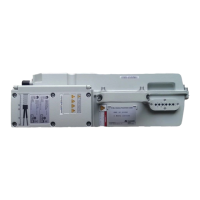

 To Next Page
 General