This document is an operator's manual for Husqvarna 225L/LD, 225L Lite, and 232L trimmers. It provides detailed information on the machine's function, safety, assembly, fuel handling, starting and stopping procedures, maintenance, and technical data.
Function Description
The Husqvarna 225L/LD, 225L Lite, and 232L are trimmers designed primarily for trimming grass and clearing unwanted vegetation. The engine unit acts as the drive source for various cutting attachments. The machine is equipped with a vibration damping system to reduce the transfer of vibrations between the engine unit/cutting equipment and the handles, aiming for comfortable use. A muffler is integrated to minimize noise and direct exhaust fumes away from the operator; some models feature a catalytic converter to reduce harmful exhaust components and a spark arrest screen to mitigate fire risk. The cutting equipment, typically a trimmer head with a cord, is secured by a locking nut on the output shaft. The throttle trigger lock prevents accidental engagement of the throttle, and a stop switch is provided for immediate engine shutdown.
Important Technical Specifications
- Engine: Two-stroke engine, requiring a mixture of petrol and two-stroke oil.
- 225L/LD & 225L Lite: Cylinder capacity 1.55 cu. in (25.4 cm³), cylinder bore 1.34 in (34 mm), stroke length 1.10 in (28 mm).
- 232L: Cylinder capacity 1.88 cu. in (30.8 cm³), cylinder bore 1.38 in (35 mm), stroke length 1.26 in (32 mm).
- Speed:
- Recommended max. speed: 11,000-12,000 rpm for all models.
- Max. speed (should not be exceeded): 14,000 rpm for all models.
- Idling speed: 2,700 rpm for all models.
- Speed of output axle: 10,000 rpm for all models.
- Engine Output (acc. to ISO 8893):
- 225L/LD & 225L Lite: 0.9 kW / 9,000 rpm.
- 232L: 1.1 kW / 8,400 rpm.
- Ignition System: Walbro MB/CD, Champion RCJ 7Y spark plug with an electrode gap of 0.02 in (0.5 mm).
- Fuel Lubrication System: Walbro WT carburettor. Fuel tank capacity: 1.06 US pint (0.5 litres) for all models.
- Weight (without fuel, cutting tool, and guard):
- 225L: 12.6 lbs (5.7 kg).
- 225LD: 13.2 lbs (6.0 kg).
- 225L Lite: 12.4 lbs (5.6 kg).
- 232L: 13.2 lbs (6.0 kg).
- Noise Levels (min/max):
- Equivalent noise pressure level at user's ear (prEN 31806 and ISO 7917): 95/99 dB(A) for 225L/LD & 225L Lite; 92/100 dB(A) for 232L.
- Equivalent noise power level at user's ear (prEN 31806 and ISO 10884): 104/109 dB(A) for 225L/LD & 225L Lite; 107/110 dB(A) for 232L.
- Vibration Levels (m/s, prEN 31806 and ISO 7916):
- 225L/LD: Idling (left/right handles) min 2.8/2.0, max 2.8/2.0; Max. speed (left/right handles) min 2.6/2.8, max 5.0/5.0.
- 225L Lite: Idling (left/right handles) min 6.1/3.8, max 6.1/3.8; Max. speed (left/right handles) min 3.0/8.0, max 4.0/10.0.
- 232L: Idling (left/right handles) min 2.5/2.3, max 4.0/3.0; Max. speed (left/right handles) min 3.8/2.7, max 6.8/3.4.
- Approved Accessories: Includes various plastic knives (Tricut 300 mm), trimmer heads (Trimmy H II, Trimmy Fix, Trimmy Hit Pro, Superauto II), edger attachment (Ø200 mm, for LD models), and hedge trimmer attachment (Length 580 mm, for LD models).
Usage Features
- Assembly: Instructions are provided for assembling the loop handlebar, the two-part shaft (225LD models), spray guard, and trimmer head. The two-part shaft allows for easier transport and storage.
- Fuel Handling: The machine operates on a mixture of unleaded petrol (minimum 87 octane) and Husqvarna two-stroke oil at a 1:50 (2%) ratio. Proper ventilation is crucial during fuelling, and the machine should be moved at least 3m from the filling position before starting.
- Starting: For a cold engine, the stop switch is set to the start position, and the choke control is set to the choke position. For a warm engine, the choke is not used directly but the start throttle position is achieved by setting the choke and then returning it. The starter handle is pulled quickly and powerfully after feeling resistance. The choke control is reset once the engine fires.
- Stopping: The engine is stopped by moving the stop switch to the stop position.
- Working Techniques:
- Trimming: The trimmer head should be held just above the ground at an angle, allowing the cord to work at its own pace without pressing it into the area.
- Clearing: This technique removes unwanted vegetation by tilting the trimmer head and letting the cord strike the ground around obstacles.
- Sweeping: The rotating cord's fanning effect can be used for quick cleaning by holding the cord parallel to and above the area to be swept.
- Full throttle is generally recommended for trimming and sweeping, but less than full throttle should be used for trimming and clearing to prolong cord life and reduce wear on the trimmer head.
- The machine should always be operated with an approved guard fitted.
Maintenance Features
- Daily Maintenance: Includes checking the throttle trigger and lock, stop switch, trimmer head rotation at idling, harness condition, spray guard, trimmer head for damage, locking nut tightness, and general nuts and screws.
- Weekly Maintenance: Involves checking the starter cord and return spring, cleaning the carburettor area, cleaning and checking the spark plug electrode gap (0.5 mm), cleaning cooling fins, checking angle gear grease level (3/4 full with special grease), cleaning the air filter, and cleaning/replacing the muffler's spark arrest screen (if applicable).
- Monthly Maintenance: Requires cleaning the fuel tank, exterior of the carburettor, fan, checking fuel hoses for damage, changing the fuel filter, checking clutch components for wear, checking electrical wires, changing the spark plug, changing the air filter, and cleaning the muffler's catalytic converter spark arrest screen (if applicable).
- Carburettor Adjustment: The carburettor is factory-set but requires fine adjustment after 8-10 tanks of fuel for peak performance and reduced emissions. This should be done by a skilled technician using a revolution counter. Adjustments involve the low-speed needle (L), high-speed needle (H), and idle speed screw (T). A clean air filter is essential before adjustment.
- Muffler: Regular inspection and cleaning of the spark arrest screen are necessary to prevent engine overheating. Damaged mufflers should never be used.
- Cooling System: Regular cleaning of the air intake, flywheel fins, cylinder fins, and cylinder cover is vital to prevent engine overheating.
- Spark Plug: The spark plug should be cleaned and checked for a 0.5 mm electrode gap. It should be replaced after approximately one month of operation or sooner if needed.
- Angle Gear: Factory-filled with grease, it should be checked to be 3/4 full with HUSQVARNA special grease. Grease typically does not need changing unless the angle gear is repaired.
- Two-part Shaft: The drive axle end in the lower shaft should be lubricated with grease every 30 hours to prevent jamming.

 Need help?
 General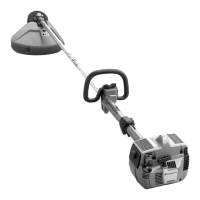





 To Next Page