1110
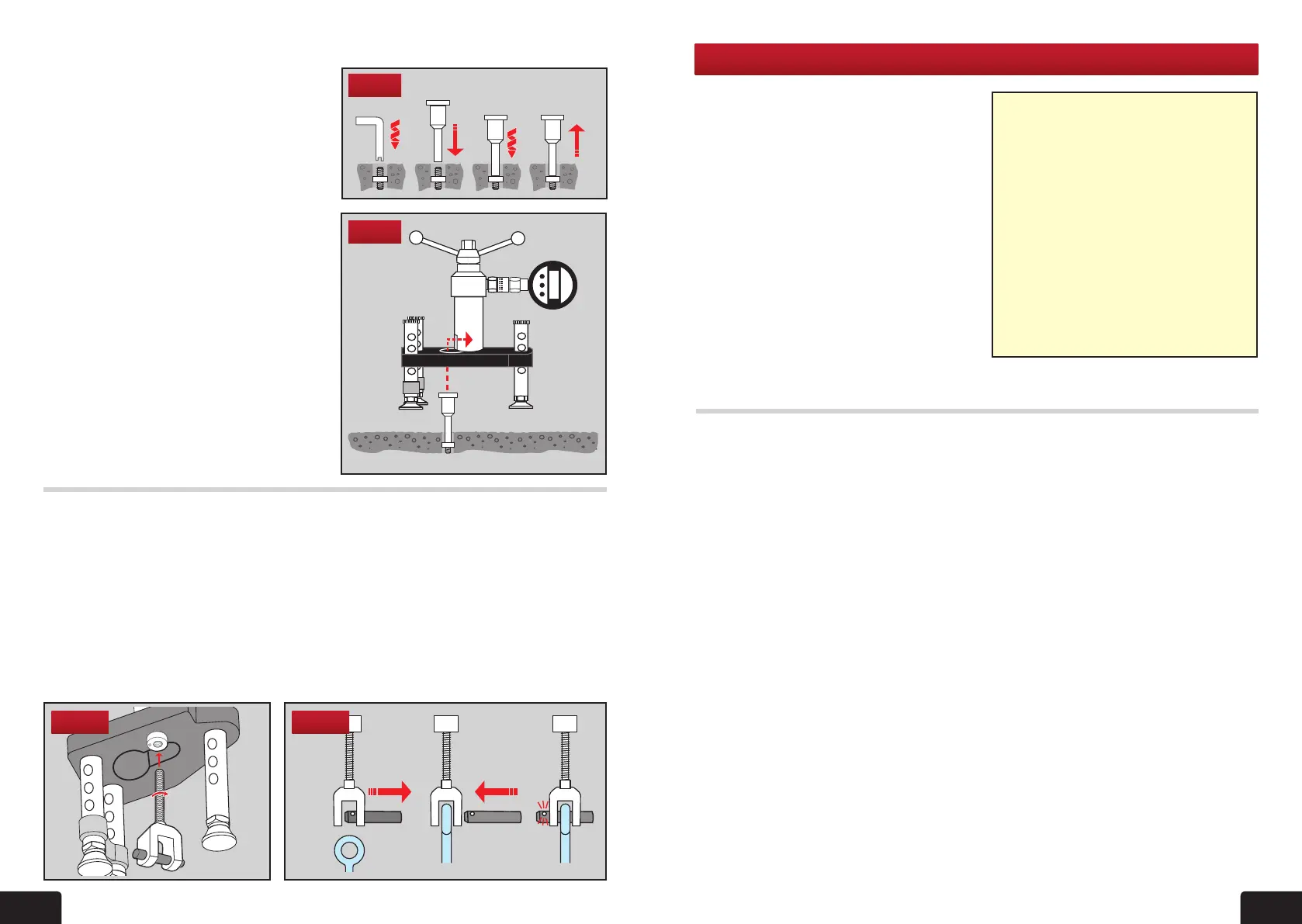
For testing ringbolts the Clevis adaptor is used.
Mount the locking adaptor into the tester (see Section 1 General testing procedure). Then
thread the clevis adaptor into the tester body until it is fully engaged, using a quarter turn
for positioning (g 18).
Remove crosspin from the clevis adaptor and offer the tester and bridge to engage eye of
the anchor in the clevis. Some adjustment will be required on the swivel feet, so that this
t is achieved. Push clevis pin through the clevis and eyebolt, ensuring that the ball on the
pin clicks into place, having passed through the second fork (g 19). Once tted securely
commence testing (see Section 1 General testing procedure).
Fig 19
Fig 18
2.5 THE CLEVIS ADAPTOR
2.4 M5, M6, M8 AND M10 THREADED ROD ADAPTORS
Fig 16
The M5 and M6 threaded rod adaptors are
equipped with an external M12 thread for
use in conjunction with the M12 threaded
button adaptor. They are used primarily
for testing remedial wall ties. The M8 and
M10 threaded rod adaptors are equipped
with an M16 external thread and the M16
nut tted with connects to the pulling slot
in the tester or bolt tester adaptor.
Connect the threaded rod adaptor to the
thread on the xing (g 16).
Remove the locking adaptor if tted (see
Section 1 General testing procedure).
Adjust the length of the bridge legs and
the height of the button adaptor/nut so that
the adaptor can pass through the hole in
the bridge and engage it in the pulling jaw
of the tester (g 17).
Level the load spreading bridge with the
adjustable legs before commencing the
application of the load.
Fig 17
1 2 3 4
3. SCAFFOLD TESTER KIT
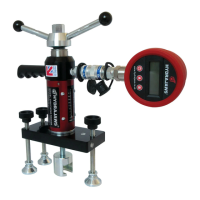
The Hydrajaws Test meter is part of a
purpose made system for testing xings
and measures the load supplied. The
Scaffold Tester Kit has accessories
designed to test Scaffold Anchors and
Ringbolts to the requirements of the
guidance note TG4:17 issued by National
Access and Scaffolding Confederation
(NASC) and the Construction Fixings
Association (CFA).
The Tester is factory assembled with the
bolt tester adaptor screwed into the M12
locking adaptor located in the Tester jaw.
Height can be adjusted using the swivel
feet (20mm).
KIT CONTENTS:
• M2000 Medium Duty Tester
with 25kN Digital/Analogue Gauge
• 2020 Load Spreading Bridge
• Turning handle with integrated
22mm operating nut
• M16 Hex Setscrew
• Bolt Tester Adaptor
• M12 Ringbolt Adaptor Clevis
• M12 Locking Adaptor
• Calibration Certicate
• Padded Carrying Case
TESTING OF M16 DROP IN SCAFFOLD TIE ANCHORS
Fit the M16 hexagon setscrew to the anchor, ensuring at least two complete turns for
ample thread engagement. Offer Tester with bridge to the hexagon head of the setscrew
and engage head in bolt tester adaptor jaw. Make adjustment on each swivel foot by
unscrewing from the telescopic legs so that each foot is resting on the material around the
anchor and the bridge is square and level. Check that the gauge is registering zero.
Commence the test by turning the operating handle on the Tester clockwise and observe
the gauge as the load on the anchor is increasing. Continue applying the load until the
proof test load is reached. Stop applying the load and observe if the reading falls back. If
the fall back is minimal, apply the load again until reading is at the test load required and
leave the test load in place for approximately 10 seconds.
Should the reading not reach the maximum test load requirement, or the
operating handle has to be turned to maintain the load, it is certain that the anchor will
have failed the test.


 To Next Page