Important Information on Reverse
Osmosis Filters:
Reverse Osmosis is the most cost effective and efficient way to
remove 98%+ of all contaminants from your water. The key com-
ponent of the system is the RO membrane that is tightly wrapped
sheets of a semi-permeable material. Under pressure the mem-
brane allows pure H2O to pass through it and rejects, or flushes
away, most impurities down the drain. That is why all RO systems
have a certain amount of waste water. The ratio of waste water is
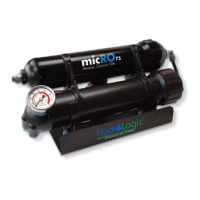
determined by the restrictor used on the drain line. The micRO75
is designed to run at a ratio of 2:1 ( 2 parts drain to 1 part product
water) being about 50% more efficient than similar RO systems.
The flow of water is determined by inlet pressure, inlet tempera-
ture, and inlet PPM’s. The micRO75 has the capacity to produce
75 gallons per day, with inlet water at 77º F, 60 PSI, 500 PPM. The
higher the inlet pressure and temperature, the better the flow. You
will notice in colder areas or in the winter when water tempera-
tures are lower that the water flow can be slower. A minimum of
40 psi is required to properly operate the system.
Inlet water that is very high in total PPM or very hard with calci-
um or magnesium may shorten the life of the membrane and/or
cause slower flow rates. The RO membrane included with the filter
can handle water up to 1000 PPM and with a hardness of 170
PPM or 10 grains of hardness per gallon. Note that this is consid-
ered both very contaminated and very hard water and may short-
en the life of the membrane. At these levels of contamination and
hardness, and especially beyond, you may consider pre-treatment
in the form of a water softener or other equipment. Please contact
HydroLogic for more information.
All RO systems exhibit “TDS creep”. The first few ounces of RO wa-
ter produced are higher in PPM than after the system has run a few
minutes. Take any PPM readings a full five minutes after turning
the system on to assure accuracy.
1


 To Next Page