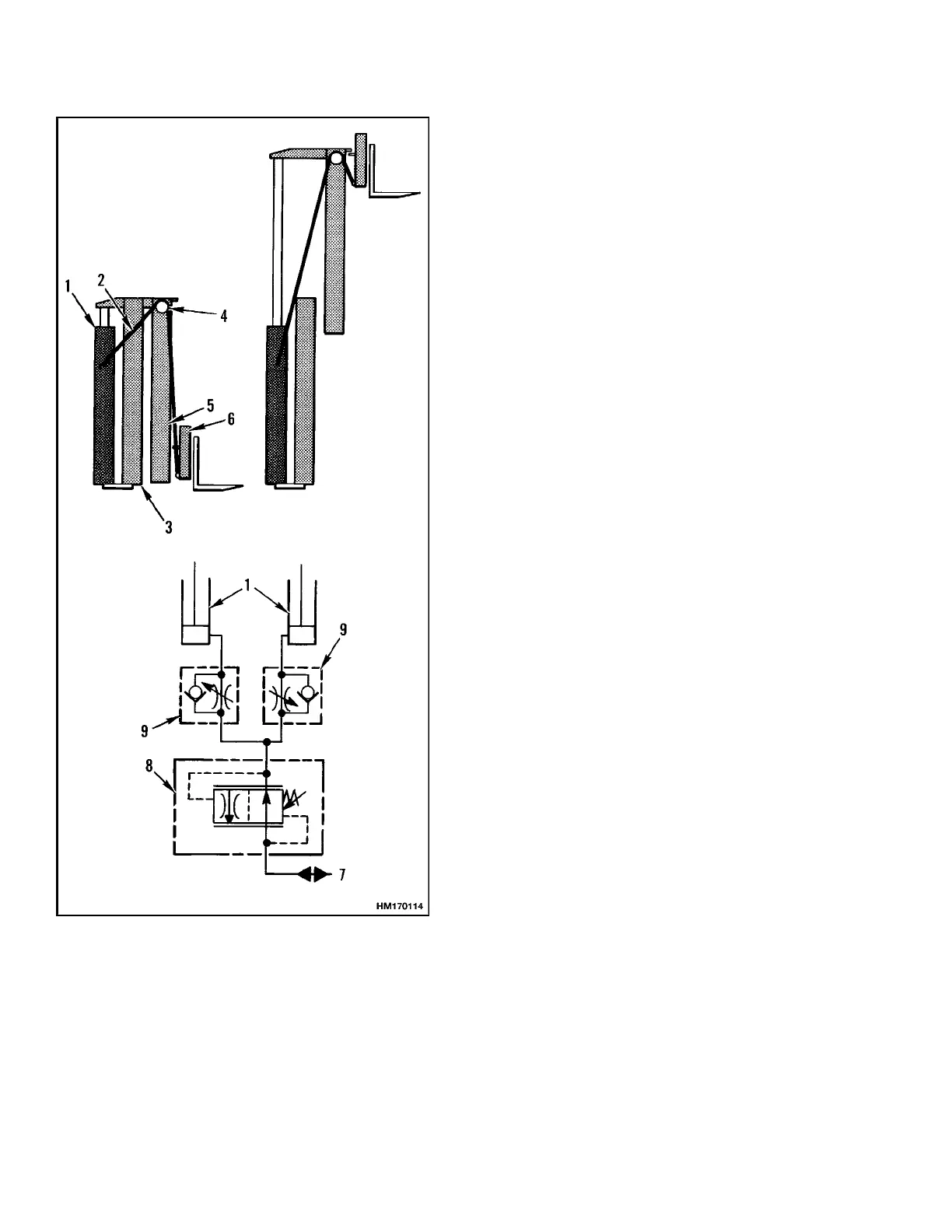
Description and Operation 4000 SRM 340
1. LIFT CYLINDER (2)
2. LIFT CHAIN
3. OUTER WELDMENT
4. CHAIN SHEAVE
5. INNER WELDMENT
6. CARRIAGE
7. FROM MAIN CONTROL VALVE
8. EXTERNAL LOWERING CONTROL VALVE
9. INTERNAL LOWERING CONTROL VALVE
Figure 2. Two-Stage Mast With Limited
Free-Lift
Two lift chains control the movement of the carriage.
The chains are fastened to mounts near the top of
the lift cylinder shells. The chains go up and over
the chain sheaves on the inner weldment and then
connect to the carriage. When the lift cylinders ex-
tend, the lift chains transfer the force from the lift
cylinders to the carriage.
When the lift cylinders retract, the weight of the
load, carriage and inner weldment push the oil
from the lift cylinders. The oil flows from the lift
cylinders, through the lowering control valves, main
control valve and then to the hydraulic tank.
TWO-STAGE MAST WITH FULL FREE-LIFT
MAST
The Vista Free-Lift mast has an inner weldment, an
outer weldment and three single stage lift cylinders.
See Figure 3. It is called a free-lift mast because the
carriage can travel to the top of the inner weldment
without increasing mast height. The free-lift mast
has load roller and strip bearing arrangements sim-
ilar to the two-stage mast.
The two main lift cylinders are installed at the back
of the outer weldment. The base of each lift cylin-
der sits in a mount at the bottom of the outer weld-
ment. The hydraulic fitting for each lift cylinder goes
through a hole in the mount. The top of each lift
cylinder (cylinder rod) fits into guides at the top of
the inner weldment.
The free-lift cylinder is installed in the inner weld-
ment. The main lift cylinder on the right side of the
mast and the free-lift cylinder each have an inter-
nal lowering control valve. A single external lower-
ing control valve is connected by tubing to all of the
lift cylinders. Two chain sheaves are installed on the
cylinder rod of the free-lift cylinder. The lift chains
are connected to a mount behind the free-lift cylin-
der. The chains then go over the sheaves and are
connected to the carriage.
The three lift cylinders are connected by hoses and
tubing. To extend the mast, oil from the main control
valve flows to all of the lift cylinders at the same time.
The free-lift cylinder raises first because it lifts the
least amount of weight. The free-lift cylinder raises
the carriage to the top of the inner weldment. After
the free-lift cylinder reaches the end of its stroke, the
main lift cylinders begin to extend and raise the inner
weldment.
2



 To Next Page