33
440 01 2021 01
Use e lbows and 3²
²²
² pipe nipple to connect valve to
piping when using left side gas pipe entry.
*Union may be installed inside the cabinet when necessary
because of clearances.
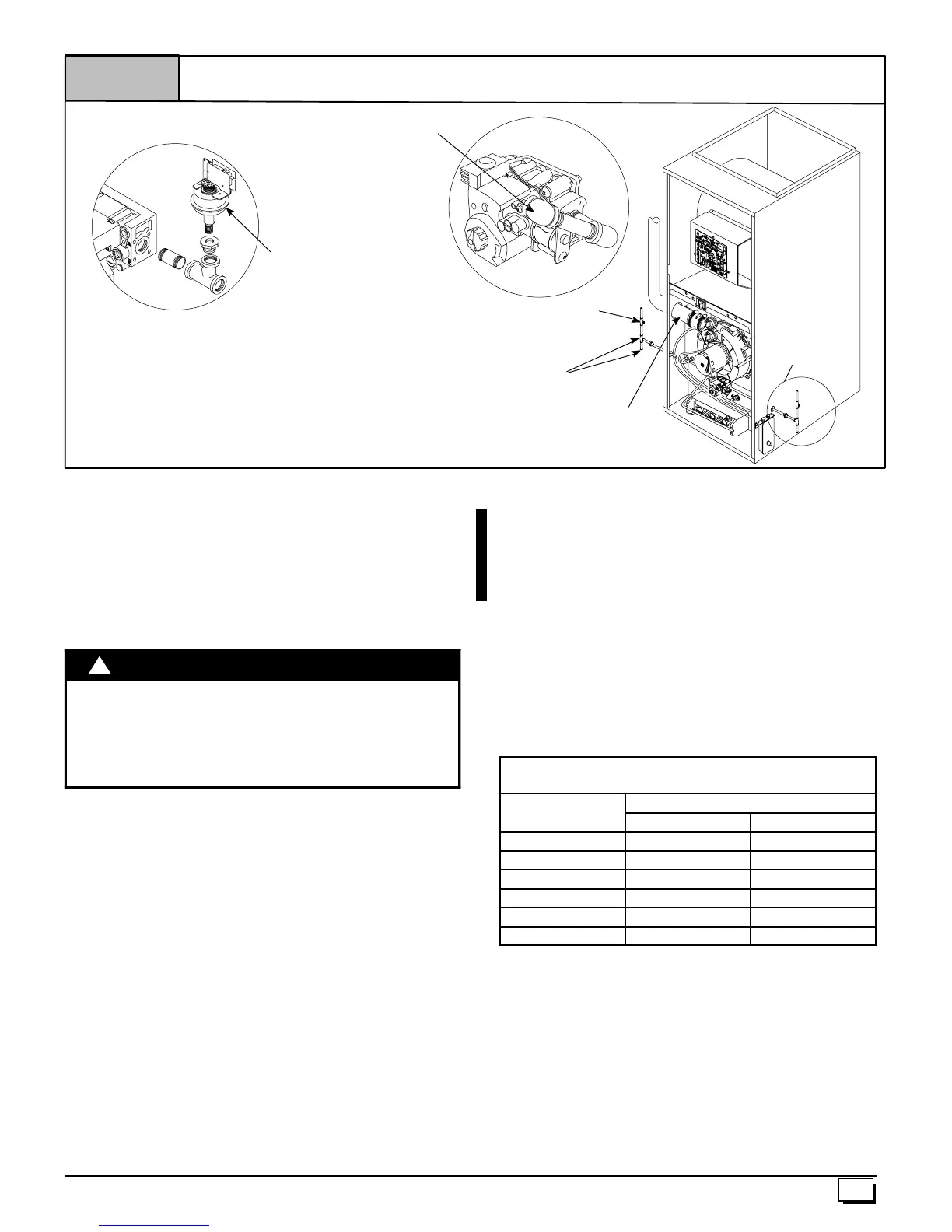
Figure 36
Typical Gas Piping for Downflow
Drip Leg and Union, Union* should be outside the cabinet.
Manualshut--offvalveMUSTbeupstream ofdripleg, union,
and furnace.
LP Low pressure switch.
Optional LP conversion.
GasPipeGrommet
(Single Pipe)
Manual shut-off
valve
Alterative
installation
Additional LP Connection Requirements
1. Have a licensed LP gas dealer make all c onnections at stor-
age tank and check all connections from tank to furnace.
2. If copper tubing is used, it MUSTcomply with limitation set in
National Fuel Gas Code or CGA c odes.
3. Two--stage regulation of LP gas is recommended.
Supply Pressure
FIRE HAZARD.
Failure to properly set input pressure could result in
death, personal injury and/or property damage.
Do NOT set input rating above that shown on rating
plate.
!
WARNING
1. A
1
/
8
² NPT plugged fitting, accesible for a test gauge con-
nection, must be installed immediately upstream of the gas
supply connection to furnace.
2. Gas input to burners MUST NOT exceed the rated input
shownonratingplate.
3. Do NOT allow minimum gas supply pressure to vary down-
ward. Doing so will decrease input to furnace. Refer to
Table 6 or Table 7 for normal gas supply and manifold pres-
sures.
Gas Supply Pressure
Gas supply pressure should be within minimumand maximum val-
ues listed on rating plate. Pressures are usually set by gas suppli-
ers.
Manifold Gas Pressure Adjustment (Hi & Lo Fire)
NOTE: Make adjustment to manifold pressure with burners oper-
ating.
General Derating Rules
1. These furnaces may be used at full input rating when
installed at altitudes up to 2,000¢. When installed above
2,000¢, the input must be decreased 2% (natural) or 4% (LP)
for each 1000¢ above sea level in the USA. In Canada, the
input rating must be derated 5% (natural) or 10% (LP) for
each 1000¢ above sea level.
2. For operation with natural gas at altitudes above 2,000¢,ori-
fice change and/or manifold pressure adjustments may be
required for the gas supplied. First consult your local gas
supplier, then refer to Table 6 for required pressure change
and/or orifice change for high altitudes.
3. For operation with LP gas, gas orifices MUST be changed
and manifold pressure MUST be maintained as per
Table 7. Orifices can be ordered through our distributor.
(See Figure 37)
High Altitude Input Rate =
Nameplate Sea Level Input Rate x (Multiplier) [USA]
High Altitude Multiplier
e
at
on
Natural Gas LP Gas
2001¢ - 3000¢ 0.95 0.90
3001¢ - 4000¢ 0.93 0.86
4001¢ - 5000¢ 0.91 0.82
5001¢ - 6000¢ 0.89 0.78
6001¢ - 7000¢ 0.87 0.74
7001¢ - 8000¢ 0.85 0.70
* Based on mid--range of elevation.
4. In cases where Table 6 is not applicable, eg. alternate input
rate application, refer to above table for required high alti -
tude input rate.
High Altitude Air Pressure Switch
Altitudes over 4,000¢ may require a different air pressure switch
than the one installed at the factory. Check parts list for pressure
switch and consult your distributor for part number and availability.
In Canada, provincial codes may govern installation of switch.
Check with governing authorities.
NOTE: The derating of these units at 2% (Natural) and 4% (L.P.)
has been tested and approved by CSA.



 To Next Page