35
440 01 2021 01
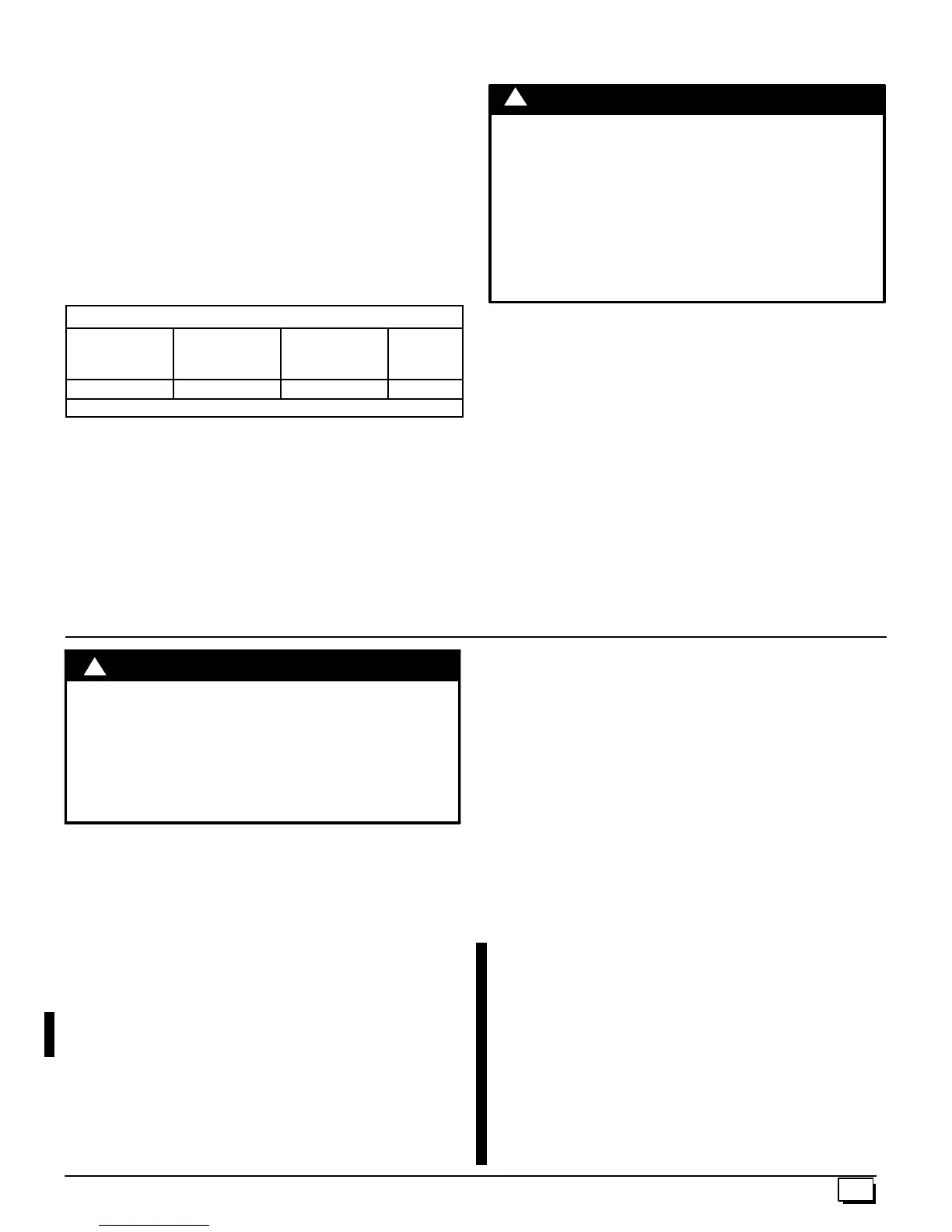
Natural Gas Input Rating Check
NOTE: The gas meter can be used to measure input to furnace.
Rating is based on a natural gas BTU content of 1,000 BTU’s per
cubic meter. Check with gas supplier for actual BTU content.
1. Turn OFF gas supply to all appliances and start furnace.
Use jumper wire on R to W1 and W2 for Hi fire.
2. Time how many seconds it takes the smallest dial on the gas
meter to make one complete revolution. Refer to Example.
3. Repeat steps 1 and 2 with jumper wire on R to W1 for low
fire.
NOTE: Third (3rd) dip switch must be in “ON” position. (See
Furnace Wiring Diagram). Return third (3rd) dip switch to
previous setting after check.
Example
Natural Gas
BTU Content
No. of
Seconds
Per Hour
Time Per
Cubic Foot in
Seconds
BTU Per
Hour
1,000 3,600 48 75,000
1,000 x 3,600 ¸ 48 = 75,000 BTUH
Final Check
FIRE OR EXPLOSION HAZARD
Failure to follow this warning exactly could result
in serious injury, death and/or property damage.
Never test for gas leaks with an open flame. Use a
commercially available soapsolution made specifi-
cally for the detection of leaks to check all
connections. A fire or explosion could result
causing property damage, personal injury and/or
loss of life.
!
WARNING
1. The furnace and the equipment shut off valve must be discon -
nected from the gas supply piping system during any pres-
sure testing of that system at test pressures in excess of
1
/2²
PSIG. Close the manual shut--off v alve before testing at
such pressures.
2. The furnace must be isolated from the gas supply system by
closing the equipment shut off valve during any pressure
testing of the gas supply system at test pressure equal to or
less than
1
/2² PSI (3.5 Upa).
3. When installation is complete, test all pipe connections for
leaks with the gas pressure less than
1
/2² PSIG to the gas
valve.
4. Apply a commercial soap solution to all joints to test for
leaks. Correct any leaks indicated by bubbles.
5. Correct even the smallest leak at once.
6. Check for leaks at gas valve and orifice connections to the
burner manifold along with the pilot tube connections to the
valve and pilot assembly while the furnace is operating.
7. Electrical Wiring
ELECTRICAL SHOCK HAZARD.
Failure to turn off power could result in death or
personal injury.
Turn OFF electrical power at fuse box or service
panel before making any electrical connections
and ensure a proper ground connection is made
before connecting line voltage.
!
WARNING
Power Supply Wiring
The furnace MUST be electrically wired and grounded in accor -
dance with local codes, or in the absence of local codes with the
latest edition of The National Electric Code, ANSI NFPA 70 and/or
The Canadian Electric Code CSA C22.1.
Field wiring connections must be made inside the furnace connec-
tion box. A suitable strain relief should be used at the point the
wires exit the furnace c asing.
NOTE: Furnace will not have normal operation is line polarity is re-
versed. Check ALL field and control connections prior to opera-
tion.
Copper conductors shall be used. Line voltage wires should
conform to temperature limitation of 63° F(35° C) rise and be sized
for the unit maximum amps stated on the rating plate. Add the full
load amps for potential field--installed accessories such as elec-
tronic air cleaners and humidifiers that would receive power from
the furnace control. The furnace control is rated for a maximum of
1.0 amps combined for EAC and HUM. Consult NEC or local
codes for proper wire and circuit sizing.
J-Box Relocation
The j--box is installed on left side of casing. An alternate j--box
location on right side can be used.
1. Remove bag containing two hole plugs and two self tapping
screws from loose parts bag in blower compartment.
2. Remove two screws holding j--box to casing.
3. Move large hole plug from right to left j--box location.
4. Clip wire tie holding j--box wires.
5. Move j--box to alternate location and attach using two self
tapping screws from bag.
6. Apply two hole p lugs from bag at left j--box location.
Thermostat
The 2 --stage furnace c ontrol will operate with either a s ingle stage
or a two stage heating thermostat and will provide 2 --stage heating
operation.
For single--stagethermostat installations, the R and W wires from
the thermostat connect to the R and W1 connections on the fur-
nace control.
Note:The TT (Thermostat Type) DIP switch (SW1--3) should be in
the off position for the furnace to operate properly with a single--
stage thermostat. Failure to change DIP switch with single stage
thermostat will result in Low Heat operation ONLY. (See Figure 38
and wiring diagram)
During operation, the furnace will operate on low Heat for up to12
minutes. If the heat request exists for more than 12 minutes, the



 To Next Page