
 Need help?
Do you have a question about the Ideal Heating LOGIC COMBI2 C30 and is the answer not in the manual?
Covers critical safety information, regulations, and general precautions for boiler operation.
Identifies boiler controls and details the boiler startup procedure.
Instructions for identifying and clearing frozen condensate pipe blockages.
Troubleshooting steps for when there is no hot water supply.
Troubleshooting steps for when there is no central heating.
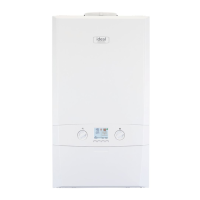
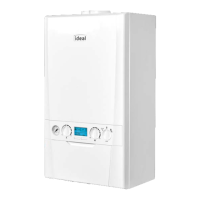
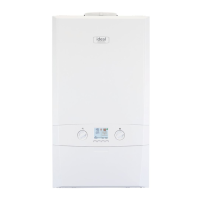
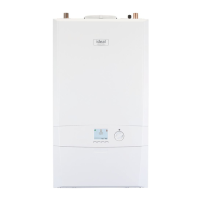
The Ideal Logic Combi² is a combination boiler designed to provide both central heating and instantaneous domestic hot water. It features full-sequence automatic ignition and fan-assisted combustion, ensuring efficient and reliable operation. As a high-efficiency condensing appliance, it automatically adjusts its output to match heating demand, thereby reducing gas consumption.
The Logic Combi² boiler offers two primary functions: central heating and domestic hot water. For central heating, the boiler controls the radiator temperature, adjustable via the central heating temperature knob (B) on the control panel. Users can set the temperature between approximately 30°C and 80°C, with 72°C or less recommended for high-efficiency operation. The boiler condenses water from flue gases when operating most efficiently, contributing to reduced gas usage. For domestic hot water, the boiler provides instantaneous hot water, with its temperature limited to a maximum of 65°C, adjustable via the domestic hot water temperature knob (A). Approximate temperatures range from 40°C to 65°C. The boiler is factory-set with preheat turned off to provide standard hot water delivery and reduce gas usage, but this can be switched on during installation for faster delivery. When preheat is enabled, the boiler features a timed intelligent preheat function that learns usage patterns over 24 hours, periodically firing for a few seconds to maintain water temperature and improve DHW response speed while minimizing gas use.
The boiler is equipped with a siphonic condensate trap system to reduce the risk of condensate freezing. Condensate produced from the flue gases is drained through a plastic waste pipe at the base of the boiler, and a condensate 'plume' may be visible at the flue terminal.
To start the boiler, users must ensure all hot water taps are turned off, the electricity supply is on, and the mode button is pressed until no cross is shown through the radiator symbol. The domestic hot water and central heating temperature knobs should then be turned clockwise to their desired target temperatures (e.g., 65°C for DHW and 80°C for CH).
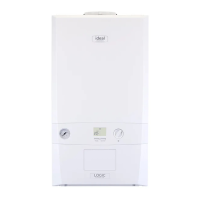
The boiler's control panel includes a mode button (C), boiler status display (D), burner on indicator (E), restart button (F), and a pressure gauge (G). The boiler status display shows various codes indicating its operational status:
The burner on indicator (E) illuminates when the burner is lit during normal operation. The boiler also features frost protection that operates in all modes, provided the power supply is on. If the water in the boiler falls below 5°C, the frost protection activates to prevent freezing. However, this does not guarantee protection for other parts of the system. If a system frost thermostat is installed, the boiler must be in winter mode for the system frost protection to run. For short absences, it's recommended to leave heating controls on at a reduced temperature. For longer periods, the entire system should be drained.
In systems with weather compensation, the central heating temperature knob (B) controls room temperature. Turning it clockwise increases room temperature, and anti-clockwise decreases it. Once the desired setting is achieved, the system automatically maintains the room temperature regardless of outside weather conditions.
The system water pressure gauge (G) indicates the central heating system pressure, which should ideally be between 1 and 2 bar. If the pressure falls below 0.3 bar, the boiler will not operate. Users can re-pressurize the system by connecting a filling loop to the Domestic Hot Water (DHW) inlet and gradually opening the blue and green handles until the pressure gauge reaches 1 to 1.5 bar. After re-pressurizing, the handles should be returned to the closed position, and the filling loop disconnected.
In case of a frozen condensate pipe, users can attempt to unblock it by applying a hot water bottle, microwaveable heat pack, or warm damp cloth to the frozen area. Warm water (not boiling) can also be poured onto the pipe. Once the blockage is removed, the appliance can be restarted by pressing the restart button (F). During cold weather, setting the central heating temperature knob to maximum and placing the heating on continuous (with the room thermostat turned down to 15°C overnight or when unoccupied) can help prevent freezing.
For general cleaning, the boiler casing can be dusted with a dry cloth or wiped with a damp cloth for stubborn marks and stains, followed by a dry cloth. Abrasive cleaning materials should not be used.
The boiler pump performs a brief self-check every 24 hours, regardless of system demand. Minimum clearances for servicing are 165 mm above, 100 mm below, 2.5 mm at the sides, and 450 mm at the front of the boiler casing. The bottom clearance after installation can be reduced to 5 mm if an easily removable panel allows visibility of the pressure gauge and provides 100 mm clearance.
If a fault occurs, the boiler may display a fault code (e.g., "F01" for low water pressure, "F02" for flame loss, "F03" for fan fault, etc.). Many faults can be resolved by restarting the appliance using the restart button (F). If the boiler fails to light after five attempts, fault code "L12" will be displayed. If a fault persists or if a fault code indicates a lockout (e.g., "L01" for flow temperature overheat), a Gas Safe Registered Engineer should be contacted.
The Benchmark scheme ensures high standards of installation, commissioning, and servicing of central heating systems. The Benchmark Service Interval Record must be completed after each service, which should be carried out at least annually by a Gas Safe Registered Engineer. In case of a suspected gas leak, the National Gas Emergency Service should be contacted immediately. All naked flames must be extinguished, electrical switches should not be operated, and all windows and doors should be opened.
 General
| Type | Combi Boiler |
|---|---|
| Output Rating | 30 kW |
| Fuel Type | Natural Gas |
| Dimensions (H x W x D) | 700 x 395 x 278 mm |
| Hot Water Flow Rate | 12.3 l/min |
| Mounting | Wall-mounted |
| ERP Rating | A |
| DHW Output (kW) | 30 kW |
| ErP Heating | A |
| ErP Water | A |
| Max. working pressure | 3 bar |
| Standard Warranty (Years) | 2 years |


 To Next Page
