Engineering
44
HR9Z-B2192 8/2020
Signal Interlock Monitoring
Overview
Signal interlock is a monitoring function used to detect conditions in which one of the
sensors/devices cannot provide the expected input signal for the device, for example, as a result
of contact welding.
The device expects “simultaneous” deactivation of the two safety-related inputs within the signal
interlock monitoring time of 200 ms.
If the two monitored safety-related inputs are not deactivated within 200 ms, this is a signal
interlock condition and the device triggers a signal interlock alert. The device remains in the defined
safe state, i.e., there is no transition from operating state Run: Outputs Deenergized to operating
state Run: Outputs Energized (T3).
To exit the signal interlock condition, the two affected safety-related inputs must be deactivated for
at least one second. After that, the safety-related inputs can be activated again which activates the
safety-related outputs as well.
Signal interlock is available for certain of the application functions
(see page 58)
the device
provides.
Examples
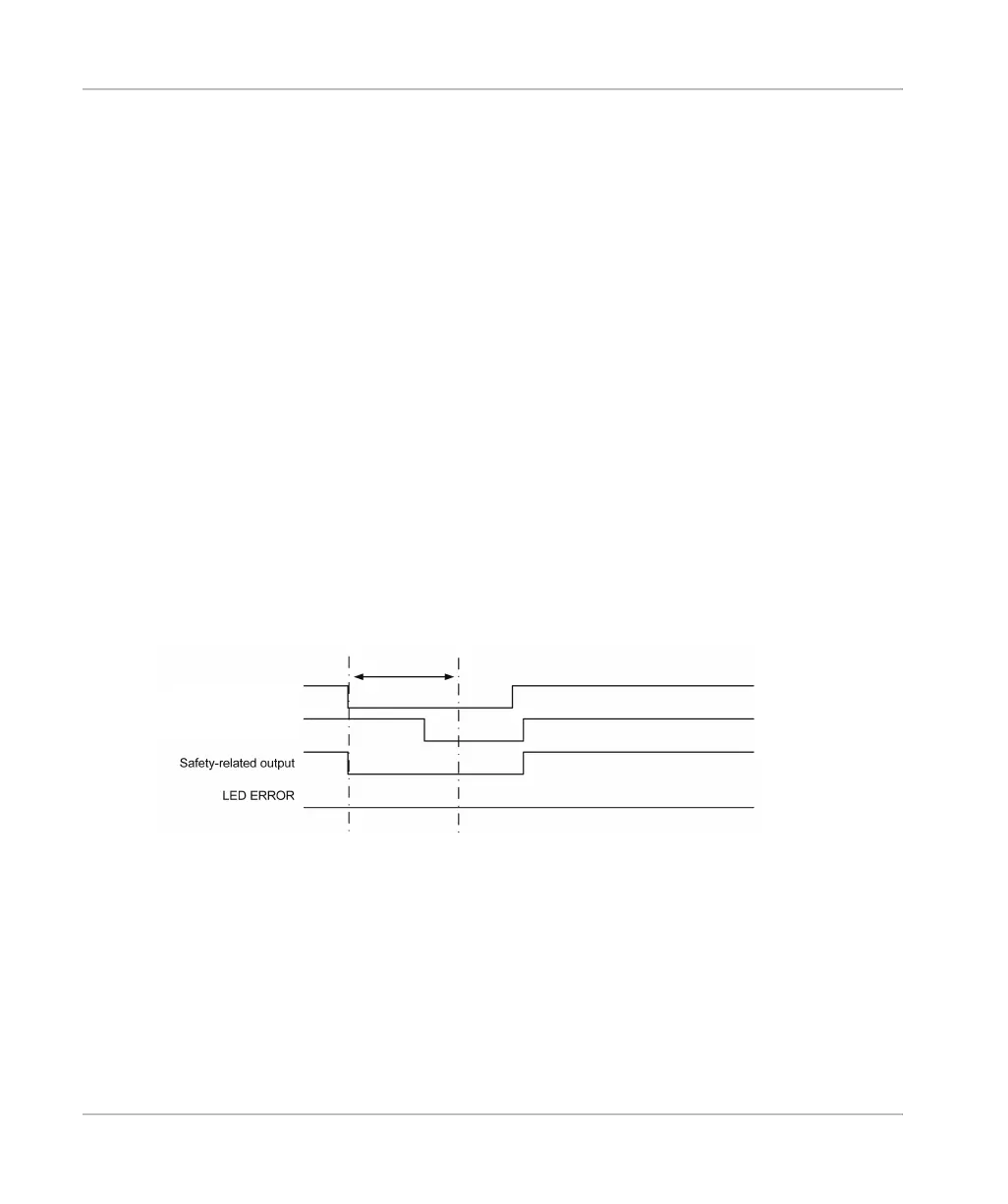
The following figure illustrates a condition without signal interlock:
Both safety-related inputs are deactivated within the signal interlock monitoring time of 200 ms.
When they are activated again, the safety-related outputs are also activated.
Safety-relaed input S##
Safety-relaed input S##


 To Next Page