eling. Gasoline build up inside the fuel tank depending on
the fuel used, the weather conditions and the tank venting
system.
In order to reduce the risk of burns and other personal
injury from escaping gas vapor and fumes, remove the
fuel ller cap on your engine allow any pressure build-up
in the tank to release slowly. Never remove the fuel ller
cap while the engine is running. Select bare ground for
fueling and move at least 10 feet (3 m) from the fueling
spot before starting the engine. Wipe o any spilled fuel
before starting your machine.
Warning!
Check for fuel leakage while refueling and during opera-
tion. If fuel leakage is found, do not start or run the en-
gine until the leak is xed and any spilled fuel has been
wiped away. Take care not to get fuel onyour clothing. If
this happens, change your clothing immediately. Dierent
models may be equipped with dierent fuel caps.
If the fuel has overowed, do not attempt to start the motor.
Instead, the tool must be moved away from the petrol-
soaked area before startup.
Cap with grip
Warning!
In order to reduce the risk of fuel spillage and re from
an improperly tightened fuel cap, correctly position and
tighten the fuel cap in the fuel tank opening.
Screw cap
Warning!
Unit vibrations can cause an improperly
tightened fuel ller cap to loosen or come
o and spill quantities of fuel.
In order to reduce the risk of fuel spillage
and re, tighten the fuel ller cap by hand
as securely as possible.
Before Starting
Warning!
Always check your engine for proper condition and op-
eration before starting, particularly the throttle trigger,
throttle trigger interlock, stop switch and working tool.
The throttle trigger (if applicable) must move freely and
always spring back to the idle position. Never attempt to
modify the controls or safety devices.
Warning!
Never use a power tool that is damaged or not properly
maintained.
Check that the spark plug boot is securely mounted on
the spark plug loose boot may cause arcing that could
ignite combustible fumes and cause a re. Keep the han-
dles clean and dry at all times; it is particularly important
to keep them free of moisture, pitch, oil, grease or resin in
order for you to maintain a rm grip and properly control
your engine.
Starting
Start the engine at least 10 feet (3 meters) from the
fueling spot, outdoors only.
Place the power tool on rm ground or other solid sur-
face in an open area. Maintain good balance and secure
footing.
Warning!
Your engine is a one-person machine. Do not allow other
persons in the general work area, even when starting.
To reduce the risk of injury from loss of control, do not
attempt to “drop start” your power tool.
When you pull the starter grip, do not wrap the starter
rope around your hand. Do not let the grip snap back,
but guide the starter rope to rewind it properly. Failure to
follow this procedure may result in injury to your hand or
ngers and may damage the starter mechanism.
Important Adjustments
Warning!
To reduce the risk of personal injury from loss of control or
contact with the running working tool, do not use a power
tool with incorrect idle adjustment. At correct idle speed,
the working tool should not move.
During Operation
Holding and controlling the power tool
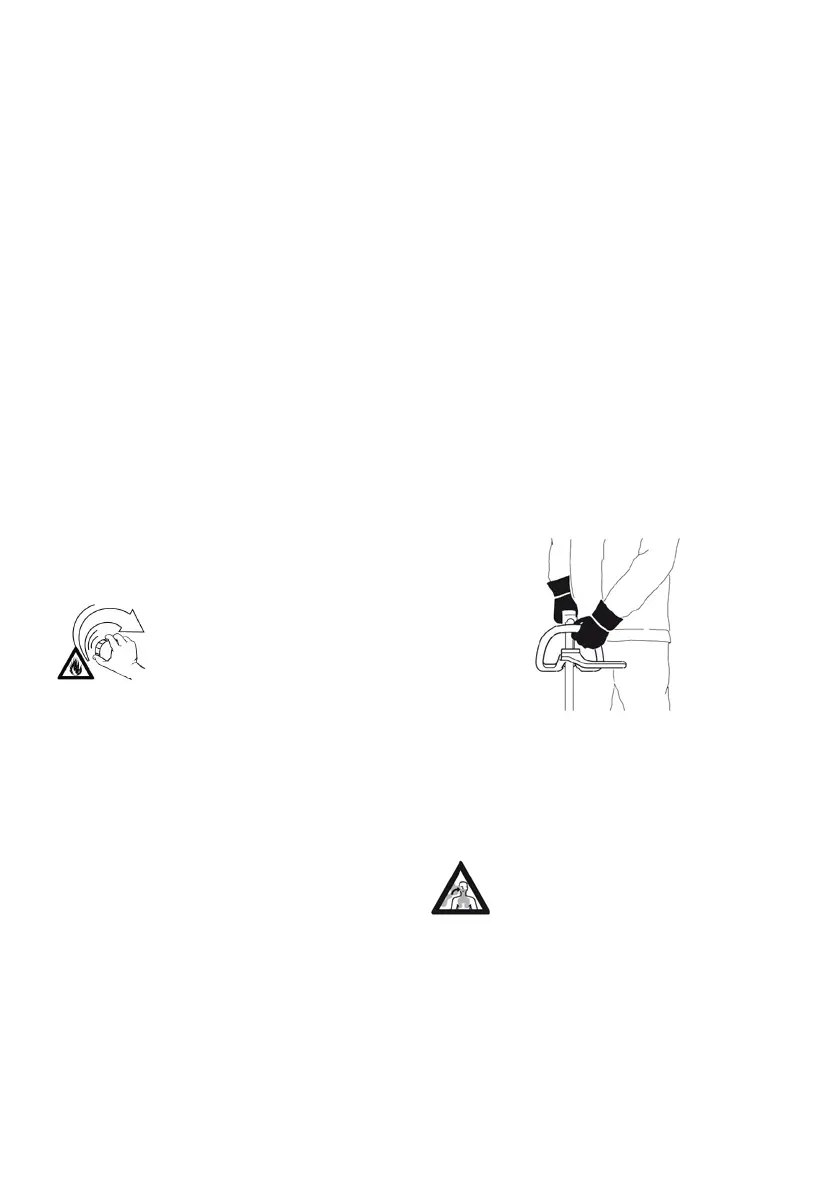
Always hold the unit rmly with both hands on the
handles while you are working. Wrap your ngers and
thumbs around the handles.
Your right hand should grip the rear handle. This also ap-
plies to left-handers.
Working conditions
Operate and start your power tool only outdoors in a well
ventilated area. Operate it under good visibility and day-
light conditions only. Work carefully.
Warning!
As soon as the engine is running, this prod-
uct generates toxic exhaust fumes containing
chemicals (such as unburned hydrocarbons and
carbon monoxide) known to cause respiratory
problems, cancer, birth defects, or other repro-
ductive harm. Some of the gases (e.g. carbon
monoxide) may be colorless and odorless. To
reduce the risk of serious or fatal injury/illness
from inhaling toxic fumes, never run the ma-
chine indoors or in poorly ventilated locations.
The muer and other parts of the engine (e.g. ns of the
cylinder, spark plug) become hot during operation and re-
main hot for a while after stopping the engine.
To reduce risk of burns do not touch the muer and other
parts while they are hot.
GB-8


 To Next Page
 Loading...